The Megawatt Shock: How BYD’s 1,000 kW Charger Exposes the West’s EV Paralysis
BYD promises 250 miles of range in five minutes, even on budget hatchbacks. But forcing a full megawatt into a $10,000 car demands a brutal rewrite of battery chemistry and grid infrastructure.
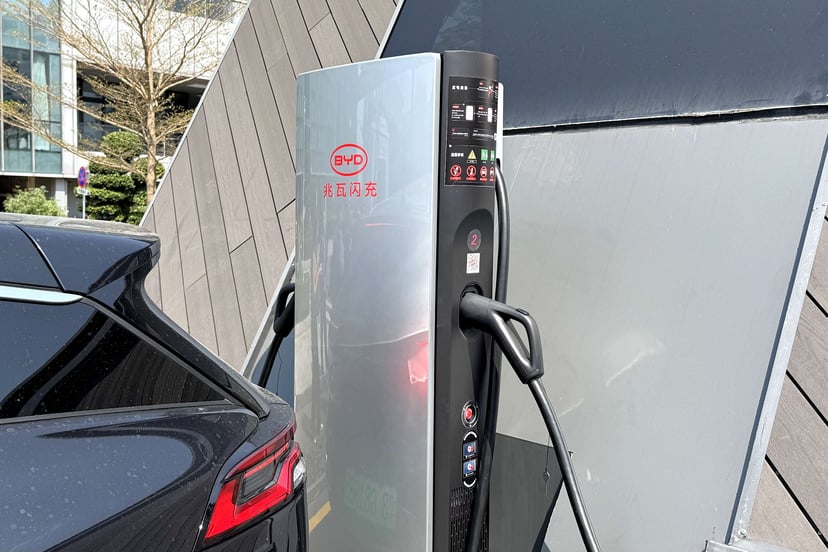
The automotive world operates on a strict diet of incremental gains, but every so often, a manufacturer throws a sledgehammer through the establishment's window. On Monday, BYD did exactly that, unveiling a new charging architecture that promises to alter the fundamental physics of the electric vehicle commute. The Chinese juggernaut announced a staggering 1,000 kW charging system, an infrastructural leviathan capable of adding almost 250 miles of range to an electric vehicle in a mere five minutes. To put this in perspective, funneling a full megawatt of electrical current into a passenger vehicle transcends typical rapid transit—it is a violent transfer of energy more akin to industrial manufacturing than consumer commuting. Yet, BYD is not reserving this witchcraft for high-dollar hypercars. The company intends to deploy this monumental charging capability across its rapidly expanding lineup, forcing the entire industry to confront a new, incredibly hostile benchmark.
The timing of this technological flex exposes a brutal dichotomy in the global automotive landscape. While the legacy establishment—specifically American and European rivals—continues to bleed cash while awkwardly transitioning their fleets to battery electric vehicles, the narrative in the East is starkly different. A new crop of Chinese EV startups are not merely surviving the costly transition; they are actively in the black. Recent market analysis confirms that multiple Chinese automakers are currently making money, turning the conventional wisdom of the loss-leading EV transition on its head. This profitability chasm means that while Western boardrooms are locked in panic meetings over delayed platforms and bloated R&D budgets, Chinese manufacturers possess the liquid capital to bankroll moonshot infrastructure projects.The timing of this technological flex exposes a brutal dichotomy in the global automotive landscape. While the legacy establishment—specifically American and European rivals—continues to bleed cash while awkwardly transitioning their fleets to battery electric vehicles, the narrative in the East is starkly different. A new crop of Chinese EV startups are not merely surviving the costly transition; they are actively in the black. Recent market analysis confirms that multiple Chinese automakers are currently making money, turning the conventional wisdom of the loss-leading EV transition on its head. This profitability chasm means that while Western boardrooms are locked in panic meetings over delayed platforms and bloated R&D budgets, Chinese manufacturers possess the liquid capital to bankroll moonshot infrastructure projects.
This financial supremacy is rapidly translating into a product offensive that is leaving traditional luxury stalwarts grasping at air. The conversation is no longer just about BYD's volume; it is about the staggering price-to-feature ratio offered by a rising tide of domestic competitors. Take the Li Auto L9, a vehicle that has recently become the subject of intense comparative analysis against Western benchmarks. Industry observers are aggressively pitting the advanced features and distinctly low price point of the Chinese SUV against the established supremacy of American and European counterparts like Tesla and BMW. Alongside rising marques like Avatr, Zeekr, and Maextro, the Li Auto L9 is demonstrating that the Chinese market has moved far beyond cheap imitation, delivering sophisticated technology suites and premium interior appointments at a fraction of the cost of a comparable Bavarian or Californian export.
But BYD’s gambit with its 1,000 kW network pulls the spotlight back to the entry-level segment, creating a paradox that automotive engineers are currently scrambling to decipher. The brand is allegedly pushing ultra-fast charging architectures into models as accessible as the new BYD Seagull—a sub-compact EV boasting a staggering $10,000 price tag. Claims suggest this budget-friendly hatchback will possess the capability to execute a 10 to 80 percent charge at speeds that theoretically outpace high-end performance stalwarts like Porsche. However, promising a hyper-fast charge on a five-figure economy car exposes severe, inescapable limits in current battery chemistry. When you force-feed that much voltage into a compact lithium-ion pack, the resulting thermal stress is catastrophic if not managed by advanced liquid-cooling systems that traditionally cost a significant fraction of the Seagull’s entire sticker price.But BYD’s gambit with its 1,000 kW network pulls the spotlight back to the entry-level segment, creating a paradox that automotive engineers are currently scrambling to decipher. The brand is allegedly pushing ultra-fast charging architectures into models as accessible as the new BYD Seagull—a sub-compact EV boasting a staggering $10,000 price tag. Claims suggest this budget-friendly hatchback will possess the capability to execute a 10 to 80 percent charge at speeds that theoretically outpace high-end performance stalwarts like Porsche. However, promising a hyper-fast charge on a five-figure economy car exposes severe, inescapable limits in current battery chemistry. When you force-feed that much voltage into a compact lithium-ion pack, the resulting thermal stress is catastrophic if not managed by advanced liquid-cooling systems that traditionally cost a significant fraction of the Seagull’s entire sticker price.
Beyond the internal chemistry of the vehicle, funneling a full megawatt of power from BYD's newly unveiled 1,000 kW chargers demands a localized infrastructure overhaul that defies traditional utility grid capabilities. You cannot simply tap a megawatt charger into the municipal power supply without browning out the surrounding neighborhood. To legitimately support the claim of adding almost 250 miles of range in just five minutes, these stations require massive localized grid buffer storage. We are talking about grid-level battery banks installed at the charging site, designed to slowly sip power from the local utility overnight and dump it violently into the vehicle’s chassis on demand. Without this localized buffering, the sheer load would melt the substations of most modern cities, proving that BYD’s true battleground is as much about civil engineering as it is about automotive design.Beyond the internal chemistry of the vehicle, funneling a full megawatt of power from BYD's newly unveiled 1,000 kW chargers demands a localized infrastructure overhaul that defies traditional utility grid capabilities. You cannot simply tap a megawatt charger into the municipal power supply without browning out the surrounding neighborhood. To legitimately support the claim of adding almost 250 miles of range in just five minutes, these stations require massive localized grid buffer storage. We are talking about grid-level battery banks installed at the charging site, designed to slowly sip power from the local utility overnight and dump it violently into the vehicle’s chassis on demand. Without this localized buffering, the sheer load would melt the substations of most modern cities, proving that BYD’s true battleground is as much about civil engineering as it is about automotive design.
To understand the sheer violence of a megawatt energy transfer, one must look to the sharpest end of motorsport. In the Formula 1 paddock, engineers spend millions managing the thermal discharge of hybrid systems that deploy only a fraction of this raw electrical power. Racing teams utilize exotic materials and hyper-complex telemetry just to keep their battery packs from detonating under heavy load. Yet, BYD is proposing a system that subjects consumer vehicles to similarly intense thermal cycles, day in and day out, in the hands of average commuters. While American and European rivals bleed cash trying to figure out how to build a profitable standard-range crossover, Chinese manufacturers are effectively attempting to commercialize endurance-racing-level energy deployment for the morning school run.
The juxtaposition of these two realities—the advanced features of the Li Auto L9 and the raw, unbridled charging speed of the $10,000 BYD Seagull—paints a terrifying picture for traditional automakers like Tesla and BMW. If Chinese EV companies aren't just making great cars, but are also actively making money while doing so, the barrier to entry for these futuristic technologies vanishes. They are no longer theoretical concepts showcased at auto shows; they are weaponized products hitting the tarmac. The bold claim that a budget EV could theoretically charge 10 to 80 percent faster than a Porsche fundamentally rewrites the rules of automotive prestige, stripping legacy brands of the technological superiority they have historically relied upon to justify their exorbitant price premiums.The juxtaposition of these two realities—the advanced features of the Li Auto L9 and the raw, unbridled charging speed of the $10,000 BYD Seagull—paints a terrifying picture for traditional automakers like Tesla and BMW. If Chinese EV companies aren't just making great cars, but are also actively making money while doing so, the barrier to entry for these futuristic technologies vanishes. They are no longer theoretical concepts showcased at auto shows; they are weaponized products hitting the tarmac. The bold claim that a budget EV could theoretically charge 10 to 80 percent faster than a Porsche fundamentally rewrites the rules of automotive prestige, stripping legacy brands of the technological superiority they have historically relied upon to justify their exorbitant price premiums.
Ultimately, BYD's megawatt ambitions serve as a harsh referendum on the state of the global EV race. The promise of adding 250 miles of range in five minutes via a 1,000 kW charger is a logistical nightmare wrapped in a technological marvel, demanding unprecedented advances in both battery chemistry and localized grid buffer storage. But if the companies fielding brands like Avatr, Zeekr, and Maextro are already operating in the black, they have the war chest to solve these infrastructural puzzles while their competitors falter. This charging architecture isn't just a piece of hardware; it is a declaration of dominance, signaling that the future of automotive propulsion will not be dictated by Detroit or Munich, but by the relentless, well-funded innovators rising from the East.Ultimately, BYD's megawatt ambitions serve as a harsh referendum on the state of the global EV race. The promise of adding 250 miles of range in five minutes via a 1,000 kW charger is a logistical nightmare wrapped in a technological marvel, demanding unprecedented advances in both battery chemistry and localized grid buffer storage. But if the companies fielding brands like Avatr, Zeekr, and Maextro are already operating in the black, they have the war chest to solve these infrastructural puzzles while their competitors falter. This charging architecture isn't just a piece of hardware; it is a declaration of dominance, signaling that the future of automotive propulsion will not be dictated by Detroit or Munich, but by the relentless, well-funded innovators rising from the East.
Gallery
"While American and European rivals bleed cash transitioning to EVs, a new crop of Chinese EV startups are actively in the black."
Why it matters
BYD's ultra-fast charging architecture threatens to erase the last remaining advantage of legacy automakers. If budget Chinese EVs can charge faster than Western sports cars without melting the local grid, the global hierarchy of the automotive industry will be permanently rewritten.
Sources
- 1.
- 2.
- 3.
Reported by the Downforce & Divots desk from the sources above.
The clubhouse.
- No replies yet. Be the first.