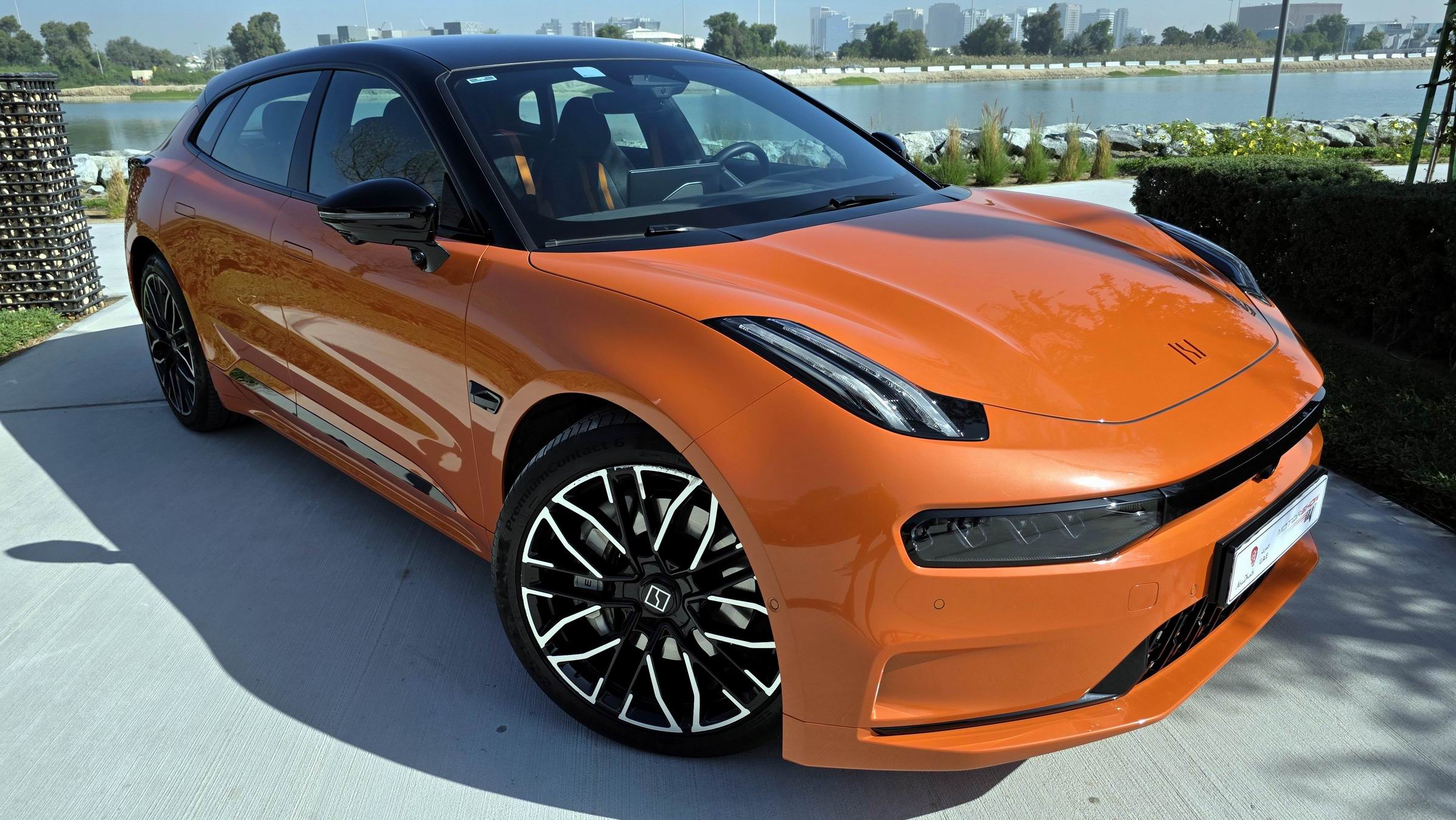
The 76-Second Pulse: Inside the Industrial Machine Rewriting Global Horsepower
From 1,300-horsepower quad-motor missiles to automated lines cycling every minute, China's domestic manufacturers have turned manufacturing velocity into the ultimate performance spec.
To understand why legacy Western boardrooms are experiencing cold sweats, one only needs to look at two distinct numbers emerging from China's automotive heartland: 1,300 horsepower and 76 seconds. The former belongs to the Zeekr 001 FR, a quad-motor performance weapon that treats tarmac with the violent indifference once reserved for seven-figure boutique hypercars. The latter is the metronomic production cadence inside Xiaomi's automated manufacturing facilities, where an army of more than 700 robots stamps, welds, and rolls out a new electric vehicle roughly every minute and a quarter.
This is no longer an industry fighting for validation through cheap commuter boxes. Domestic heavyweights—a sprawling cohort led by BYD, Chery, Nio, Zeekr, and XPeng—are systematically dismantling the market share of established multinational giants like Volkswagen, General Motors, and Tesla. What began as a subsidised domestic transition has coalesced into an industrial shockwave that blends staggering performance metrics with terrifying assembly velocity.
At the centre of this structural realignment sits BYD. Founded in Shenzhen in 1995 by Wang Chuanfu as a modest battery manufacturer, the company has engineered one of the most ruthless vertical integration models in modern industrial history. By controlling its own supply chain down to the cellular level—manufacturing its proprietary Blade Battery, in-house semiconductors, and bespoke drive units—BYD achieved what legacy Western titans deemed impossible: in 2022, it became the world's first major automaker to completely terminate production of pure fossil-fuel vehicles.At the centre of this structural realignment sits BYD. Founded in Shenzhen in 1995 by Wang Chuanfu as a modest battery manufacturer, the company has engineered one of the most ruthless vertical integration models in modern industrial history. By controlling its own supply chain down to the cellular level—manufacturing its proprietary Blade Battery, in-house semiconductors, and bespoke drive units—BYD achieved what legacy Western titans deemed impossible: in 2022, it became the world's first major automaker to completely terminate production of pure fossil-fuel vehicles.
That foundational independence allows for a product cadence that leaves traditional five-year product cycles looking hopelessly antiquated. BYD's sprawling portfolio now stretches from the accessible high-volume Dynasty and Ocean model series to aggressive premium sub-brands: Denza, the rugged Fang Cheng Bao, and the ultra-luxury Yangwang tier. Paired with proprietary DM plug-in hybrid architecture and pure electric platforms, the company can deploy targeted sheet metal across every market segment before competitors can conclude an initial feasibility study.That foundational independence allows for a product cadence that leaves traditional five-year product cycles looking hopelessly antiquated. BYD's sprawling portfolio now stretches from the accessible high-volume Dynasty and Ocean model series to aggressive premium sub-brands: Denza, the rugged Fang Cheng Bao, and the ultra-luxury Yangwang tier. Paired with proprietary DM plug-in hybrid architecture and pure electric platforms, the company can deploy targeted sheet metal across every market segment before competitors can conclude an initial feasibility study.
Meanwhile, consumer tech transplants like Xiaomi have entered the fray with the SU7, bringing consumer electronics product velocity directly to the factory floor. When combined with export corridors expanding across Europe, Southeast Asia, and Latin America, the narrative of Western technological superiority is evaporating. The global automotive hierarchy is being rewritten not by heritage or badge prestige, but on the cold, unrelenting logic of robotic precision and unmatched industrial scale.Meanwhile, consumer tech transplants like Xiaomi have entered the fray with the SU7, bringing consumer electronics product velocity directly to the factory floor. When combined with export corridors expanding across Europe, Southeast Asia, and Latin America, the narrative of Western technological superiority is evaporating. The global automotive hierarchy is being rewritten not by heritage or badge prestige, but on the cold, unrelenting logic of robotic precision and unmatched industrial scale.
Gallery
"Xiaomi's futuristic factories use 700+ robots, reportedly producing a car every 76 seconds."
Why it matters
China's domestic EV giants are no longer competing merely on price; they are out-engineering legacy multinationals in raw output, vertical integration, and hypercar-level performance. As factory cycles drop to 76 seconds and in-house component supply chains insulate brands like BYD, global automakers face an existential challenge to their core market share.
Sources
- 1.
- 2.BYD News, Sales, & New Modelscnevpost.com
- 3.
- 4.
Reported by the Downforce & Divots desk from the sources above.
The clubhouse.
- No replies yet. Be the first.