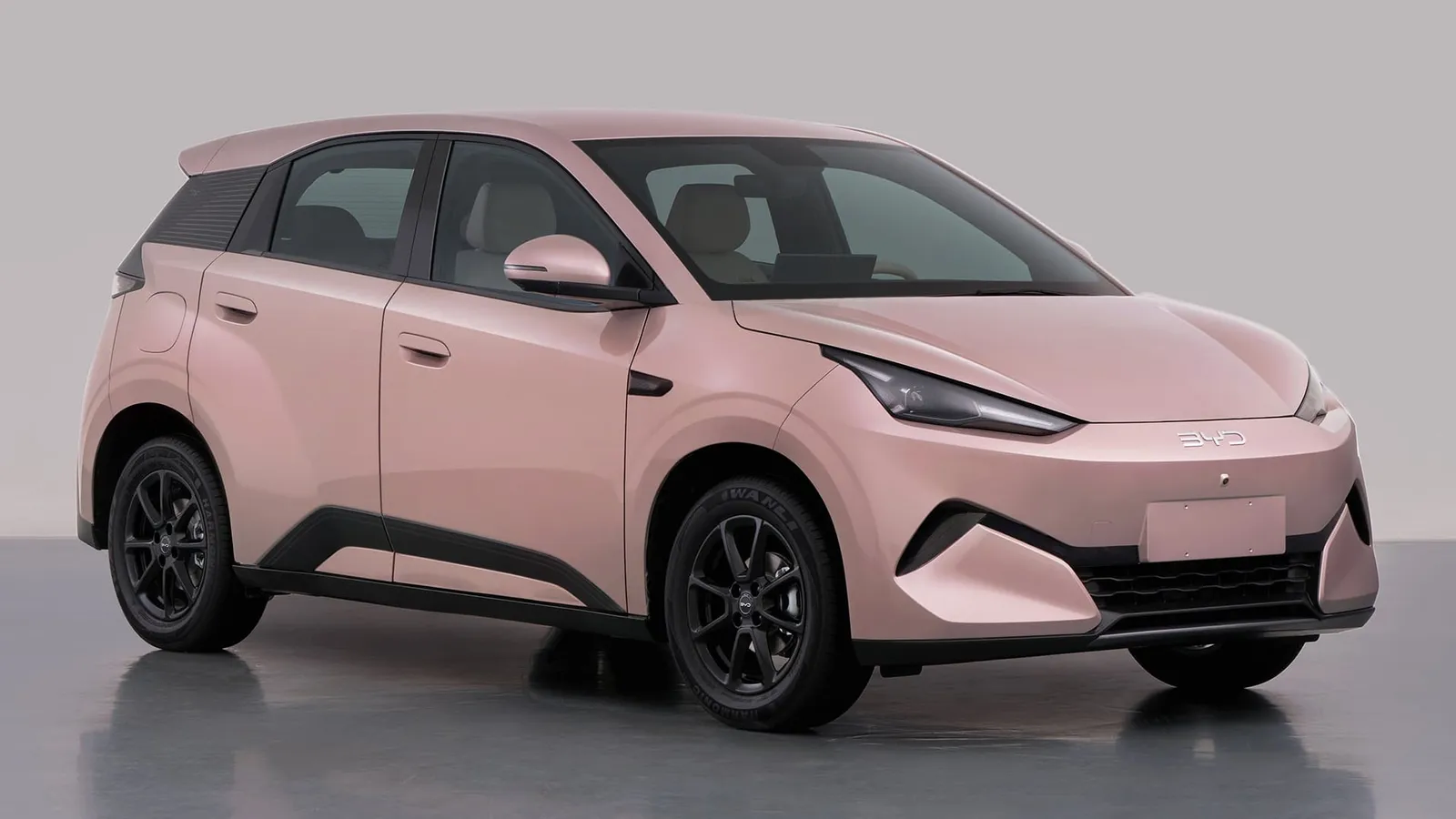
The All-Seeing City Car: How BYD’s LiDAR-Equipped Great Seagull Weaponizes Scale
Leaked spyshots of a compact BYD prototype reveal advanced optical perception hardware on an entry-level chassis, triggering fresh paranoia in Washington about the geopolitical risks of hyper-scaled automotive technology.
The leaked spyshots of the BYD "Great Seagull" in road testing reveal an engineering reality that Western automakers are wholly unprepared to combat: a roof-mounted LiDAR pod sitting atop a compact 2,650mm-wheelbase footprint. We are talking about a sub-compact city car chassis—a platform that traditionally struggles to package basic infotainment without compromising cabin space, let alone house advanced optical perception hardware. BYD has historically been the industry’s fiercest cost-cutter, systematically stripping margins to the bone to win the volume war. Yet, here is a laser-pulsing sensor suite, the kind usually reserved for six-figure luxury sedans, mounted to an entry-level platform. This isn't just a prototype leak; it's a paradigm shift in automotive tiering. The democratization of optical perception down to a platform of this scale demands a complete re-evaluation of BYD’s supply chain alchemy and its ultimate technological endgame.
To understand how an entry-level hatchback justifies aerospace-grade hardware, one must look at the sheer, unyielding absurdity of the Chinese domestic electric vehicle market. It is an ecosystem defined by extreme engineering stunts and rapid-fire product cycles. Take the recent marketing offensive for the Zeekr 009 MPV, where engineers literally ran over the vehicle’s seat foam with a 20-ton truck to publicly prove it remained intact. Or observe the relentless cadence of Geely, which is slated to officially launch its new EX5 on September 23, barely leaving room for competitors to breathe. In this hyper-Darwinian environment, a traditional automaker’s standard five-year development cycle is a death sentence. BYD is forced to deploy LiDAR on its smallest vehicles not as a luxury upgrade, but as a table-stakes survival mechanism against domestic rivals who treat automotive engineering as a daily arms race.
The financial mechanics of this deployment are tied directly to BYD’s aggressively scaled volume, which dictates the economics of its sensor architecture. While global EV leaders like Xpeng have set high technological benchmarks, BYD has weaponized its pricing strategy with ruthless efficiency. The company registered a staggering 70,500 units in the first half of 2025 alone, leveraging a vertically integrated manufacturing base that absorbs costs other automakers are forced to pass on to the consumer. When you are moving that kind of sheer volume, the unit cost of a roof-mounted LiDAR array drops from a premium barrier-to-entry to a rounding error in the bill of materials. The Great Seagull operates as a volume-driven trojan horse, proving that mass-market production numbers can completely offset the inherently expensive nature of advanced perception technologies.
But putting high-fidelity optical sensors on thousands of cheap city cars creates a secondary, highly volatile output: data. A LiDAR-equipped Great Seagull isn't just a means of getting from a cramped apartment block to a commercial district; it is a continuously scanning cartography drone. This is precisely where the engineering marvel crashes headlong into geopolitical paranoia. U.S. Representative John Moolenaar, a Michigan Republican acting as the chairman of the House Select Committee on the Chinese Communist Party, recently synthesized Washington’s terror by bluntly labeling BYD's vehicles as "rolling data collection devices." When an automaker packages millimeter-accurate 3D mapping technology onto its cheapest, most ubiquitous models, the sheer volume of environmental data collected every second becomes an unprecedented asset—or a profound national security threat, depending on where the server farms reside.But putting high-fidelity optical sensors on thousands of cheap city cars creates a secondary, highly volatile output: data. A LiDAR-equipped Great Seagull isn't just a means of getting from a cramped apartment block to a commercial district; it is a continuously scanning cartography drone. This is precisely where the engineering marvel crashes headlong into geopolitical paranoia. U.S. Representative John Moolenaar, a Michigan Republican acting as the chairman of the House Select Committee on the Chinese Communist Party, recently synthesized Washington’s terror by bluntly labeling BYD's vehicles as "rolling data collection devices." When an automaker packages millimeter-accurate 3D mapping technology onto its cheapest, most ubiquitous models, the sheer volume of environmental data collected every second becomes an unprecedented asset—or a profound national security threat, depending on where the server farms reside.
The timing of the Great Seagull's leak is politically explosive, arriving just as the geopolitical tectonic plates are grinding together. On September 24, Chinese President Xi Jinping is scheduled to make a state visit to Washington. Internal rumors, reportedly being reviewed by officials including Xi’s chief of staff Cai Qi, suggest that seven pivotal companies are under consideration for the business entourage. Four of these operate directly in the auto or battery sector, with executives from battery juggernaut CATL, consumer electronics titan Xiaomi, and BYD potentially walking the halls of American power. The optics are staggering: BYD leadership could be shaking hands in Washington while House Republicans loudly brand the enterprise a "Pentagon-designated Chinese military company" that they claim has perpetrated human rights abuses and utilized slave labor.The timing of the Great Seagull's leak is politically explosive, arriving just as the geopolitical tectonic plates are grinding together. On September 24, Chinese President Xi Jinping is scheduled to make a state visit to Washington. Internal rumors, reportedly being reviewed by officials including Xi’s chief of staff Cai Qi, suggest that seven pivotal companies are under consideration for the business entourage. Four of these operate directly in the auto or battery sector, with executives from battery juggernaut CATL, consumer electronics titan Xiaomi, and BYD potentially walking the halls of American power. The optics are staggering: BYD leadership could be shaking hands in Washington while House Republicans loudly brand the enterprise a "Pentagon-designated Chinese military company" that they claim has perpetrated human rights abuses and utilized slave labor.
For American lawmakers, the LiDAR array on the Great Seagull is the technological manifestation of a much wider economic siege. Moolenaar has argued vehemently that the Chinese Communist Party uses BYD specifically to "advance industrial policies that will bankrupt automakers and ruin the manufacturing base of Western nations." This isn't mere protectionist rhetoric; it is a visceral reaction to the impossible math that BYD presents. If an American legacy automaker attempts to build an EV with a 2,650mm wheelbase, they struggle to keep the base price under thirty thousand dollars with a standard ultrasonic sensor suite. BYD, armed with state-backed industrial scale and unmatched vertical integration, is threatening to flood the zone with a technologically superior product that undercuts the West’s most basic economic assumptions.For American lawmakers, the LiDAR array on the Great Seagull is the technological manifestation of a much wider economic siege. Moolenaar has argued vehemently that the Chinese Communist Party uses BYD specifically to "advance industrial policies that will bankrupt automakers and ruin the manufacturing base of Western nations." This isn't mere protectionist rhetoric; it is a visceral reaction to the impossible math that BYD presents. If an American legacy automaker attempts to build an EV with a 2,650mm wheelbase, they struggle to keep the base price under thirty thousand dollars with a standard ultrasonic sensor suite. BYD, armed with state-backed industrial scale and unmatched vertical integration, is threatening to flood the zone with a technologically superior product that undercuts the West’s most basic economic assumptions.
The defense against this automotive insurgency has taken the form of stringent political blockades and internal policing within the American auto sector. Moolenaar’s position has hardened aggressively over the past eight months, peaking on January 15 when he publicly admonished Ford for pursuing a potential partnership with BYD. The Michigan representative warned that engaging with the Chinese automaker would "diminish Ford’s status as an iconic American company." The implication was clear: the American automotive establishment must quarantine itself from BYD’s supply chain, even if it means missing out on the exact kind of cost-cutting efficiencies that allowed the Great Seagull to mount a LiDAR pod on a budget roofline. The U.S. market is attempting to build a legislative wall against an engineering reality that is already driving off the assembly lines in Shenzhen.The defense against this automotive insurgency has taken the form of stringent political blockades and internal policing within the American auto sector. Moolenaar’s position has hardened aggressively over the past eight months, peaking on January 15 when he publicly admonished Ford for pursuing a potential partnership with BYD. The Michigan representative warned that engaging with the Chinese automaker would "diminish Ford’s status as an iconic American company." The implication was clear: the American automotive establishment must quarantine itself from BYD’s supply chain, even if it means missing out on the exact kind of cost-cutting efficiencies that allowed the Great Seagull to mount a LiDAR pod on a budget roofline. The U.S. market is attempting to build a legislative wall against an engineering reality that is already driving off the assembly lines in Shenzhen.
Ultimately, the leaked spyshots of the BYD Great Seagull represent the point where the traditional trickle-down theory of automotive technology collapses. For decades, the industry operated on a predictable cadence: advanced telemetry and sensor suites were pioneered in the F1 paddock or on flagship luxury sedans, taking a decade to eventually filter down to the mass market. BYD has inverted that pyramid. By strapping advanced optical perception hardware onto an entry-level city car platform and weaponizing an aggressive pricing strategy, they are rewriting the rules of automotive packaging. Whether these vehicles are viewed as engineering triumphs or, in the words of U.S. lawmakers, dangerous machines that "endanger Americans and have no place in the United States," the Great Seagull proves that the era of the dumb, cheap city car is dead. The new baseline has arrived, and it is watching everything.
Gallery
"The company’s vehicles are rolling data collection devices that endanger Americans and have no place in the United States."
Why it matters
BYD's ability to package premium LiDAR technology into a sub-compact platform proves their absolute dominance over the EV supply chain. As geopolitical tensions mount ahead of Xi Jinping's U.S. visit, the technological leapfrogging of Chinese entry-level cars presents an existential economic and political threat to Western automakers.
Sources
- 1.
- 2.EV Latest News - CarNewsChina.comcarnewschina.com
- 3.US Congress Says BYD is 'Pentagon-Designated Chinese ...eletric-vehicles.com
Reported by the Downforce & Divots desk from the sources above.
The clubhouse.
- No replies yet. Be the first.