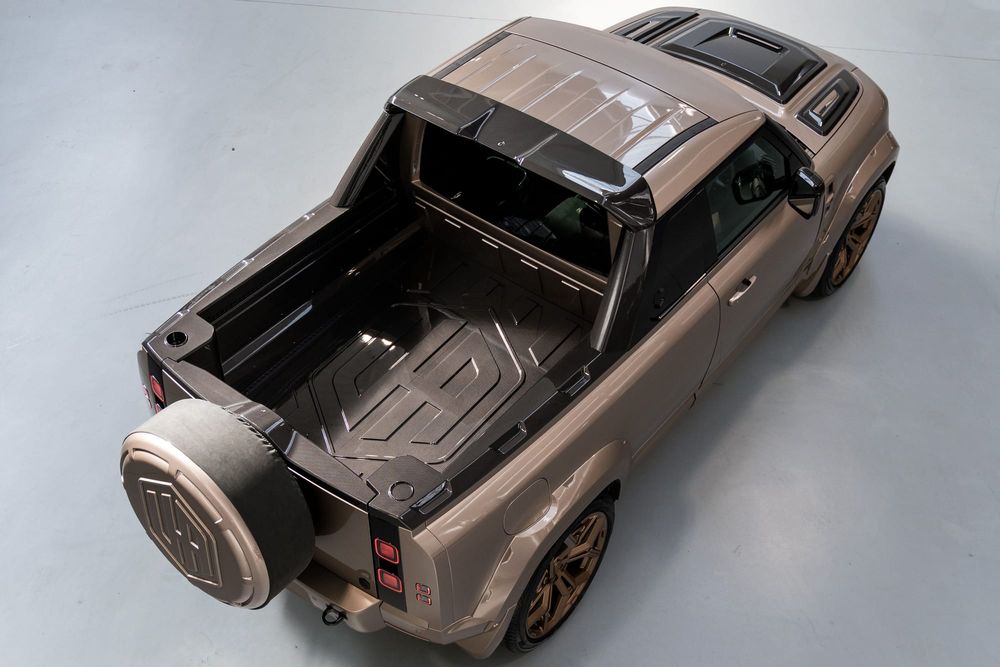
The Unibody Butcher: How Urban Automotive Hacked a Pickup Out of the Modern Defender
When Land Rover ditched the traditional ladder frame, it quietly killed its iconic factory pickup. Urban Automotive’s 'Avontur' project is bringing it back—through sheer, structurally terrifying force of engineering will.
When Land Rover engineers finally put the classic, agriculturally beloved Defender out to pasture and introduced the L663 generation, they traded centuries-old simplicity for twenty-first-century refinement. The shift from a traditional body-on-frame ladder chassis to a stiff, aluminum monocoque transformed the storied SUV into a dynamically capable, quiet, and highly crash-compliant machine. But that modernization quietly executed one of the most iconic silhouettes in the marque's long history: the factory pickup. In the old days, separating the cargo bed from the cabin was a matter of unbolting a few painted panels. Today, the roof, pillars, and rear quarter panels are fully stressed structural members holding the car together. To carve a bed into the back of a modern 110, you can't just reach for a wrench; you have to take a reciprocating saw to a rigid, highly engineered safety cage. That is exactly the kind of automotive violence Urban Automotive committed to birth the 'Avontur' Widetrack.When Land Rover engineers finally put the classic, agriculturally beloved Defender out to pasture and introduced the L663 generation, they traded centuries-old simplicity for twenty-first-century refinement. The shift from a traditional body-on-frame ladder chassis to a stiff, aluminum monocoque transformed the storied SUV into a dynamically capable, quiet, and highly crash-compliant machine. But that modernization quietly executed one of the most iconic silhouettes in the marque's long history: the factory pickup. In the old days, separating the cargo bed from the cabin was a matter of unbolting a few painted panels. Today, the roof, pillars, and rear quarter panels are fully stressed structural members holding the car together. To carve a bed into the back of a modern 110, you can't just reach for a wrench; you have to take a reciprocating saw to a rigid, highly engineered safety cage. That is exactly the kind of automotive violence Urban Automotive committed to birth the 'Avontur' Widetrack.
Unveiled to the public at the 2026 Goodwood Festival of Speed, the Avontur is not your typical cosmetic bolt-on exercise. It is a fundamental reinvention of the vehicle's foundational architecture. As chronicled in the first episode of a two-part documentary released in late September—a nearly twenty-minute film that quickly amassed over 77,000 views and effectively broke the internet for the Land Rover aftermarket subculture—Urban Automotive laid bare the staggering complexities of the build. The video documents the genesis of the idea, spearheaded by Lenny Howlett and the Urban team, and details the grueling final push required to assemble a functional prototype in time for Lord March's manicured lawns. This was an undertaking where a single miscalculation in stress distribution could result in a vehicle that folds under its own weight the moment it hits a speed bump.Unveiled to the public at the 2026 Goodwood Festival of Speed, the Avontur is not your typical cosmetic bolt-on exercise. It is a fundamental reinvention of the vehicle's foundational architecture. As chronicled in the first episode of a two-part documentary released in late September—a nearly twenty-minute film that quickly amassed over 77,000 views and effectively broke the internet for the Land Rover aftermarket subculture—Urban Automotive laid bare the staggering complexities of the build. The video documents the genesis of the idea, spearheaded by Lenny Howlett and the Urban team, and details the grueling final push required to assemble a functional prototype in time for Lord March's manicured lawns. This was an undertaking where a single miscalculation in stress distribution could result in a vehicle that folds under its own weight the moment it hits a speed bump.
The engineering realities of slicing open a unibody SUV are, to put it mildly, nightmarish. Because the modern Defender’s monocoque relies on its continuous outer aluminum shell—specifically the sweeping C and D pillars—for its immense torsional rigidity, removing the rear roof section effectively compromises the entire structure. Without a heavy steel ladder frame running underneath to carry the load, Urban's fabricators had to design, model, and integrate complex structural reinforcements hidden entirely beneath the bespoke bodywork. They had to map completely new load paths, ensuring that the heavy-duty rear bulkhead separating the newly truncated cabin from the open bed could anchor the remaining structure. It is a high-wire act of automotive surgery; if the structural reinforcements are too weak, the chassis flexes under load, the air suspension calibration goes rogue, and the front doors refuse to shut. If the bracing is too heavy, the vehicle's vaunted modern driving dynamics are entirely ruined.The engineering realities of slicing open a unibody SUV are, to put it mildly, nightmarish. Because the modern Defender’s monocoque relies on its continuous outer aluminum shell—specifically the sweeping C and D pillars—for its immense torsional rigidity, removing the rear roof section effectively compromises the entire structure. Without a heavy steel ladder frame running underneath to carry the load, Urban's fabricators had to design, model, and integrate complex structural reinforcements hidden entirely beneath the bespoke bodywork. They had to map completely new load paths, ensuring that the heavy-duty rear bulkhead separating the newly truncated cabin from the open bed could anchor the remaining structure. It is a high-wire act of automotive surgery; if the structural reinforcements are too weak, the chassis flexes under load, the air suspension calibration goes rogue, and the front doors refuse to shut. If the bracing is too heavy, the vehicle's vaunted modern driving dynamics are entirely ruined.
This level of invasive, highly technical fabrication highlights a fascinating friction in the contemporary automotive market. As global automakers consolidate their entire lineups onto shared, unibody platforms to maximize economies of scale and pass increasingly stringent global crash testing, the traditional canvas for bespoke coachbuilders has all but vanished. Gone are the days when a custom house could simply order a rolling chassis from the factory and build whatever whimsical shape they desired on top of it. Yet, paradoxically, the demand for ultra-exclusive, hyper-utilitarian luxury vehicles has never been higher among the ultra-wealthy. Buyers who frequent the VIP hospitality suites at global auto events or commission million-dollar restomods are no longer satisfied with off-the-shelf dealership offerings. The Avontur represents the apex of this market tension—brute-forcing a beloved, extinct bodystyle out of a platform explicitly designed not to accommodate it.This level of invasive, highly technical fabrication highlights a fascinating friction in the contemporary automotive market. As global automakers consolidate their entire lineups onto shared, unibody platforms to maximize economies of scale and pass increasingly stringent global crash testing, the traditional canvas for bespoke coachbuilders has all but vanished. Gone are the days when a custom house could simply order a rolling chassis from the factory and build whatever whimsical shape they desired on top of it. Yet, paradoxically, the demand for ultra-exclusive, hyper-utilitarian luxury vehicles has never been higher among the ultra-wealthy. Buyers who frequent the VIP hospitality suites at global auto events or commission million-dollar restomods are no longer satisfied with off-the-shelf dealership offerings. The Avontur represents the apex of this market tension—brute-forcing a beloved, extinct bodystyle out of a platform explicitly designed not to accommodate it.
There is a distinct, undeniable swagger in showing up to a premier automotive event with a machine that functionally should not exist. The Avontur Widetrack taps into the same vein of rebellious automotive subculture that birthed the modern 6x6 craze and the soaring popularity of Safari-style sports cars. It is a specific brand of luxury defined not by softer leather or larger infotainment screens, but by sheer engineering defiance. By replacing the enclosed rear greenhouse with a meticulously finished open bed, complete with heavily widened arches to accommodate an aggressive track width, Urban Automotive isn't just selling utility; they are selling the sheer audacity of the build. It stands as a rolling, aluminum middle finger to the homogenized, restrictive constraints of modern unibody manufacturing.There is a distinct, undeniable swagger in showing up to a premier automotive event with a machine that functionally should not exist. The Avontur Widetrack taps into the same vein of rebellious automotive subculture that birthed the modern 6x6 craze and the soaring popularity of Safari-style sports cars. It is a specific brand of luxury defined not by softer leather or larger infotainment screens, but by sheer engineering defiance. By replacing the enclosed rear greenhouse with a meticulously finished open bed, complete with heavily widened arches to accommodate an aggressive track width, Urban Automotive isn't just selling utility; they are selling the sheer audacity of the build. It stands as a rolling, aluminum middle finger to the homogenized, restrictive constraints of modern unibody manufacturing.
The frenetic timeline detailed in Urban's documentary release mirrors the relentless, sleep-deprived pace typically found in a top-tier motorsport garage ahead of a season opener. The push to transition from early CAD development to a finalized, physical prototype ready for a world debut left virtually no margin for error. In the realm of monocoque structural modification, there is little room for trial and error. The first major cuts to the L663 shell are largely irreversible. The team had to trust their mathematical reinforcements, their precision welding, and their bespoke panel gaps to hold up under the intense scrutiny of the Goodwood crowds, where the world's most cynical automotive critics scrutinize every shutline, rivet, and suspension mount.The frenetic timeline detailed in Urban's documentary release mirrors the relentless, sleep-deprived pace typically found in a top-tier motorsport garage ahead of a season opener. The push to transition from early CAD development to a finalized, physical prototype ready for a world debut left virtually no margin for error. In the realm of monocoque structural modification, there is little room for trial and error. The first major cuts to the L663 shell are largely irreversible. The team had to trust their mathematical reinforcements, their precision welding, and their bespoke panel gaps to hold up under the intense scrutiny of the Goodwood crowds, where the world's most cynical automotive critics scrutinize every shutline, rivet, and suspension mount.
But the applause on the Goodwood estate was only the opening act. As Urban Automotive openly states, the initial prototype is just the beginning of a much longer, exponentially more complicated journey. The upcoming second phase of the Avontur's development will chronicle the transition from a static showpiece and early test runner into a fully sorted vehicle capable of surviving the unpredictable rigors of daily use. The aftermarket landscape is littered with ambitious, one-off hacksaws that look brilliant under auto show lights but fall apart structurally in the real world. If Urban can successfully refine, test, and commodify this immensely complex structural surgery, they will have achieved something monumental. They won't just have built the pickup truck that Land Rover deemed too difficult to justify—they will have successfully rewritten the modern rules of unibody coachbuilding.But the applause on the Goodwood estate was only the opening act. As Urban Automotive openly states, the initial prototype is just the beginning of a much longer, exponentially more complicated journey. The upcoming second phase of the Avontur's development will chronicle the transition from a static showpiece and early test runner into a fully sorted vehicle capable of surviving the unpredictable rigors of daily use. The aftermarket landscape is littered with ambitious, one-off hacksaws that look brilliant under auto show lights but fall apart structurally in the real world. If Urban can successfully refine, test, and commodify this immensely complex structural surgery, they will have achieved something monumental. They won't just have built the pickup truck that Land Rover deemed too difficult to justify—they will have successfully rewritten the modern rules of unibody coachbuilding.
Gallery
"In the realm of monocoque structural modification, there is little room for trial and error. The first major cuts to the shell are largely irreversible."
Why it matters
The Avontur proves that the demise of the traditional chassis hasn't killed coachbuilding; it has just raised the barrier to entry. By successfully engineering a truck bed into a unibody Defender 110, Urban Automotive is tapping into a highly lucrative, utility-obsessed luxury market that major OEMs have abandoned.
Sources
- 1.
Reported by the Downforce & Divots desk from the sources above.
The clubhouse.
- No replies yet. Be the first.