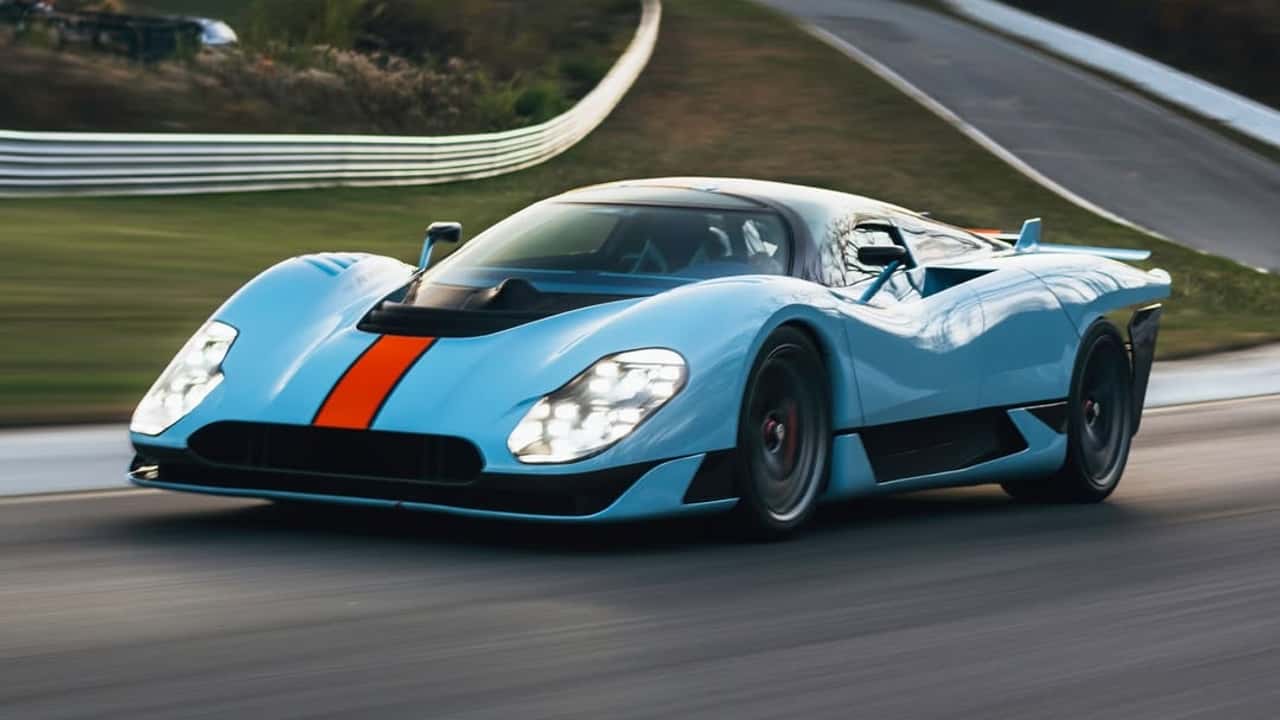
The Ghost in the Machine: Why a New Hypercar Hides a 20-Year-Old Porsche V10
A Connecticut dealership is rebirthing the legendary Porsche Carrera GT as a bespoke hypercar called the JC9. It's a powerful statement about why the raw, analog thrills of the 2000s still define automotive perfection in an age of hybrid speed.
While the world’s biggest automakers chase hybrid hypercar glory, a curious thing is happening at Miller Motorcars in Connecticut. They’ve revealed a stunning, Porsche-inspired hypercar named the JC9, but its true secret lies beneath the bespoke bodywork. As detailed by Motor1.com, this one-off creation is animated by the foundational mechanics of a Porsche Carrera GT—specifically, its howling naturally aspirated V10 engine and six-speed manual gearbox. In an era defined by electrification and dual-clutch transmissions, building a new flagship around a 20-year-old analog powertrain isn’t just contrarian; it’s a mission statement.While the world’s biggest automakers chase hybrid hypercar glory, a curious thing is happening at Miller Motorcars in Connecticut. They’ve revealed a stunning, Porsche-inspired hypercar named the JC9, but its true secret lies beneath the bespoke bodywork. As detailed by Motor1.com, this one-off creation is animated by the foundational mechanics of a Porsche Carrera GT—specifically, its howling naturally aspirated V10 engine and six-speed manual gearbox. In an era defined by electrification and dual-clutch transmissions, building a new flagship around a 20-year-old analog powertrain isn’t just contrarian; it’s a mission statement.
The choice of a Carrera GT donor is sacrilege and sacrament in one. Produced only from 2003 to 2006, just 1,270 units were ever built, making any single example a piece of Porsche history. Its legend is built on a formidable spec sheet: a 5.7-liter V10 engine good for over 600 horsepower, a carbon fiber chassis, and, crucially, a complete absence of modern interventions like stability control or hybrid assistance. The JC9 project gambles on the idea that these very components—a high-revving engine and a manual transmission—are not merely parts of an old car, but the finished article, the absolute peak of visceral engagement worth preserving in a new vessel.The choice of a Carrera GT donor is sacrilege and sacrament in one. Produced only from 2003 to 2006, just 1,270 units were ever built, making any single example a piece of Porsche history. Its legend is built on a formidable spec sheet: a 5.7-liter V10 engine good for over 600 horsepower, a carbon fiber chassis, and, crucially, a complete absence of modern interventions like stability control or hybrid assistance. The JC9 project gambles on the idea that these very components—a high-revving engine and a manual transmission—are not merely parts of an old car, but the finished article, the absolute peak of visceral engagement worth preserving in a new vessel.
This reverence for a bygone feel isn't an isolated phenomenon; it’s a booming subculture with its own market logic. Content creators are now building entire businesses, like one dealer's venture named after “The Driver's Era,” explicitly to trade in enthusiast Porsches and JDM legends that prioritize feedback over raw numbers. It’s a philosophical counterpoint to the tech-forward “Holy Trinity” of the 2010s—the LaFerrari, McLaren P1, and Porsche 918 Spyder—whose hybrid systems represented a very different definition of performance. The JC9 simply applies this same purist logic to the highest echelon of the market, suggesting the soul of a machine is more valuable than its processing power.This reverence for a bygone feel isn't an isolated phenomenon; it’s a booming subculture with its own market logic. Content creators are now building entire businesses, like one dealer's venture named after “The Driver's Era,” explicitly to trade in enthusiast Porsches and JDM legends that prioritize feedback over raw numbers. It’s a philosophical counterpoint to the tech-forward “Holy Trinity” of the 2010s—the LaFerrari, McLaren P1, and Porsche 918 Spyder—whose hybrid systems represented a very different definition of performance. The JC9 simply applies this same purist logic to the highest echelon of the market, suggesting the soul of a machine is more valuable than its processing power.
Ultimately, the JC9 isn’t a restomod so much as a reliquary. By re-skinning the Carrera GT, the project argues that while aesthetics evolve, the zenith of the internal combustion driving experience may already be in our rearview mirror. It suggests that for a certain clientele, the future of halo cars isn’t about inventing a new feeling, but about finding ever-more-exquisite ways to experience an old one. The V10 scream and the satisfying throw of a gear lever are no longer just features; they are the main event, a standard so high that even two decades later, the only improvement is the box it comes in.Ultimately, the JC9 isn’t a restomod so much as a reliquary. By re-skinning the Carrera GT, the project argues that while aesthetics evolve, the zenith of the internal combustion driving experience may already be in our rearview mirror. It suggests that for a certain clientele, the future of halo cars isn’t about inventing a new feeling, but about finding ever-more-exquisite ways to experience an old one. The V10 scream and the satisfying throw of a gear lever are no longer just features; they are the main event, a standard so high that even two decades later, the only improvement is the box it comes in.
Gallery
"5.7-liter V10 engine producing 605 horsepower with a 6-speed manual transmission… No hybrid assistance, no stability control."
Why it matters
The JC9 project shows that the peak of the analog supercar era is now considered a 'classic' foundation for modern coachbuilding. This highlights a clear divergence in the high-end market between those chasing the next technological frontier and those willing to pay millions to preserve a specific, raw driving experience. It proves the enduring value of mechanical engagement over pure performance metrics.
Sources
- 1.
- 2.
- 3.
- 4.RM Sotheby's - Facebookfacebook.com
- 5.
- 6.
- 7.
- 8.HotCars - Facebookfacebook.com
- 9.
Reported by the Downforce & Divots desk from the sources above.
The clubhouse.
- No replies yet. Be the first.