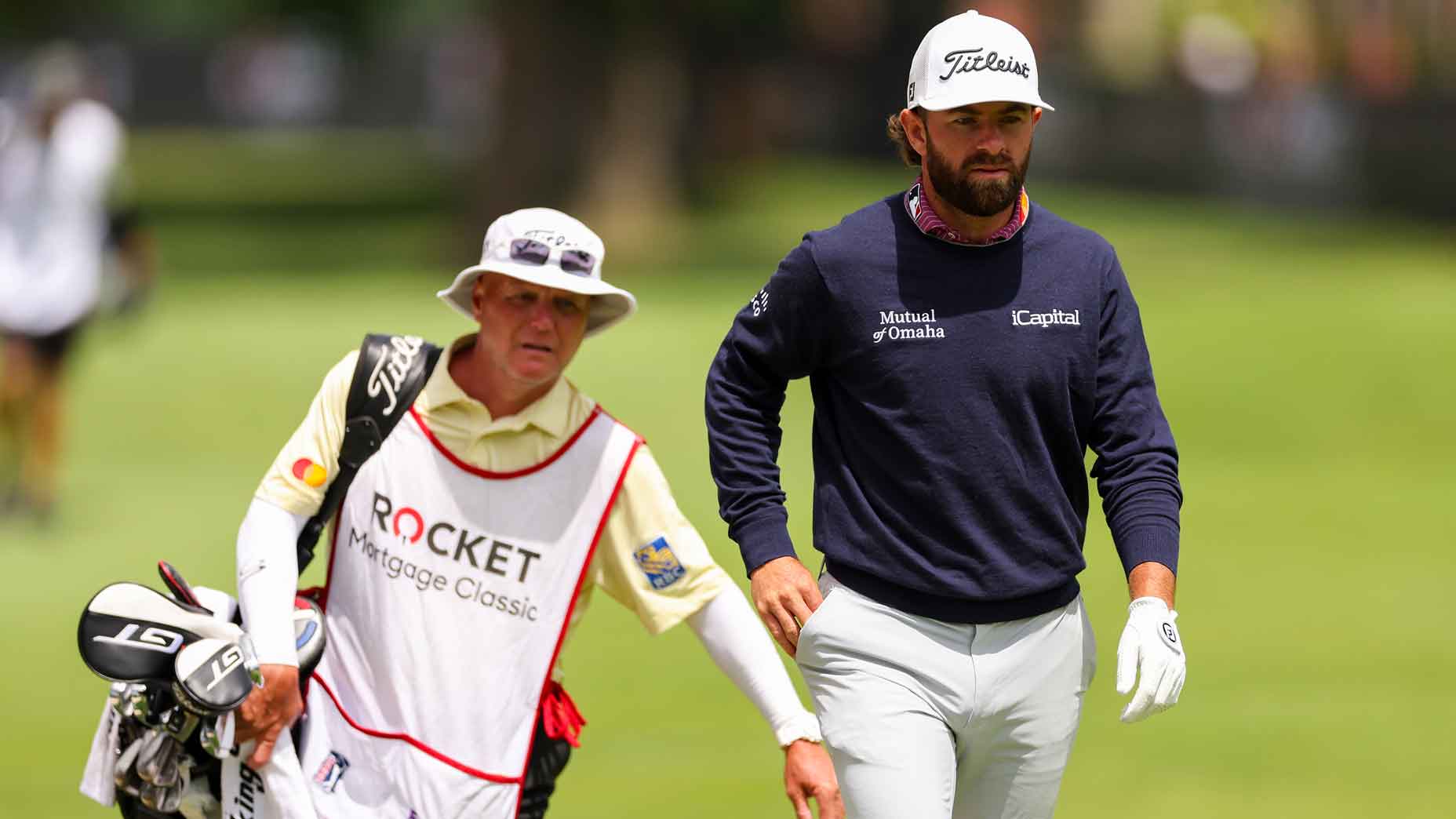
The Anatomy of a Perfect 'Boring' 61: How Cameron Young Broke Golf Without a Putter
Cameron Young fired a career-low 11-under 61 at the Rocket Mortgage Classic without making a single putt over 15 feet. We dissect the staggering ball-striking data that defines one of the most statistically rare rounds in modern PGA TOUR history.
An 11-under 61 is a score that screams fireworks: a white-hot putter, draining bombs from all over the zip code, a player bending the law of averages to their will for five straight hours. But on Friday at the Rocket Mortgage Classic, Cameron Young authored his career-low round with a whisper. He carded eleven birdies and seven pars at Detroit Golf Club for a masterful 61 that vaulted him into contention. The astonishing part, the detail that reframes the entire performance, is how it happened: not a single one of his made putts came from outside 15 feet. In a sport where the flatstick is often seen as the great equalizer, Young rendered his nearly irrelevant, producing a score for the ages through a display of pure, relentless, almost mechanical ball-striking.An 11-under 61 is a score that screams fireworks: a white-hot putter, draining bombs from all over the zip code, a player bending the law of averages to their will for five straight hours. But on Friday at the Rocket Mortgage Classic, Cameron Young authored his career-low round with a whisper. He carded eleven birdies and seven pars at Detroit Golf Club for a masterful 61 that vaulted him into contention. The astonishing part, the detail that reframes the entire performance, is how it happened: not a single one of his made putts came from outside 15 feet. In a sport where the flatstick is often seen as the great equalizer, Young rendered his nearly irrelevant, producing a score for the ages through a display of pure, relentless, almost mechanical ball-striking.
The raw data from Young’s second round tells a story of total dominance from tee to green. According to PGA TOUR ShotLink, he gained a staggering +7.9 strokes on the field with his full swings, a figure that places the round in a vanishingly small category of all-time great performances. The engine room of this display was his iron play. Young gained over 4.5 strokes on approach alone, a metric that quantifies just how much better his shots into the greens were than the competition's. The most vivid illustration of this precision is his proximity to the hole, which averaged an absurd 15 feet, 4 inches for the entire round. For context, the field average at Detroit Golf Club was more than double that, at 35 feet, 1 inch. Hitting all 18 greens in regulation is one thing; hitting them with this level of consistent accuracy is another thing entirely.
For his part, Young described the round with the kind of understatement that only a player in a state of supreme control can muster. 'It's just one of those days where you hit a lot of shots really close,' he told the PGA TOUR after his round. 'I didn't have to sweat much over the putter, which is always nice.' This wasn't false modesty; it was a factual summary. Seven of his eleven birdies came on putts from inside 10 feet, turning what are normally pressure-packed moments into straightforward conversions. This clinical execution carries a particular weight for Young, a player widely considered among the best on TOUR to have never won. A five-time runner-up, his career has been a narrative of immense talent on the cusp of a breakthrough. This round felt different—not a fluke, but the ultimate expression of his core strength.For his part, Young described the round with the kind of understatement that only a player in a state of supreme control can muster. 'It's just one of those days where you hit a lot of shots really close,' he told the PGA TOUR after his round. 'I didn't have to sweat much over the putter, which is always nice.' This wasn't false modesty; it was a factual summary. Seven of his eleven birdies came on putts from inside 10 feet, turning what are normally pressure-packed moments into straightforward conversions. This clinical execution carries a particular weight for Young, a player widely considered among the best on TOUR to have never won. A five-time runner-up, his career has been a narrative of immense talent on the cusp of a breakthrough. This round felt different—not a fluke, but the ultimate expression of his core strength.
To truly grasp the rarity of Young’s performance, one must look past the scorecard and into the architecture of modern golf analytics. Mark Broadie, the Columbia professor who invented the Strokes Gained metric, has provided the framework for understanding such outliers. 'To gain that many strokes on approach without the putter bailing you out is exceptionally rare,' Broadie noted in a Golf Digest analysis of such rounds. 'It's a testament to complete control over the golf ball... We see rounds where someone gains 5 strokes putting; gaining over 4.5 on approach alone is arguably a greater feat of skill.' Broadie's point is crucial: a scorching hot putter can feel random, a fortunate alignment of the stars. A round built on elite approach play, however, is a demonstration of repeatable, technical mastery at the highest level.To truly grasp the rarity of Young’s performance, one must look past the scorecard and into the architecture of modern golf analytics. Mark Broadie, the Columbia professor who invented the Strokes Gained metric, has provided the framework for understanding such outliers. 'To gain that many strokes on approach without the putter bailing you out is exceptionally rare,' Broadie noted in a Golf Digest analysis of such rounds. 'It's a testament to complete control over the golf ball... We see rounds where someone gains 5 strokes putting; gaining over 4.5 on approach alone is arguably a greater feat of skill.' Broadie's point is crucial: a scorching hot putter can feel random, a fortunate alignment of the stars. A round built on elite approach play, however, is a demonstration of repeatable, technical mastery at the highest level.
Young’s 61 now enters a rarified statistical airspace. According to analytics from DataGolf, since Strokes Gained data began being tracked in 2004, only a handful of rounds have ever featured a player gaining more than 7.5 strokes from tee-to-green while gaining less than two strokes with the putter. For his 61, Young gained a modest +1.6 strokes putting—a solid day, but hardly the stuff of legend. His round joins an exclusive club that includes performances like Henrik Stenson’s final-round duel with Phil Mickelson to win the 2016 Open Championship and Corey Conners’ Monday-qualifier-to-winner story at the 2021 Valero Texas Open. While different in context, these rounds are spiritual brethren, linked by a shared DNA of overwhelming ball-striking. They are the modern evolution of the standard set by Tiger Woods, whose 2000 U.S. Open victory at Pebble Beach remains the benchmark for pure tee-to-green dominance.
The venue itself played a key role in enabling this masterpiece. The Detroit Golf Club, a classic Donald Ross design, is a beloved track, but one that DataGolf analysis notes can be 'defenseless against modern elite ball-striking,' especially when conditions are soft. Young, one of the TOUR’s more powerful players, leveraged that advantage perfectly. His +1.8 Strokes Gained: Off-the-Tee demonstrates how he consistently set himself up with shorter clubs for his approach shots, turning par-4s into wedge-fests. This combination—a powerful driver, a generational iron display, and a receptive golf course—created the perfect storm for a historic low number built not on luck, but on strategic and physical demolition.The venue itself played a key role in enabling this masterpiece. The Detroit Golf Club, a classic Donald Ross design, is a beloved track, but one that DataGolf analysis notes can be 'defenseless against modern elite ball-striking,' especially when conditions are soft. Young, one of the TOUR’s more powerful players, leveraged that advantage perfectly. His +1.8 Strokes Gained: Off-the-Tee demonstrates how he consistently set himself up with shorter clubs for his approach shots, turning par-4s into wedge-fests. This combination—a powerful driver, a generational iron display, and a receptive golf course—created the perfect storm for a historic low number built not on luck, but on strategic and physical demolition.
There is a peculiar beauty to what Golf Digest has termed the 'art of the ‘boring’ 61.' Unlike a round saved by miraculous 40-foot putts, Young’s performance was defined by its relentless rhythm. Tee shot in fairway, approach shot to kick-in distance, tap-in for birdie. Repeat. The lack of stress over the putter creates a feedback loop of confidence, freeing the player to swing aggressively at flags, knowing they don’t need to hole a monster putt to cash in. It shifts the entire mental dynamic from one of survival and scrambling to one of pure execution and opportunity. It is golf played with the precision of a surgeon, not the frantic energy of a gambler on a hot streak.There is a peculiar beauty to what Golf Digest has termed the 'art of the ‘boring’ 61.' Unlike a round saved by miraculous 40-foot putts, Young’s performance was defined by its relentless rhythm. Tee shot in fairway, approach shot to kick-in distance, tap-in for birdie. Repeat. The lack of stress over the putter creates a feedback loop of confidence, freeing the player to swing aggressively at flags, knowing they don’t need to hole a monster putt to cash in. It shifts the entire mental dynamic from one of survival and scrambling to one of pure execution and opportunity. It is golf played with the precision of a surgeon, not the frantic energy of a gambler on a hot streak.
Ultimately, this 61 is more than just a number on a leaderboard or a statistical anomaly for the history books. It is a profound statement from Cameron Young. For a player still chasing that elusive first PGA TOUR victory, this round is validation. His season-long rank inside the top 5 for Strokes Gained: Approach confirms that this is not an aberration, but the peak of a world-class skill he possesses day-in and day-out. The question now is whether this historic display of ball-striking, this perfect execution of his greatest weapon, will be the catalyst that finally carries him across the finish line on a Sunday. As the weekend unfolds in Detroit, Young isn't just in contention for the Rocket Mortgage Classic; he’s making a case that his time is now, armed not with a magic wand, but with the unerring precision of his irons.Ultimately, this 61 is more than just a number on a leaderboard or a statistical anomaly for the history books. It is a profound statement from Cameron Young. For a player still chasing that elusive first PGA TOUR victory, this round is validation. His season-long rank inside the top 5 for Strokes Gained: Approach confirms that this is not an aberration, but the peak of a world-class skill he possesses day-in and day-out. The question now is whether this historic display of ball-striking, this perfect execution of his greatest weapon, will be the catalyst that finally carries him across the finish line on a Sunday. As the weekend unfolds in Detroit, Young isn't just in contention for the Rocket Mortgage Classic; he’s making a case that his time is now, armed not with a magic wand, but with the unerring precision of his irons.
Gallery
"It's just one of those days where you hit a lot of shots really close... I didn't have to sweat much over the putter, which is always nice."
Why it matters
Young's round provides a rare, quantifiable look at a pure ball-striking performance, separating it from rounds defined by hot putting. It highlights how modern players can dominate with overwhelming tee-to-green precision and places his specific skill set in a historical context among the game's all-time great iron players.
Sources
- 1.Rocket Classic 2026 Golf Leaderboardpgatour.com
- 2.
- 3.
Reported by the Downforce & Divots desk from the sources above.
The clubhouse.
- No replies yet. Be the first.