The Doral Doctrine: Why Carlos Sainz and the F1 Grid Are the PGA Tour's New Secret Weapon
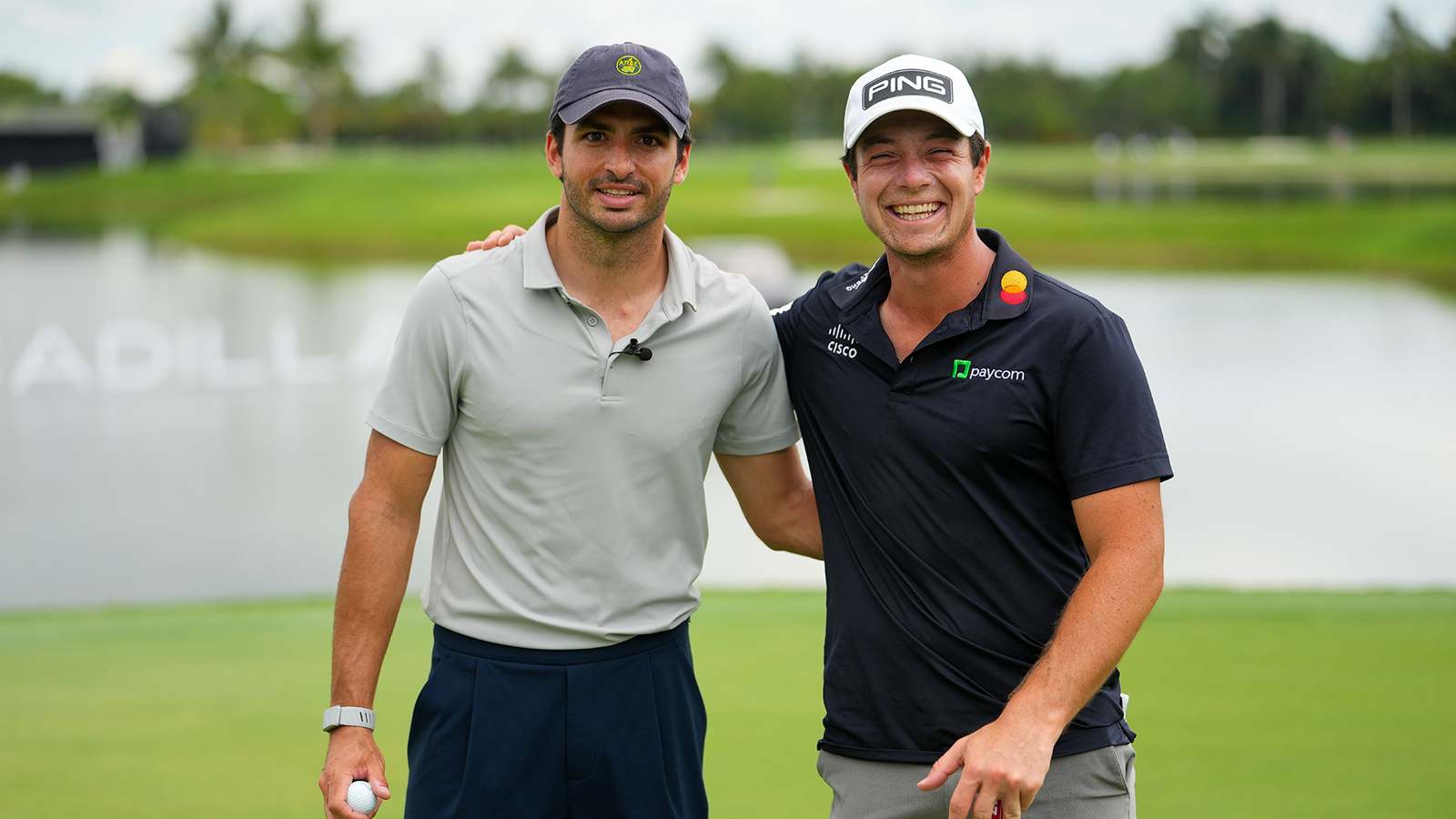
While his rivals prepped for the Miami Grand Prix, Carlos Sainz was on the first tee at Doral with Viktor Hovland. It wasn't just a casual round; it was a calculated play in the high-stakes game of crossover sports marketing, revealing as much about the future of sports media as it does about a driver's swing.
In the lead-up to the 2026 Miami Grand Prix, a week defined by meticulous data analysis and high-G shakedowns, one of Formula 1’s fiercest competitors was focused on a different kind of apex. At Trump National Doral, Carlos Sainz, mic’d up for the PGA Tour’s official YouTube channel, stood alongside professional golfer Viktor Hovland for the Cadillac Championship Pro-Am. When asked a simple question—was he more nervous in his race car or on the first tee—Sainz’s answer was immediate and disarming: “Always playing golf.” For a man whose day job involves threading a carbon-fiber missile between concrete walls at 200 mph, the admission was more than just a soundbite. It was a window into the peculiar psychological pressure of golf and, more importantly, a signal of a seismic shift in how sports properties are leveraging star power beyond their native arenas.
Sainz is far from a dilettante picking up a new hobby. His participation wasn't a one-off photo opportunity; it’s a genuine passion he actively cultivates within the punishing F1 schedule. As he confessed to the PGA Tour cameras, he tries to play “once every two weeks,” and during a rare week off, he’ll get out “probably two or three times.” This dedication is a common thread among the paddock, where drivers like Pierre Gasly have also been spotted honing their game, in his case at Austin’s Fazio Canyons Golf Course. Yet, Sainz’s self-assessment remains grounded. He humorously suggested that while he might be the best golfer among the F1 drivers in his group, what they do is “something else” entirely compared to a PGA Tour pro like Hovland. This blend of serious commitment and humble reverence is precisely what makes these athletes so compelling outside their primary sport—they are elite performers grappling with the same maddening pursuit of perfection that defines the amateur golf experience, only their baseline for physical excellence is otherworldly.
The physical transfer between the cockpit and the course is more profound than it appears. While F1 demands lightning reflexes and immense neck strength to withstand cornering forces, the golf swing presents a different, yet equally intense, biomechanical challenge. A full swing, according to research on golf injuries, can generate compressive forces on the lumbar spine equivalent to eight times a person’s body weight. It is a violent, explosive rotation that, if executed improperly, leads to debilitating injury. As detailed by DRVN Golf, lower back pain—the single most common golf ailment, affecting up to 55% of recreational players—is often a symptom of rotational deficits in the hips and thoracic spine. An F1 driver, whose entire physical preparation is centered on core stability and efficient force transfer through the torso, is uniquely conditioned to understand these principles of kinetic chain movement. Their finely tuned proprioception, essential for feeling a car’s balance on the edge of adhesion, translates into a hyper-awareness of the body mechanics required for a repeatable, powerful golf swing.The physical transfer between the cockpit and the course is more profound than it appears. While F1 demands lightning reflexes and immense neck strength to withstand cornering forces, the golf swing presents a different, yet equally intense, biomechanical challenge. A full swing, according to research on golf injuries, can generate compressive forces on the lumbar spine equivalent to eight times a person’s body weight. It is a violent, explosive rotation that, if executed improperly, leads to debilitating injury. As detailed by DRVN Golf, lower back pain—the single most common golf ailment, affecting up to 55% of recreational players—is often a symptom of rotational deficits in the hips and thoracic spine. An F1 driver, whose entire physical preparation is centered on core stability and efficient force transfer through the torso, is uniquely conditioned to understand these principles of kinetic chain movement. Their finely tuned proprioception, essential for feeling a car’s balance on the edge of adhesion, translates into a hyper-awareness of the body mechanics required for a repeatable, powerful golf swing.
This crossover appeal is not happening in a vacuum; it’s a cornerstone of the PGA Tour’s modern growth strategy. The Tour is actively cultivating these moments, turning a Pro-Am round into shareable content for its official TikTok and YouTube channels, where the Sainz and Hovland pairing was promoted as a “memorable moment for fans of both golf and Formula 1.” The motivation is clear when you look at the numbers. The PGA Tour is riding a wave of positive momentum, with Front Office Sports reporting that its eight signature events in 2026 averaged a robust 3.44 million viewers for their final rounds. This builds on a significant 2025 bounce-back, where, according to Golf Digest, CBS viewership saw a 21% year-over-year increase and NBC’s FedEx Cup coverage grew by 18%. To sustain and accelerate that growth, the Tour needs to tap into new demographics—and Formula 1, with its booming, digitally-native, and global fanbase supercharged by Netflix’s *Drive to Survive*, represents the perfect target.
What we are witnessing is the evolution of the celebrity Pro-Am participant. For decades, the format relied on actors, musicians, and retired stick-and-ball athletes. Today, the most valuable “plus-one” is an active, globally recognized athlete from another high-performance world. F1 drivers, in particular, bring a unique cachet: they are international, embody a luxury lifestyle, and possess a level of physical and mental fortitude that resonates with the demands of golf. When the PGA Tour features Sainz, it’s not just borrowing his fame; it’s cross-pollinating its audience with F1’s. The 22,789 views on the initial YouTube video are a testament to this appeal, representing a direct pipeline to fans who might not otherwise tune into a golf tournament’s ancillary content. The Tour is no longer just selling golf; it’s selling access to the athletes that a new generation of fans idolizes, regardless of the sport they play.What we are witnessing is the evolution of the celebrity Pro-Am participant. For decades, the format relied on actors, musicians, and retired stick-and-ball athletes. Today, the most valuable “plus-one” is an active, globally recognized athlete from another high-performance world. F1 drivers, in particular, bring a unique cachet: they are international, embody a luxury lifestyle, and possess a level of physical and mental fortitude that resonates with the demands of golf. When the PGA Tour features Sainz, it’s not just borrowing his fame; it’s cross-pollinating its audience with F1’s. The 22,789 views on the initial YouTube video are a testament to this appeal, representing a direct pipeline to fans who might not otherwise tune into a golf tournament’s ancillary content. The Tour is no longer just selling golf; it’s selling access to the athletes that a new generation of fans idolizes, regardless of the sport they play.
For the drivers, the benefits extend beyond a simple change of pace. The golf course offers a unique sanctuary from the relentless data streams, team strategy sessions, and media obligations of a Grand Prix weekend. It’s a competitive outlet that is purely individual. In F1, a driver’s result is contingent on a thousand variables—engineering, pit stops, strategy calls, and the actions of 19 other drivers. On the golf course, as Sainz’s nerves attest, the battle is entirely internal. This solitary challenge can serve as a vital tool for mental conditioning, a way to sharpen focus and manage pressure in a different context, aligning with principles of enhancing athletic performance through varied stimuli, as explored in sports medicine literature. The walk down the fairway offers a mental reset that the cacophony of the paddock simply cannot provide, allowing them to decompress while still stoking their innate competitive fire.For the drivers, the benefits extend beyond a simple change of pace. The golf course offers a unique sanctuary from the relentless data streams, team strategy sessions, and media obligations of a Grand Prix weekend. It’s a competitive outlet that is purely individual. In F1, a driver’s result is contingent on a thousand variables—engineering, pit stops, strategy calls, and the actions of 19 other drivers. On the golf course, as Sainz’s nerves attest, the battle is entirely internal. This solitary challenge can serve as a vital tool for mental conditioning, a way to sharpen focus and manage pressure in a different context, aligning with principles of enhancing athletic performance through varied stimuli, as explored in sports medicine literature. The walk down the fairway offers a mental reset that the cacophony of the paddock simply cannot provide, allowing them to decompress while still stoking their innate competitive fire.
The success of the Sainz-Hovland collaboration at the Cadillac Championship is a blueprint for the future of sports marketing. It demonstrates that the modern fan’s allegiance is often to the athlete first and the sport second. As Formula 1 continues its aggressive expansion in the United States, we should expect these integrated events to become even more central to the Grand Prix experience. Pro-Am pairings will be less of a Wednesday footnote and more of a pillar of the week’s narrative, engineered for maximum social media impact. The PGA Tour has found a powerful engine for audience acquisition, and F1 drivers have discovered a global platform to showcase a different side of their personality and skill. The fairway and the front straight are becoming two parts of the same extended sporting universe, a shared stage where the drama of elite competition plays out for an audience that wants it all.
Gallery
"Are you more nervous in a car or on the first tee today? Always playing golf."
Why it matters
Carlos Sainz's Pro-Am appearance highlights a deliberate strategy by the PGA Tour to capture the global, youth-oriented audience of Formula 1. It signifies a new era of sports marketing where athlete crossovers are not just a novelty but a core tactic for audience growth and content creation. This synergy leverages the shared demands of precision and mental fortitude between the two sports to build a broader, more engaged fanbase.
Sources
- 1.
- 2.
- 3.Carlos Sainz: The Chill Formula 1 Drivertiktok.com
- 4.
- 5.
- 6.
- 7.PGA Tour's Key Events Deliver Ratings Gains Ahead of TV ...frontofficesports.com
- 8.
- 9.
- 10.Minimizing Injuries and Enhancing Performance in Golf ... - PMCpmc.ncbi.nlm.nih.gov
Reported by the Downforce & Divots desk from the sources above.
The clubhouse.
- No replies yet. Be the first.