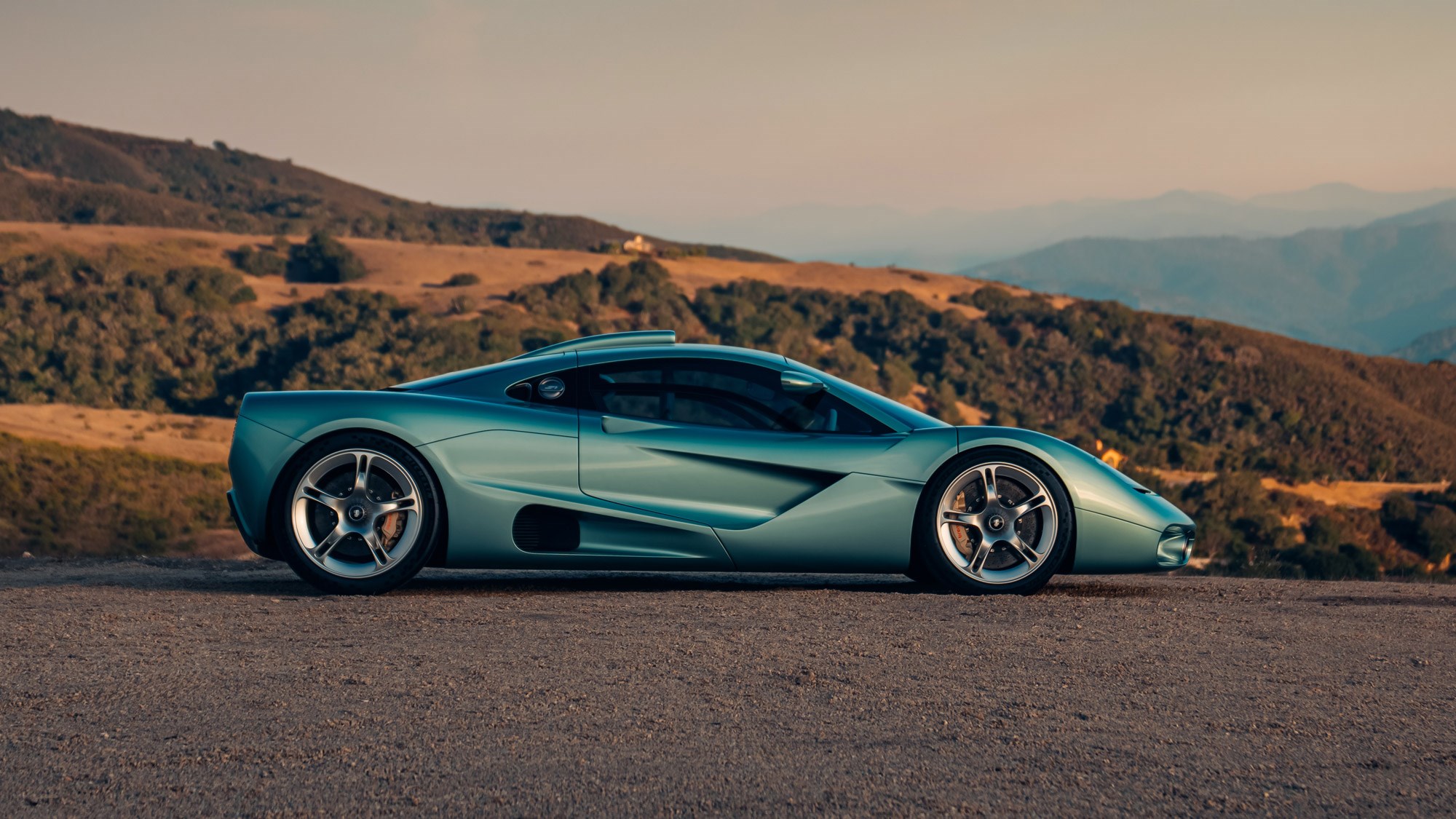
The 12,100 RPM Question: Inside the Glorious, Anachronistic Heart of Gordon Murray's S1
While the automotive world hurtles toward a silent, electric future, Gordon Murray and Cosworth have built a defiant masterpiece—a naturally aspirated V12 that screams to a five-figure redline. We explore the engineering obsession required to create the last true analog hypercar engine.
Monterey Car Week has become a showcase for the sublime and the ridiculous, a manicured lawn where carbon fiber meets old money. This year, the dominant conversation was electric, a cacophony of promised 2,000-horsepower outputs from vaporware startups with silent powertrains. And then, standing apart in a quiet corner, was a turquoise masterpiece from Gordon Murray Automotive. It didn't boast the biggest numbers, but one figure on its spec sheet was more electrifying than any lithium-ion pack: a 12,100 revolutions per minute redline. In a world where even high-performance engines rarely touch 9,000 rpm, and a typical road car is advised to shift into its final gear by 25 mph, this number feels like a deliberate, glorious provocation—a statement of purpose from a man who defines the very concept of the analog supercar.Monterey Car Week has become a showcase for the sublime and the ridiculous, a manicured lawn where carbon fiber meets old money. This year, the dominant conversation was electric, a cacophony of promised 2,000-horsepower outputs from vaporware startups with silent powertrains. And then, standing apart in a quiet corner, was a turquoise masterpiece from Gordon Murray Automotive. It didn't boast the biggest numbers, but one figure on its spec sheet was more electrifying than any lithium-ion pack: a 12,100 revolutions per minute redline. In a world where even high-performance engines rarely touch 9,000 rpm, and a typical road car is advised to shift into its final gear by 25 mph, this number feels like a deliberate, glorious provocation—a statement of purpose from a man who defines the very concept of the analog supercar.
To understand the audacity of the GMA S1, one must first look back at its creator’s magnum opus: the McLaren F1. As noted by a recent comparison in Autoevolution, the F1 established the blueprint with its legendary 6.1-liter BMW V12 and a Le Mans victory to cement its icon status. It was, and for many remains, the definitive hypercar, a perfect harmony of lightweight design, a central driving position, and raw, naturally aspirated power. For decades, it seemed like an unrepeatable achievement, a high-water mark for an entire era of engineering. Yet, the S1 is not merely an homage; it is Gordon Murray’s direct answer to his own legacy, a successor in spirit and execution, right down to the fastidious production numbers. Both the iconic F1 and its modern S1 counterpart were planned with an exclusive run of just 64 build slots, creating a perfect, symmetrical narrative of automotive genius.
At the core of this new narrative is a mechanical heart that defies modern convention: a bespoke, naturally aspirated Cosworth V12. This is not some off-the-shelf unit with a tweaked ECU. It’s a ground-up creation designed with a singular focus on driver engagement. While producing a formidable 654 horsepower, the true magic lies in *how* it produces that power. The engine’s ability to spin to 12,100 rpm is a testament to an obsessive focus on minimizing inertia and maximizing mechanical strength. This screaming powerplant is bolted into a chassis with a dry weight of just 997 kg, according to data from Gordon Murray Automotive. This creates a power-to-weight ratio that prioritizes response and tactility over the brute force of its hybrid and electric rivals. The S1 is a symphony of lightness and high-revving fury, a formula Murray perfected and has now returned to refine.At the core of this new narrative is a mechanical heart that defies modern convention: a bespoke, naturally aspirated Cosworth V12. This is not some off-the-shelf unit with a tweaked ECU. It’s a ground-up creation designed with a singular focus on driver engagement. While producing a formidable 654 horsepower, the true magic lies in *how* it produces that power. The engine’s ability to spin to 12,100 rpm is a testament to an obsessive focus on minimizing inertia and maximizing mechanical strength. This screaming powerplant is bolted into a chassis with a dry weight of just 997 kg, according to data from Gordon Murray Automotive. This creates a power-to-weight ratio that prioritizes response and tactility over the brute force of its hybrid and electric rivals. The S1 is a symphony of lightness and high-revving fury, a formula Murray perfected and has now returned to refine.
Achieving a five-figure redline in an engine intended for road use is a monumental engineering feat. The internal physics are staggering. As outlined in technical discussions regarding piston speed, the velocity at which a piston travels up and down its cylinder is a critical limiting factor for engine longevity and performance. At 12,100 rpm, the S1's pistons and connecting rods are subjected to G-forces and stresses typically reserved for purpose-built racing machines that are torn down and rebuilt after every weekend. To ensure durability for road miles, Cosworth and Murray had to employ exotic materials and manufacturing tolerances that are almost unheard of in a production vehicle. This stands in stark contrast to the average manual transmission car, where the engine loafs along, shifting at RPMs that barely register on the S1’s tachometer. The S1’s engine is not just an iteration; it’s a fundamental rejection of compromise, engineered to deliver an experience that mass-market efficiency has rendered almost extinct.Achieving a five-figure redline in an engine intended for road use is a monumental engineering feat. The internal physics are staggering. As outlined in technical discussions regarding piston speed, the velocity at which a piston travels up and down its cylinder is a critical limiting factor for engine longevity and performance. At 12,100 rpm, the S1's pistons and connecting rods are subjected to G-forces and stresses typically reserved for purpose-built racing machines that are torn down and rebuilt after every weekend. To ensure durability for road miles, Cosworth and Murray had to employ exotic materials and manufacturing tolerances that are almost unheard of in a production vehicle. This stands in stark contrast to the average manual transmission car, where the engine loafs along, shifting at RPMs that barely register on the S1’s tachometer. The S1’s engine is not just an iteration; it’s a fundamental rejection of compromise, engineered to deliver an experience that mass-market efficiency has rendered almost extinct.
This masterpiece of internal combustion arrives at a time when the regulatory walls are closing in. While a low-volume manufacturer like GMA can navigate a unique path to compliance, the broader industry operates under immense pressure. A glance at the U.S. Code of Federal Regulations reveals the scale of the paradigm shift. Documents like 40 CFR Part 1036, which governs emissions for new heavy-duty highway engines, and 40 CFR Part 1039, for nonroad compression-ignition engines, paint a picture of a world moving inexorably toward stricter controls and, ultimately, away from the very concept of the fossil-fuel engine. These dense, highly technical documents, filled with stipulations on duty cycles and certification, represent the tide against which the S1 defiantly swims. Its V12 is not just an engine; it's an anachronism, a glorious relic of a fading era, built in the face of a global legislative pivot.This masterpiece of internal combustion arrives at a time when the regulatory walls are closing in. While a low-volume manufacturer like GMA can navigate a unique path to compliance, the broader industry operates under immense pressure. A glance at the U.S. Code of Federal Regulations reveals the scale of the paradigm shift. Documents like 40 CFR Part 1036, which governs emissions for new heavy-duty highway engines, and 40 CFR Part 1039, for nonroad compression-ignition engines, paint a picture of a world moving inexorably toward stricter controls and, ultimately, away from the very concept of the fossil-fuel engine. These dense, highly technical documents, filled with stipulations on duty cycles and certification, represent the tide against which the S1 defiantly swims. Its V12 is not just an engine; it's an anachronism, a glorious relic of a fading era, built in the face of a global legislative pivot.
The S1, therefore, is more than just a car; it’s a philosophical statement on wheels. It is a deliberate and unapologetic celebration of the analog. In an age where even the most potent supercars are laden with hybrid systems, all-wheel drive, and dual-clutch transmissions that shift faster than a human can think, the S1 offers a V12, a traditional manual gearbox, and a purity of purpose that connects the driver directly to the mechanics. As Autoevolution highlights, the parallel between the F1 and the S1 is about more than just their shared creator; it's about a shared ethos. The S1 is proof that the multi-sensory experience of a lightweight, high-revving, naturally aspirated machine remains the pinnacle of driving pleasure for a certain connoisseur. It is Murray doubling down on his foundational belief that the quality of the experience trumps raw, quantifiable metrics every time.The S1, therefore, is more than just a car; it’s a philosophical statement on wheels. It is a deliberate and unapologetic celebration of the analog. In an age where even the most potent supercars are laden with hybrid systems, all-wheel drive, and dual-clutch transmissions that shift faster than a human can think, the S1 offers a V12, a traditional manual gearbox, and a purity of purpose that connects the driver directly to the mechanics. As Autoevolution highlights, the parallel between the F1 and the S1 is about more than just their shared creator; it's about a shared ethos. The S1 is proof that the multi-sensory experience of a lightweight, high-revving, naturally aspirated machine remains the pinnacle of driving pleasure for a certain connoisseur. It is Murray doubling down on his foundational belief that the quality of the experience trumps raw, quantifiable metrics every time.
Ultimately, what the S1 and its Cosworth V12 offer is something increasingly rare: character. You can’t download it, simulate it, or synthesize it through a speaker. It is born from the violent, beautiful chaos of thousands of controlled explosions per minute, a mechanical scream that builds to a crescendo at a point where other engines have long since given up. It is the vibration through the carbon-fiber tub, the instantaneous throttle response, the challenge and reward of chasing that 12,100 rpm redline. While electric hypercars may claim victory on a spreadsheet, they cannot replicate this visceral, emotional connection. The S1 is a rolling piece of kinetic sculpture, and its engine is the soul of the machine. It is a final, defiant roar for the internal combustion engine, an engineering benchmark that will likely echo for decades as one of the last, and arguably greatest, of its kind.Ultimately, what the S1 and its Cosworth V12 offer is something increasingly rare: character. You can’t download it, simulate it, or synthesize it through a speaker. It is born from the violent, beautiful chaos of thousands of controlled explosions per minute, a mechanical scream that builds to a crescendo at a point where other engines have long since given up. It is the vibration through the carbon-fiber tub, the instantaneous throttle response, the challenge and reward of chasing that 12,100 rpm redline. While electric hypercars may claim victory on a spreadsheet, they cannot replicate this visceral, emotional connection. The S1 is a rolling piece of kinetic sculpture, and its engine is the soul of the machine. It is a final, defiant roar for the internal combustion engine, an engineering benchmark that will likely echo for decades as one of the last, and arguably greatest, of its kind.
Gallery
"One has a 6.1-liter BMW V12 and a Le Mans victory. The other has a 12,100 rpm V12 from Cosworth."
Why it matters
The GMA S1's Cosworth V12 represents the absolute pinnacle of naturally aspirated road car engine technology, a final, defiant statement for analog driving purity. In an industry rapidly pivoting to electrification and forced induction, its 12,100 rpm redline is a feat of engineering that may never be repeated in a series production vehicle. It serves as a benchmark for what is possible when driver engagement, not outright performance figures, is the primary goal.
Sources
- 1.
- 2.Formula 1 Live Resultsflashscore.com
- 3.Formula 1 2026 Dutch GP Resultsmotorsport.com
- 4.
- 5.McLaren F1 Vs GMA S1: The Greatest Analog Supercars ...autoevolution.com
- 6.
- 7.Stop obsessing over what RPM to shiftreddit.com
- 8.
- 9.MATERIAL Definition & Meaning - Merriam-Webstermerriam-webster.com
- 10.
Reported by the Downforce & Divots desk from the sources above.
The clubhouse.
- No replies yet. Be the first.