Editor's Guide · Updated September 2026

The Best Putters for Slow Greens

The short answer

The best putter for slow greens is the Odyssey Ai-ONE Jailbird Cruiser. Its heavier head (around 380g) and longer grip encourage a smoother, more authoritative stroke, while its Ai-ONE insert ensures consistent ball speed even on off-center hits, which is critical for lag putting. For those preferring a traditional blade, the Bettinardi Queen B #6 offers a heavier head with a soft-feeling milled face. Golfers on a budget should consider the Cleveland HB SOFT 2 Model 11 for its excellent forgiveness and face technology at a lower price.

Most putters are engineered for the pristine, lightning-fast greens you see on television. The reality for most of us is a different game entirely: slower, bumpier, and often inconsistent municipal or local club surfaces. On these greens, a standard-weight putter can lead to a tentative, jabby stroke as you try to force the ball to the hole, resulting in poor distance control and missed putts.

This guide is for the serious amateur who plays on typical public or member courses and wants a putter that makes it easier to be aggressive and confident on slower surfaces. We've focused on models with heavier head weights, forgiving face technologies that normalize roll speed, and designs that promote a stable, pendulum-like motion. Recent trends toward multi-material heads and AI-designed faces have produced exceptional options that weren't available just a few years ago.

Our recommendations are based on editor experience, player feedback, and brand specifications. We update this guide annually as new models are released and tested. We do not accept payment for editorial placement.

At a glance

PickAwardHead TypeFaceHead WeightStandard LoftPrice
Odyssey Ai-ONE Jailbird CruiserBest OverallMalletAi-ONE Urethane InsertHeavy (~380g)~$449
Bettinardi Queen B #6Best Milled BladeWide-Body BladeMilled Carbon SteelHeavy (~362g)~$450
TaylorMade Spider Tour XBest for StabilityMalletWhite TPU Pure Roll InsertStandard/Heavy (~350g+)~$349
Cleveland HB SOFT 2 Model 11Best ValueMalletMilled (Speed Optimized Face Technology)Standard/Heavy (~370g)~$149
L.A.B. Golf DF3Best for a Consistent StrokeMallet (Ultra-High MOI)Milled 6061 AluminumVery Heavy (Varies by build)2.5° (Customizable)~$469

The picks

01 · Best Overall

Odyssey Ai-ONE Jailbird Cruiser

Best for: The player who wants a complete, purpose-built tool to eliminate timid strokes and improve lag putting.

The Ai-ONE Jailbird Cruiser is the most complete solution for the challenges of slow greens. Its primary advantage is weight. The head is a substantial 380 grams, paired with a longer 38-inch shaft and a 17-inch grip, designed to be choked down on. This counterbalanced setup quiets the hands and promotes a stable, rhythmic stroke, preventing the deceleration that kills speed on long putts. The Ai-ONE face insert is the real story; its AI-designed variable topography normalizes ball speed across the face, meaning slight mis-hits still travel nearly the same distance as pure strikes. This forgiveness is invaluable when you're trying to lag a 40-footer over an imperfect surface. Compared to a milled face like the Bettinardi, the Ai-ONE feels softer and provides a more consistent roll on bumpy turf. The only significant downside is its unconventional size and setup; players accustomed to standard-length, standard-weight putters will need an adjustment period.

Head Type
Mallet
Face
Ai-ONE Urethane Insert
Head Weight
Heavy (~380g)
Standard Loft
Pros
  • + Heavy, counterbalanced design promotes a smooth tempo
  • + AI-designed face provides unmatched speed consistency
  • + Excellent alignment from the Versa high-contrast finish
Cons
  • Longer shaft and grip require a different setup and feel
  • Bulky head shape is not for traditionalists

Typical price: ~$449

02 · Best Milled Blade

Bettinardi Queen B #6

Best for: The feel-oriented player who wants a heavier blade with impeccable craftsmanship.

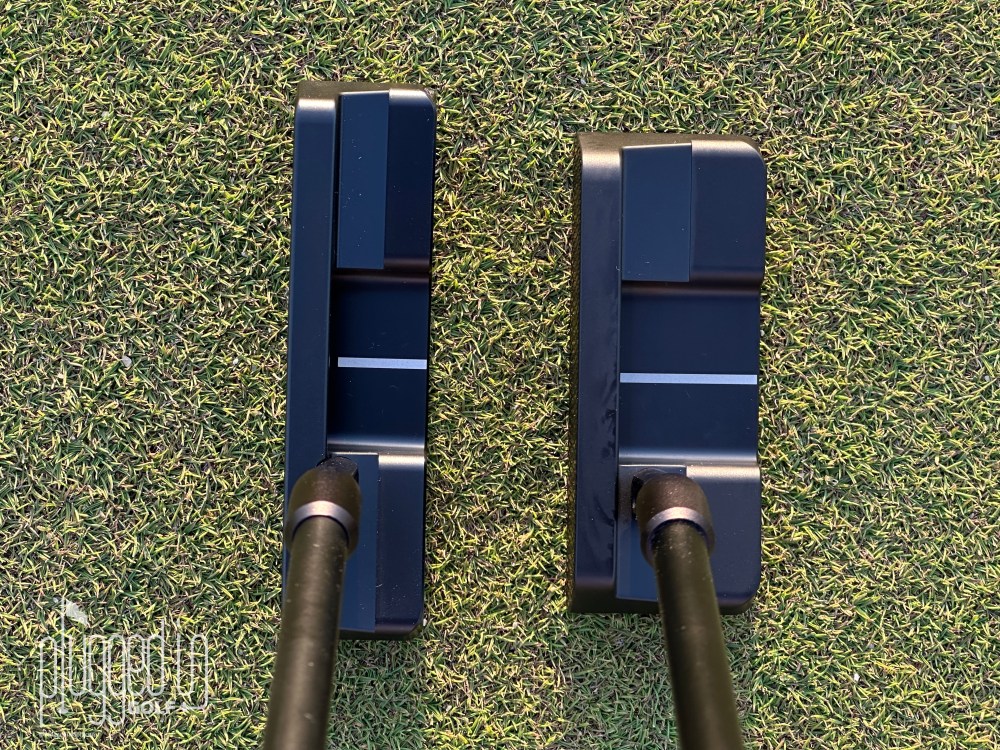
For the golfer who loves the look and feedback of a classic shape but needs more mass for slower greens, the Queen B #6 is the answer. It’s a wide-body, face-balanced blade with a head weight of 362 grams—noticeably heavier than a standard Newport-style putter. This heft makes it easier to take the club back and through without feeling the need to 'hit' the ball. The key feature is Bettinardi’s Mini Honeycomb face milling. It produces an exceptionally soft feel for a solid metal block, offering crisp audio feedback that an insert can't replicate. This helps with feel on shorter, must-make putts. While the milled face provides pure feedback, it's less forgiving on off-center strikes than the Odyssey's Ai-ONE insert. If you consistently find the center of the face and want premium feel and aesthetics, the QB6 is a superior choice. Players who spray it around the face will benefit more from the Odyssey's technology.

Head Type
Wide-Body Blade
Face
Milled Carbon Steel
Head Weight
Heavy (~362g)
Standard Loft
Pros
  • + Substantial head weight in a classic-looking package
  • + Extremely soft feel for a milled putter
  • + Elegant Caramel Copper PVD finish
Cons
  • Less forgiveness on mis-hits than an insert mallet
  • Premium price point

Typical price: ~$450

03 · Best for Stability

TaylorMade Spider Tour X

Best for: The golfer who wants maximum forgiveness and an easy alignment tool in a modern mallet.

The Spider family has long been synonymous with high MOI (Moment of Inertia), and the Tour X model refines this for players who want mallet-like forgiveness with a more blade-like feel. Its stability is its main selling point on slow greens; the head simply resists twisting on off-center hits. This is crucial when you're making a longer, more powerful stroke. The True Path alignment aid is simple and effective for aiming from distance. The white Surlyn Pure Roll insert provides a soft feel and is designed to get the ball rolling end-over-end quickly, reducing skid on less-than-perfect surfaces. Compared to the Odyssey Jailbird, the Spider Tour X has a more compact footprint and will feel more familiar to more golfers. However, the Jailbird's heavier, counter-balanced build is more purpose-built for smoothing out a poor tempo. The Spider is a better choice for a player with a decent stroke who just wants maximum stability on impact.

Head Type
Mallet
Face
White TPU Pure Roll Insert
Head Weight
Standard/Heavy (~350g+)
Standard Loft
Pros
  • + Extremely high MOI resists twisting on mis-hits
  • + Clear and effective alignment aid
  • + TSS weights allow for customized swing weight
Cons
  • Feel from the insert can be slightly muted for some
  • Not as heavy by default as the Odyssey Cruiser

Typical price: ~$349

04 · Best Value

Cleveland HB SOFT 2 Model 11

Best for: The budget-conscious golfer unwilling to sacrifice modern face-normalization technology.

Cleveland consistently delivers performance that punches well above its price tag, and the HB SOFT 2 line is no exception. The Model 11 is a fanged mallet that provides excellent stability and alignment, similar in principle to more expensive models. Its key technology is the Speed Optimized Face Technology (SOFT), which uses a unique milling pattern that is denser in the center and sparser on the heel and toe. This helps normalize ball speed across the face, just like the premium AI faces from Odyssey, but at a fraction of the cost. The roll and forgiveness are genuinely impressive for a putter in this price bracket. The trade-off? The materials and finish don't feel as premium as a Bettinardi or Scotty Cameron, and the insert doesn't have the same buttery softness as an Odyssey Ai-ONE. But for the practical golfer who wants a heavier, more forgiving putter to conquer slow greens without spending $400+, this is the smartest buy in golf.

Head Type
Mallet
Face
Milled (Speed Optimized Face Technology)
Head Weight
Standard/Heavy (~370g)
Standard Loft
Pros
  • + Exceptional value for the performance
  • + Face technology provides great distance control
  • + Heavier head weight is ideal for slow surfaces
Cons
  • Lacks the premium feel and finish of top-tier models
  • Stock grip is basic

Typical price: ~$149

05 · Best for a Consistent Stroke

L.A.B. Golf DF3

Best for: The player who struggles with face control and wants to remove a variable from their putting stroke.

L.A.B. Golf putters are designed around a single concept: Lie Angle Balance. The technology ensures the putter head stays perfectly square to the arc during the stroke without any manipulation from the hands. The DF3 is the newest, most streamlined version of their flagship design. For slow greens, this is a game-changer. The biggest challenge on long putts is keeping the face square through a bigger motion; the DF3 does this for you, promoting a confident, accelerating stroke. Because it removes face rotation as a variable, you can focus solely on speed. The feel is unique—very solid and stable, almost inert. It's a tool for rolling the ball, not 'feeling' it in the traditional sense. It's much heavier than most putters, which is a benefit here. The obvious downside is the look. It's unconventional and won't appeal to everyone. It also requires a brief learning period to trust the technology and let the putter do the work. But for the technical-minded player plagued by inconsistency, it can feel like a cheat code.

Head Type
Mallet (Ultra-High MOI)
Face
Milled 6061 Aluminum
Head Weight
Very Heavy (Varies by build)
Standard Loft
2.5° (Customizable)
Pros
  • + Lie Angle Balance technology eliminates face rotation
  • + Extremely stable and heavy, encouraging a pendulum stroke
  • + Forces a focus on speed control above all else
Cons
  • Highly unconventional looks are polarizing
  • Requires letting go of traditional 'feel' and hand action

Typical price: ~$469

How to choose

Why Head Weight Is Your Best Friend on Slow Greens

On a fast green, a light tap is all that's needed. On a slow one, you need to make a longer, more committed stroke. A standard-weight putter (around 340-350g) lacks the momentum to do this smoothly. Golfers often compensate by getting 'handsy' or 'jabby', leading to deceleration and poor distance control. A heavier putter head (360g-380g+) acts like a pendulum. Its increased mass helps you maintain a consistent tempo and accelerate through the ball naturally. It smooths out the hitches in your stroke and gives you the confidence to get the ball to the hole, and often past it—the first rule of making putts.

Face Inserts vs. Milled Faces: What's Better for Bumps?

This is a key consideration. A solid, milled-from-steel putter head provides the purest feedback and a crisp sound. For purists, this is non-negotiable. However, on bumpier greens, that 'pure' feedback can feel harsh, and a slight mis-hit can cause the ball to jump or skid offline. A soft urethane or polymer face insert acts as a buffer. It dampens vibrations and 'grips' the ball at impact, helping to impart a true end-over-end roll more quickly, even if the turf isn't perfect. Modern inserts, especially those with variable-face grooves or AI-designed topographies, also do a much better job of ensuring off-center hits roll out to a similar distance as center strikes. For most players on slow greens, a modern insert is the more practical and forgiving choice.

Mallet vs. Blade: Forgiveness for Lag Putting

On slow greens, you will face more lag putts of 30 feet or more. This is where forgiveness, measured by Moment of Inertia (MOI), becomes critical. Mallet putters, with their larger size and perimeter weighting, have a much higher MOI than traditional blades. This means when you inevitably strike a putt slightly toward the heel or toe, the putter head twists less. Less twisting means the ball starts closer to your intended line and, with modern face technology, loses less speed. While a heavy blade like the Bettinardi QB6 is a great option, a high-MOI mallet like the TaylorMade Spider or Odyssey Jailbird provides a much larger safety net for the inconsistent strikes common to long-distance putting.

The Overlooked Role of Loft

Standard putter loft is typically 3-4 degrees. This is designed to lift the ball out of the small depression it sits in and get it rolling on top of the grass. On shaggier, slower greens, the grass blades are longer and the ball may sit down even more. Some players find that a putter with slightly more loft (4-5 degrees) can be beneficial, ensuring the ball gets airborne for the first fraction of a second before it starts rolling. This prevents the ball from 'plowing' through the grass initially, which can kill speed and bounce it offline. While most off-the-rack putters have a standard loft, a good club fitter can easily adjust the loft by a degree or two to optimize your roll for the conditions you play most often.

How we picked

The selections in this guide are the result of our editorial team's collective experience playing and evaluating golf equipment, specifically focusing on the problem of slow, bumpy greens common at non-tour venues. Our ranking is not based on robot testing but on performance in real-world conditions. We prioritized putters based on three main criteria: 1. **Head Weight and Stability:** We favored heavier-than-standard heads (typically 360g or more) and designs with high MOI, as these properties help create a smoother, more stable stroke and maintain speed on longer putts. 2. **Face Technology:** We analyzed face inserts and milling patterns designed to normalize ball speed on off-center hits. On slow greens, where stroke length is greater, mis-hits are more frequent and more punishing. Models with proven technologies (like Odyssey's Ai-ONE or Cleveland's SOFT) were ranked highly. 3. **Feel and Feedback:** While subjective, 'feel' is crucial for distance control. We considered how each putter's impact sensation (soft vs. crisp) and sound translated into usable feedback for judging speed. We excluded ultra-lightweight blade putters and models with extremely firm faces, as they are poorly suited to the task. The final list represents a consensus on the best tools currently available to solve this specific, common problem for amateur golfers.

Related coverage

The Penske Pivot at East Lake — PGA Tour
Golf
5 min
PGA Tour · Sep 3, 2026

The Penske Pivot at East Lake

Rory McIlroy’s Saturday surge threatens the status quo as Scottie Scheffler questions the architecture of modern scoring.

Margot Vellis 5 min
East Lake’s Inevitable Orbit — PGA Tour
Golf
4 min
PGA Tour · Sep 2, 2026

East Lake’s Inevitable Orbit

While Rory McIlroy’s Saturday surge provided the theatrical tension, Scottie Scheffler’s clinical mastery of modern course architecture reminds the field that at East Lake, gravity always wins.

Margot Vellis 4 min
Black Tuesday at Ponte Vedra: The LIV Liquidation Begins — Tour News
Golf
5 min
Tour News · Sep 2, 2026

Black Tuesday at Ponte Vedra: The LIV Liquidation Begins

As the PIF-backed league faces a potential bankruptcy filing and mass layoffs, the $300 million wall between LIV and the PGA Tour starts to crumble.

Margot Vellis 5 min
The Monopoly at East Lake: Scottie Scheffler’s Gravity Field — PGA Tour
Golf
5 min
PGA Tour · Sep 2, 2026

The Monopoly at East Lake: Scottie Scheffler’s Gravity Field

After a season of mechanical precision, the world number one secures his second FedExCup to silence the critics of the staggered-start era.

Margot Vellis 5 min
The $300 Million Purgatory: Monahan’s Iron Gate at Ponte Vedra — Tour News
Golf
5 min
Tour News · Aug 31, 2026

The $300 Million Purgatory: Monahan’s Iron Gate at Ponte Vedra

As LIV Golf crowns Jon Rahm its 2026 champion, the PGA Tour has doubled down on its refusal to offer a path home for the defectors.

Margot Vellis 5 min
East Lake’s Inevitable Gravity: The Scheffler Monopoly Returns — PGA Tour
Golf
4 min
PGA Tour · Aug 31, 2026

East Lake’s Inevitable Gravity: The Scheffler Monopoly Returns

Scottie Scheffler secures his second FedExCup title and a $10 million payday, cementing a competitive fire that has defined the 2026 PGA Tour season.

Margot Vellis 4 min
The $300 Million Cold Shower — Tour News
Golf
5 min
Tour News · Aug 30, 2026

The $300 Million Cold Shower

As the PIF taps run dry and layoffs begin, LIV Golf's 'intergalactic' expansion plans are facing a brutal Earth-bound reality check.

Margot Vellis 5 min
LIV 2.0: The $300 Million Cold Shower — Tour News
Golf
5 min
Tour News · Aug 30, 2026

LIV 2.0: The $300 Million Cold Shower

As the Saudi-backed league faces employee layoffs and a funding restructuring, the PGA Tour is slamming the door on any potential return for defectors.

Margot Vellis 5 min
East Lake’s Inevitable Gravity — PGA Tour
Golf
5 min
PGA Tour · Aug 29, 2026

East Lake’s Inevitable Gravity

A slow start at the Tour Championship couldn’t keep Scottie Scheffler down, as the world number one recalibrates his sights on the FedExCup crown.

Margot Vellis 5 min
The +12.4-Stroke Anomaly: Inside Wyndham Clark's Statistical Demolition of Bellerive — PGA Tour
Golf
Deep Dive
9 min
PGA Tour · Aug 28, 2026

The +12.4-Stroke Anomaly: Inside Wyndham Clark's Statistical Demolition of Bellerive

Wyndham Clark didn't just win the 2026 BMW Championship; he redefined dominance with a performance that outpaced the field by over twelve strokes. We break down the historic numbers behind his third victory of the year and what they signal for the TOUR Championship.

Margot Vellis 9 min
The Gilded Escape Clause: Inside the LIV Golf Contracts as 'LIV 1.0' Unravels — Tour News
Golf
Deep Dive
9 min
Tour News · Aug 27, 2026

The Gilded Escape Clause: Inside the LIV Golf Contracts as 'LIV 1.0' Unravels

As LIV Golf downsizes and pivots towards an uncertain '2.0' future, a wave of layoffs and contract expirations has exposed a legal labyrinth for its marquee stars. For those eyeing a return to the PGA Tour, the only way out might be through a contractual loophole—if one even exists.

Margot Vellis 9 min
The Nine-Figure Question: Inside the Contractual Chaos of LIV Golf’s Collapse — Tour News
Golf
Deep Dive
9 min
Tour News · Aug 25, 2026

The Nine-Figure Question: Inside the Contractual Chaos of LIV Golf’s Collapse

As Saudi Arabia’s Public Investment Fund pulls the plug, LIV Golf’s ‘death knell’ has sounded. For the stars who signed mammoth guaranteed contracts, the real battle is just beginning.

Margot Vellis 9 min
Wyndham’s Bellerive Breakaway: The $20 Million Siege of St. Louis — PGA Tour
Golf
4 min
PGA Tour · Aug 25, 2026

Wyndham’s Bellerive Breakaway: The $20 Million Siege of St. Louis

Wyndham Clark stared down the Sunday pressure at Bellerive to secure the BMW Championship, leaving Patrick Cantlay and Rory McIlroy in his wake.

Margot Vellis 4 min
The $25 Million Repentance: Jon Rahm’s Path Back to the PGA Tour — PGA Tour
Golf
5 min
PGA Tour · Aug 25, 2026

The $25 Million Repentance: Jon Rahm’s Path Back to the PGA Tour

As Jon Rahm follows the high-priced blueprint set by Brooks Koepka, the price of admission for LIV defectors has reached a staggering new equilibrium.

Margot Vellis 5 min
Bellerive’s Sunday Siege: Wyndham Clark Clings to the Lead in St. Louis — PGA Tour
Golf
4 min
PGA Tour · Aug 23, 2026

Bellerive’s Sunday Siege: Wyndham Clark Clings to the Lead in St. Louis

With a $20 million purse on the line at the BMW Championship, Patrick Cantlay has the leader in his crosshairs as the final round turns toward the back nine.

Margot Vellis 4 min
The High Cost of Re-Entry — Tour News
Golf
5 min
Tour News · Aug 23, 2026

The High Cost of Re-Entry

As LIV Golf’s '1.0' era reaches a murky conclusion in Indianapolis, the PGA Tour’s heavyweights are making one thing clear: the road back for defectors is paved with penalties.

Margot Vellis 5 min
Gridlock at Bellerive — PGA Tour
Golf
4 min
PGA Tour · Aug 21, 2026

Gridlock at Bellerive

A five-way logjam at the top of the BMW Championship leaderboard sets a frantic pace in St. Louis.

Margot Vellis 4 min
The Arch and the Ascent: Bellerive Braces for the BMW Championship — PGA Tour
Golf
5 min
PGA Tour · Aug 20, 2026

The Arch and the Ascent: Bellerive Braces for the BMW Championship

As the PGA Tour moves to St. Louis, the FedExCup Playoffs enter their most volatile phase with Rolex timing the drama at Bellerive.

Margot Vellis 5 min
FAQ

Frequently asked

Can't I just add lead tape to my current putter?

Yes, you can, and it's a great way to experiment. Adding 5-10 grams of lead tape to the sole of your putter can make a noticeable difference in feel and stability. It's a cost-effective way to see if more weight helps your stroke. However, professionally designed heavy putters distribute that weight more precisely for optimal MOI and balance, which lead tape can't always replicate.

Do I need a separate putter for fast greens?

Not necessarily, but it can help. Many tour players have a 'fast green' and 'slow green' putter. Using a heavy putter on lightning-fast greens can make it difficult to control distance on short putts, as the ball comes off the face very hot with minimal effort. If you play a wide variety of courses, having two putters or a putter with adjustable weights is a viable strategy.

What is the ideal loft for a putter on slow greens?

There's no single ideal, but a good starting point is the standard 3-4 degrees. If you notice your ball is skipping or bouncing excessively at the start of your putts on slow greens, you may benefit from having a club fitter increase your loft to 4 or 5 degrees. This helps get the ball rolling on top of the longer grass more effectively.

Are armlock or broomstick putters better for slow greens?

They can be extremely effective. Both armlock and broomstick styles anchor the putter to your body, creating a very stable pendulum and making it easy to produce a firm, accelerating stroke. Their inherent stability and typically heavy heads are a natural fit for slow greens. However, they require a significant change in technique and are not legal in all forms of competition without specific adherence to the rules, so they are a major commitment.

Is a putter fitting worth it for this specific problem?

Absolutely. A good fitter can analyze your stroke and determine the precise head weight, loft, lie angle, and length you need to optimize your roll on the surfaces you play most often. They can use a launch monitor (like a Quintic or SAM PuttLab) to show you data on how the ball is rolling. For a problem as specific as conquering slow greens, a fitting is one of the fastest ways to find the right equipment and build confidence.