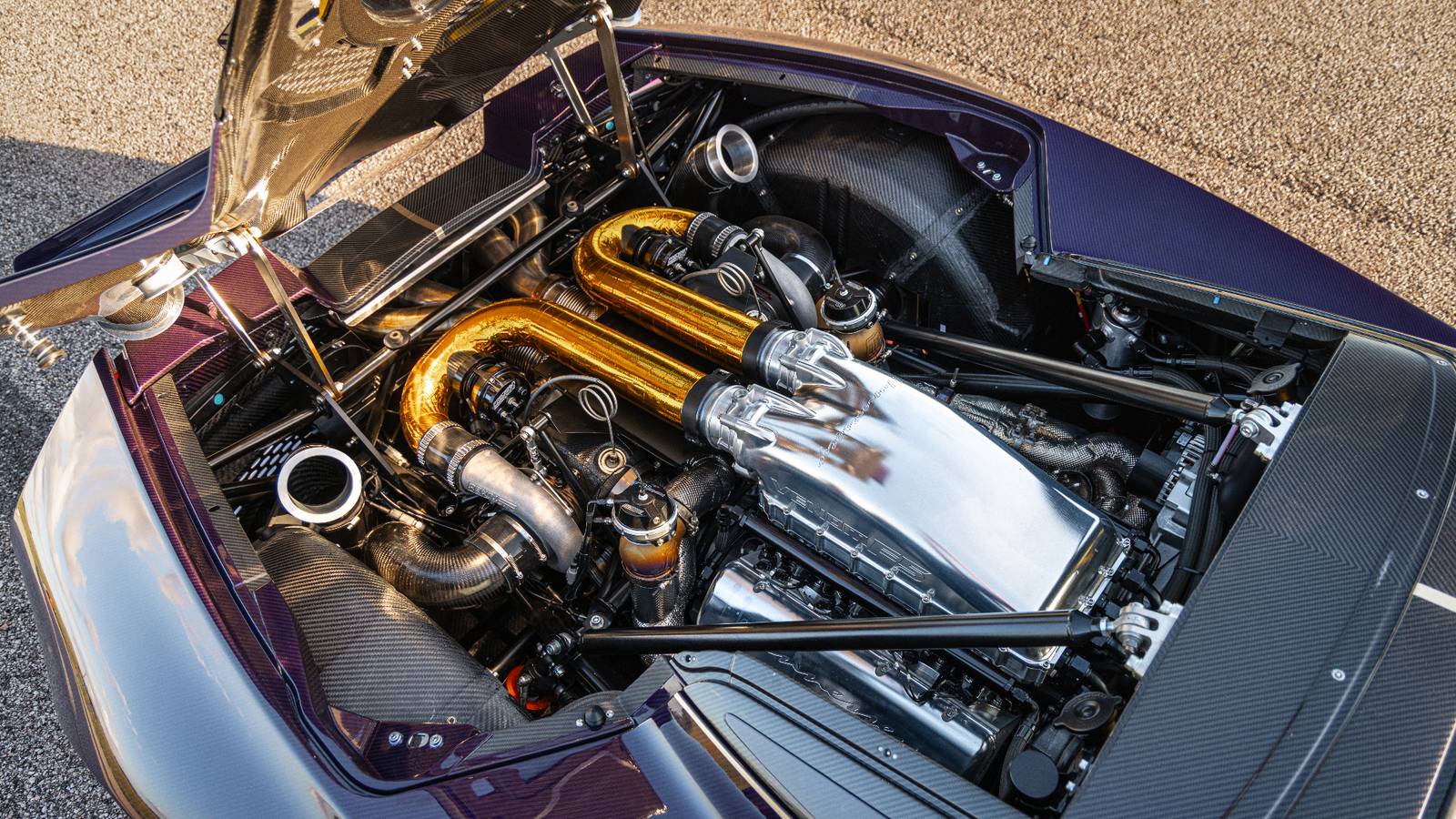
Three Pedals and 2,031 Horsepower: Inside the Glorious Insanity of Hennessey’s Manual Venom F5-M
In an era of sanitized, digitally-managed hypercars, Hennessey just dropped a twin-turbocharged V8 monster with a six-speed gated manual. It’s an act of magnificent, anachronistic engineering that questions the very definition of progress.
Let’s start with a number that defies easy comprehension: 2,031. That is the horsepower figure Hennessey Special Vehicles claims for its new Venom F5-M. It is an output derived from a 6.6-liter twin-turbocharged 'Fury' V8, an engine designed with the subtlety of a collapsing star. Now, consider the component tasked with channeling that biblical force to the rear wheels: a six-speed manual transmission, complete with a third pedal for your left foot and a metal-gated shifter for your right hand. In a world where even Ferrari is dabbling in ‘fake’ clutch pedals and the bleeding edge is defined by hybrid Le Mans prototypes like the Genesis GMR-001, Hennessey has made a deliberate, almost provocative choice. They have built what their own materials confirm is the “most powerful manual” car, a machine that forces the driver into a raw, mechanical partnership with more power than most grids at Silverstone’s Secret Meet can muster collectively.
The engineering audacity here cannot be overstated. Hypercar gearboxes are disposable assets, typically sequential paddle-shift units that are routinely rebuilt or replaced after being brutalized by far less power. Yet, Hennessey has not just dipped a toe in these waters. The new F5-M joins the 1,817-horsepower Venom F5-M Roadster, which also features a six-speed manual to wrangle its still-gargantuan 1,293 lb-ft of torque. The new coupe, however, escalates the stakes dramatically, adding another 200-plus horsepower to the equation. The central challenge is torque, the twisting force that annihilates clutches and shears gear teeth. To willingly mate a component defined by its physical linkage and human operation to an engine that produces this much fury is a statement of extreme confidence in your engineering, a defiant howl against the inexorable creep of digital intermediaries that define the modern performance car.The engineering audacity here cannot be overstated. Hypercar gearboxes are disposable assets, typically sequential paddle-shift units that are routinely rebuilt or replaced after being brutalized by far less power. Yet, Hennessey has not just dipped a toe in these waters. The new F5-M joins the 1,817-horsepower Venom F5-M Roadster, which also features a six-speed manual to wrangle its still-gargantuan 1,293 lb-ft of torque. The new coupe, however, escalates the stakes dramatically, adding another 200-plus horsepower to the equation. The central challenge is torque, the twisting force that annihilates clutches and shears gear teeth. To willingly mate a component defined by its physical linkage and human operation to an engine that produces this much fury is a statement of extreme confidence in your engineering, a defiant howl against the inexorable creep of digital intermediaries that define the modern performance car.
This commitment to analog engagement is more than just a contrarian marketing exercise; it’s a direct response to a very human desire for connection. Ask any enthusiast why a manual car feels more intense, and the answer, as one online forum contributor aptly put it, is the ability to “really rev up the engine to quite a high rpm before changing to another gear with the clutch.” This deliberate act of holding a gear, of feeling the engine build to its crescendo before physically slotting into the next ratio, is a core part of the thrill. It’s an experience that stands in stark contrast to the frictionless, and some would argue soulless, efficiency of dual-clutch transmissions or the unrelenting, single-gear thrust of electric hypercars like the Rimac Nevera—a machine celebrated for pushing the limits of what an EV can be. Hennessey, it seems, is equally dedicated to pushing limits, but their frontier is the very peak of the analog, internal-combustion experience.This commitment to analog engagement is more than just a contrarian marketing exercise; it’s a direct response to a very human desire for connection. Ask any enthusiast why a manual car feels more intense, and the answer, as one online forum contributor aptly put it, is the ability to “really rev up the engine to quite a high rpm before changing to another gear with the clutch.” This deliberate act of holding a gear, of feeling the engine build to its crescendo before physically slotting into the next ratio, is a core part of the thrill. It’s an experience that stands in stark contrast to the frictionless, and some would argue soulless, efficiency of dual-clutch transmissions or the unrelenting, single-gear thrust of electric hypercars like the Rimac Nevera—a machine celebrated for pushing the limits of what an EV can be. Hennessey, it seems, is equally dedicated to pushing limits, but their frontier is the very peak of the analog, internal-combustion experience.
Hennessey is not entirely alone on this frontier. In a move that sent shockwaves through the collecting world, Ferrari—the marque that pioneered and then all but mandated the F1-style paddle-shifter—has reintroduced a true manual option for its 2027 12Cilindri. This isn’t a mainstream production choice but a pointedly exclusive one, offered as a limited series of just 1,499 cars. According to NetCarShow.com, that specific number was chosen to recall the displacement of the very first Ferrari V12 built in 1947, explicitly linking the manual gearbox to the brand’s sacred origin story. When a company as forward-looking and historically ruthless with its product planning as Ferrari takes a step back to re-embrace its mechanical past, it signals a powerful shift in the ultra-high-end market. The most discerning clients aren't just buying speed anymore; they are buying an experience, and for a growing number, that experience involves three pedals.
The financial case is just as compelling as the emotional one. Historical data paints a vivid picture of a market that viciously rewards rarity and driver involvement. According to reports cited by DragTimes, less than 10% of Ferrari F430s sold in the U.S. were equipped with a manual gearbox. The result? A factory manual F430 can command a premium of nearly $100,000 over its F1 paddle-shift sibling. A reel from a car buying expert on Instagram reinforces this phenomenon, noting that for cars like the Ferrari 360 Modena, “most were built with the paddle-shift F1 gearbox, which collectors don't chase.” The truly desirable—and valuable—cars are the rare gated manual examples. Hennessey, a brand acutely aware of the hypercar ecosystem, is not just building a vehicle; it is consciously engineering a blue-chip collectible from the ground up, with the gated manual serving as its certificate of authenticity and future value.The financial case is just as compelling as the emotional one. Historical data paints a vivid picture of a market that viciously rewards rarity and driver involvement. According to reports cited by DragTimes, less than 10% of Ferrari F430s sold in the U.S. were equipped with a manual gearbox. The result? A factory manual F430 can command a premium of nearly $100,000 over its F1 paddle-shift sibling. A reel from a car buying expert on Instagram reinforces this phenomenon, noting that for cars like the Ferrari 360 Modena, “most were built with the paddle-shift F1 gearbox, which collectors don't chase.” The truly desirable—and valuable—cars are the rare gated manual examples. Hennessey, a brand acutely aware of the hypercar ecosystem, is not just building a vehicle; it is consciously engineering a blue-chip collectible from the ground up, with the gated manual serving as its certificate of authenticity and future value.
Of course, there is a reason the manual became an endangered species in the first place, especially at this performance level. As one Spanish-language analysis pointed out, “as power and torque increase, the classic manual begins to show its limits.” This is the physical reality that makes the Venom F5-M so perplexing and impressive. How did they solve it? The provided materials are long on horsepower figures and short on detailed transmission schematics, leaving us to speculate. Ferrari’s solution for the 12Cilindri, according to one source, is a clever workaround. It reportedly “just uses the first six gears of the DCT,” which eliminates the need to run complex physical shift linkages and cables throughout the car, a common and finicky part of traditional setups. It remains a mystery whether Hennessey has engineered a similar electronically-assisted but manually-actuated system or if they have genuinely built a gearbox and clutch pack from exotic, unobtanium materials capable of surviving 2,031 horsepower through brute mechanical strength. The answer itself is almost secondary; the achievement is in making it work at all.Of course, there is a reason the manual became an endangered species in the first place, especially at this performance level. As one Spanish-language analysis pointed out, “as power and torque increase, the classic manual begins to show its limits.” This is the physical reality that makes the Venom F5-M so perplexing and impressive. How did they solve it? The provided materials are long on horsepower figures and short on detailed transmission schematics, leaving us to speculate. Ferrari’s solution for the 12Cilindri, according to one source, is a clever workaround. It reportedly “just uses the first six gears of the DCT,” which eliminates the need to run complex physical shift linkages and cables throughout the car, a common and finicky part of traditional setups. It remains a mystery whether Hennessey has engineered a similar electronically-assisted but manually-actuated system or if they have genuinely built a gearbox and clutch pack from exotic, unobtanium materials capable of surviving 2,031 horsepower through brute mechanical strength. The answer itself is almost secondary; the achievement is in making it work at all.
Ultimately, the Venom F5-M is more than a car; it's a thesis. In a crowded field of high-performance machinery, from bespoke one-offs revealed at Monterey Car Week to the £500 million parades at England’s Secret Meet, differentiation is the final currency. By creating the world's most powerful manual car, Hennessey has crafted an identity that no spec sheet alone can capture. It is a defiant stand for visceral engagement, mechanical accountability, and the irreplaceable sensation of being an essential component, not a mere passenger, in the act of generating speed. It’s a bet that for the ultimate enthusiast, the true pinnacle of the automotive experience lies not in the perfection of automation, but in the heart-pounding challenge of mastering the machine. In the F5-M, that machine just happens to have the power of a small deity.Ultimately, the Venom F5-M is more than a car; it's a thesis. In a crowded field of high-performance machinery, from bespoke one-offs revealed at Monterey Car Week to the £500 million parades at England’s Secret Meet, differentiation is the final currency. By creating the world's most powerful manual car, Hennessey has crafted an identity that no spec sheet alone can capture. It is a defiant stand for visceral engagement, mechanical accountability, and the irreplaceable sensation of being an essential component, not a mere passenger, in the act of generating speed. It’s a bet that for the ultimate enthusiast, the true pinnacle of the automotive experience lies not in the perfection of automation, but in the heart-pounding challenge of mastering the machine. In the F5-M, that machine just happens to have the power of a small deity.
Gallery
"As power and torque increase, the classic manual begins to show its limits."
Why it matters
The Venom F5-M represents a powerful counter-narrative in the hypercar world, suggesting that peak driver engagement, not just autonomous speed, is the ultimate luxury. By engineering a manual transmission capable of handling over 2,000 horsepower, Hennessey makes a bold statement on the enduring value of analog mechanics and positions the car as an instant, blue-chip collectible.
Sources
- 1.
- 2.
- 3.
- 4.
- 5.Hennessey Venom F5-M (2027)netcarshow.com
- 6.
- 7.
- 8.
- 9.
- 10.Kingshiftfacebook.com
Reported by the Downforce & Divots desk from the sources above.
The clubhouse.
- No replies yet. Be the first.