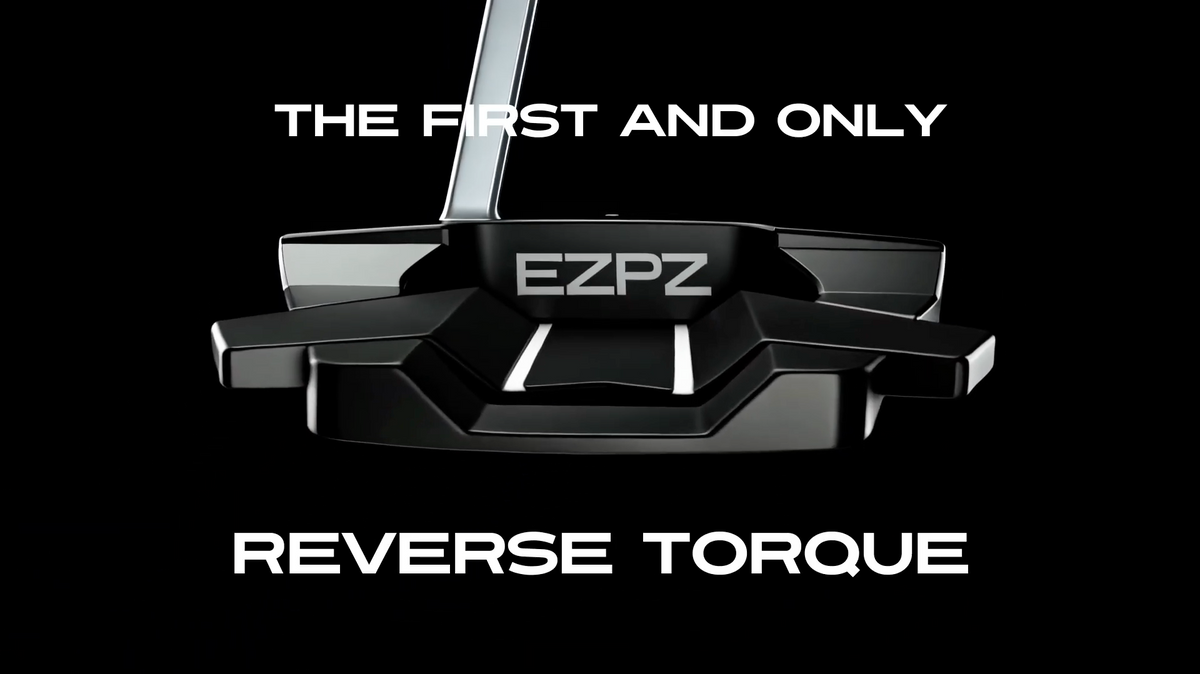
The Counter-Steer: Why Guerin Rife is Betting Against Golf’s Zero-Torque Revolution
While the equipment market rushes to eliminate face twist entirely, Evnroll's new EZPZ putter engineers a localized rebellion by introducing reverse-torque.
The current obsession in the golf equipment market is absolute neutrality. The industry buzzword is "zero-torque." Brands like L.A.B. Golf and Scotty Cameron are designing putters that refuse to twist, promising to keep the face perfectly square from the top of the backswing all the way through impact. The premise is seductive: less rotation equals more putts starting precisely on their intended line. But Guerin Rife, the veteran chief designer behind Evnroll, is staging a localized rebellion on the practice green. With the new Evnroll EZPZ reverse-torque putter, Rife has taken the exact opposite engineering bet. Rather than fighting physics to achieve a neutral balance point, he is intentionally engineering reverse-torque by dropping a staggering 60 percent of the putter's mass entirely below the shaft axis.The current obsession in the golf equipment market is absolute neutrality. The industry buzzword is "zero-torque." Brands like L.A.B. Golf and Scotty Cameron are designing putters that refuse to twist, promising to keep the face perfectly square from the top of the backswing all the way through impact. The premise is seductive: less rotation equals more putts starting precisely on their intended line. But Guerin Rife, the veteran chief designer behind Evnroll, is staging a localized rebellion on the practice green. With the new Evnroll EZPZ reverse-torque putter, Rife has taken the exact opposite engineering bet. Rather than fighting physics to achieve a neutral balance point, he is intentionally engineering reverse-torque by dropping a staggering 60 percent of the putter's mass entirely below the shaft axis.
For the uninitiated, the traditional putter fitting matrix has historically forced players into a binary choice between toe-hang and face-balanced designs. As fitting experts like those at Graves Golf point out, diagnosing whether a player needs toe-hang or a face-balanced mallet—alongside dialing in length, lie angle, and loft—is a riddle most amateur golfers cannot solve on their own. Both traditional styles demand the golfer actively manage face rotation through the stroke. Recently, zero-torque putters entered the chat to theoretically eliminate that human variable. Rife’s contrarian approach with the EZPZ argues that golfers actually need dynamic resistance to feel the clubhead, just in a completely reimagined direction.For the uninitiated, the traditional putter fitting matrix has historically forced players into a binary choice between toe-hang and face-balanced designs. As fitting experts like those at Graves Golf point out, diagnosing whether a player needs toe-hang or a face-balanced mallet—alongside dialing in length, lie angle, and loft—is a riddle most amateur golfers cannot solve on their own. Both traditional styles demand the golfer actively manage face rotation through the stroke. Recently, zero-torque putters entered the chat to theoretically eliminate that human variable. Rife’s contrarian approach with the EZPZ argues that golfers actually need dynamic resistance to feel the clubhead, just in a completely reimagined direction.
Ten years after introducing his original SweetFace technology to the golf world, Rife has equipped these new reverse-torque models with SweetFace 2.0. The updated design relies on a meticulously milled metal face combined with an exceptionally high Moment of Inertia (MOI). By anchoring the majority of the physical weight below the shaft axis, the EZPZ inherently wants to pull against the traditional opening of the face during the backswing. Instead of the putter fanning open and requiring a perfectly timed muscular closure by the hands, the reverse-torque setup naturally resists opening in the first place. The result is a remarkably soft feel at impact while maximizing distance control—a critical factor when the pressure mounts.Ten years after introducing his original SweetFace technology to the golf world, Rife has equipped these new reverse-torque models with SweetFace 2.0. The updated design relies on a meticulously milled metal face combined with an exceptionally high Moment of Inertia (MOI). By anchoring the majority of the physical weight below the shaft axis, the EZPZ inherently wants to pull against the traditional opening of the face during the backswing. Instead of the putter fanning open and requiring a perfectly timed muscular closure by the hands, the reverse-torque setup naturally resists opening in the first place. The result is a remarkably soft feel at impact while maximizing distance control—a critical factor when the pressure mounts.
The broader equipment industry is currently locked in an arms race of stabilization and predictability. Look at the top of the bag: Mizuno is churning out the Pro S-4 irons with subtle variations in its Signature line to give skilled players multi-year stability, finishing them in a glare-resistant White Satin Brush just to quiet the visual noise behind the ball. Golfers are desperately seeking consistency, aiming for less guessing and more options on the tee box. But in putting, as instructor Brendan Burns notes, the foundational elements for controlling face rotation are typically locked up in static fitting metrics like shaft length and lie angle. Rife is bypassing those static adjustments and directly attacking the dynamic physics of the stroke itself.The broader equipment industry is currently locked in an arms race of stabilization and predictability. Look at the top of the bag: Mizuno is churning out the Pro S-4 irons with subtle variations in its Signature line to give skilled players multi-year stability, finishing them in a glare-resistant White Satin Brush just to quiet the visual noise behind the ball. Golfers are desperately seeking consistency, aiming for less guessing and more options on the tee box. But in putting, as instructor Brendan Burns notes, the foundational elements for controlling face rotation are typically locked up in static fitting metrics like shaft length and lie angle. Rife is bypassing those static adjustments and directly attacking the dynamic physics of the stroke itself.
This engineering choice is the club design equivalent of counter-steering into a slide. The entire market is shouting that the putter face must be mechanically frozen by extreme balance points, pushing zero-torque as a foolproof panacea for the yips and pulled putts. Rife, who has spent decades studying how human hands interact with milled steel, recognizes that total mechanical neutrality can sometimes feel totally numb. Golfers are tactile creatures who rely on feedback. By engineering reverse-torque, Evnroll is giving the player's hands something tangible to work with—a subtle, gravitational assist that keeps the face stable without feeling like you are swinging a cinder block on a static pendulum.This engineering choice is the club design equivalent of counter-steering into a slide. The entire market is shouting that the putter face must be mechanically frozen by extreme balance points, pushing zero-torque as a foolproof panacea for the yips and pulled putts. Rife, who has spent decades studying how human hands interact with milled steel, recognizes that total mechanical neutrality can sometimes feel totally numb. Golfers are tactile creatures who rely on feedback. By engineering reverse-torque, Evnroll is giving the player's hands something tangible to work with—a subtle, gravitational assist that keeps the face stable without feeling like you are swinging a cinder block on a static pendulum.
Taking a massive swing against the prevailing zero-torque wind carries significant risk for Evnroll. The premium putting market is notoriously fickle, and convincing a player to abandon a trendy zero-torque Scotty Cameron or L.A.B. mallet for a reverse-torque concept requires fundamentally rewiring how they understand their own stroke mechanics. If the weight distribution is too aggressive, it risks fighting the player’s natural arc and creating tension in the forearms. But if Rife’s gravitational math is right, that 60-percent sub-axis mass will feel less like an aggressive intervention and more like an invisible guide track returning the metal milled face back to square.Taking a massive swing against the prevailing zero-torque wind carries significant risk for Evnroll. The premium putting market is notoriously fickle, and convincing a player to abandon a trendy zero-torque Scotty Cameron or L.A.B. mallet for a reverse-torque concept requires fundamentally rewiring how they understand their own stroke mechanics. If the weight distribution is too aggressive, it risks fighting the player’s natural arc and creating tension in the forearms. But if Rife’s gravitational math is right, that 60-percent sub-axis mass will feel less like an aggressive intervention and more like an invisible guide track returning the metal milled face back to square.
Ultimately, the proving ground for the EZPZ won't be a sterile launch monitor bay; it will be the tension-soaked final three feet on the 18th green. While the rest of the industry races to engineer the player out of the putting equation entirely, Rife’s latest design suggests that the human element shouldn't be erased—it just needs a better center of gravity. In a game increasingly dominated by those trying to build a perfectly sterile, twist-free machine, Evnroll is banking its future on a brilliantly calculated imbalance.Ultimately, the proving ground for the EZPZ won't be a sterile launch monitor bay; it will be the tension-soaked final three feet on the 18th green. While the rest of the industry races to engineer the player out of the putting equation entirely, Rife’s latest design suggests that the human element shouldn't be erased—it just needs a better center of gravity. In a game increasingly dominated by those trying to build a perfectly sterile, twist-free machine, Evnroll is banking its future on a brilliantly calculated imbalance.
Gallery
"While the rest of the industry races to engineer the player out of the putting equation entirely, Rife’s latest design suggests that the human element shouldn't be erased—it just needs a better center of gravity."
Why it matters
Putting mechanics have become an arms race of absolute neutrality, with brands heavily marketing zero-torque designs to freeze face rotation. Evnroll's bet on reverse-torque introduces a radical counter-philosophy, suggesting golfers need dynamic weight resistance—not deadened balance—to optimize feel and distance control.
Sources
- 1.
- 2.
- 3.
- 4.Evnroll EZPZ Reverse Torque Putter | Dick's Sporting Goodsdickssportinggoods.com
- 5.
- 6.
- 7.
- 8.
- 9.
- 10.
Reported by the Downforce & Divots desk from the sources above.
The clubhouse.
- No replies yet. Be the first.