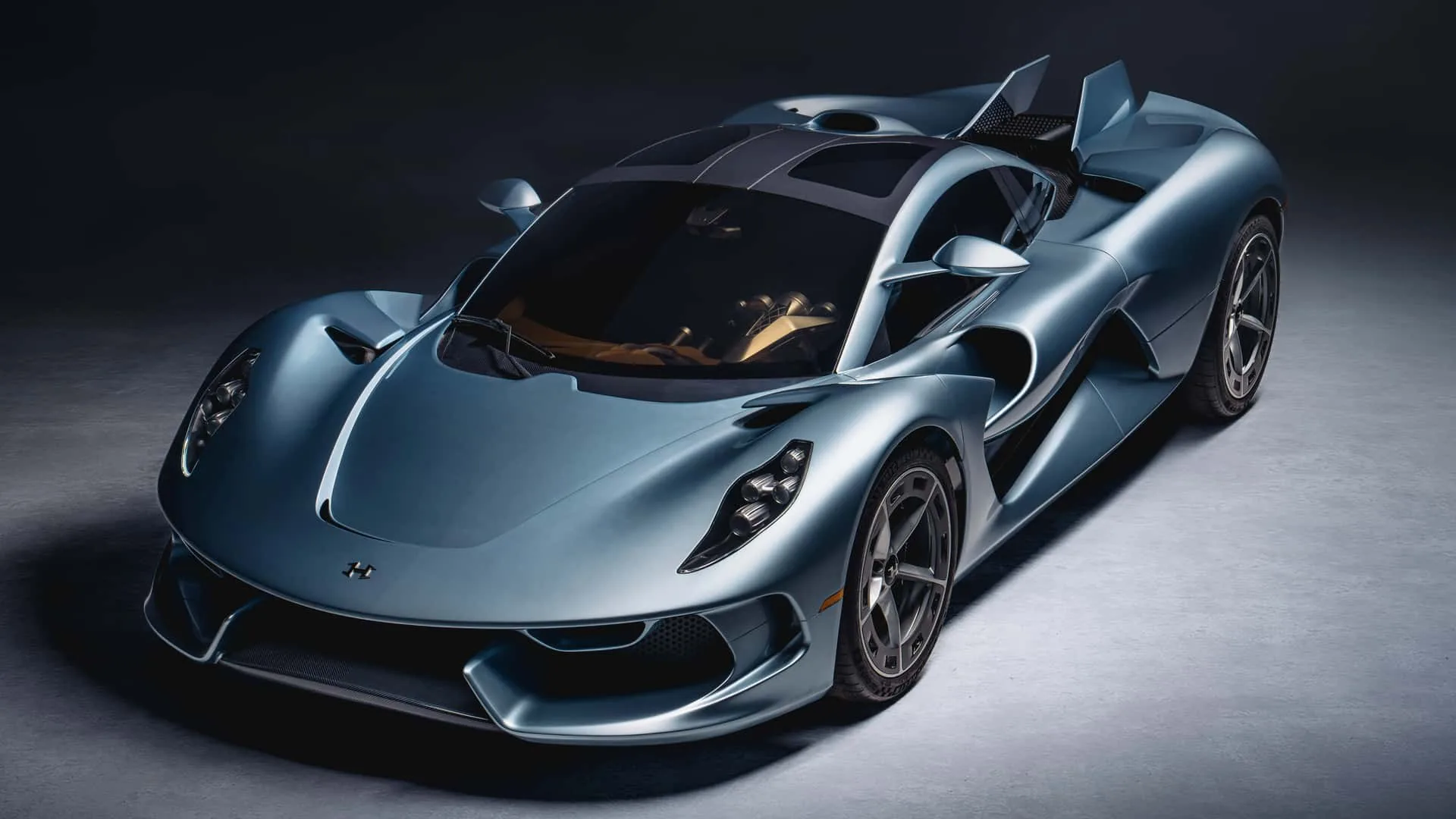
The 9,000 RPM Heart of Hennessey’s Blackbird Is Its Real Secret Weapon
Hennessey’s new $2.5 million hypercar is making waves for its analog-first philosophy, but the real story is the Ilmor-developed V8 at its core. This isn't just another engine; it's a statement of intent from a firm with deep motorsport royalty.
In an era defined by the silent surge of electrification and the whooshing complexity of hybridized turbocharging, the sound of a naturally aspirated V8 screaming past 9,000 rpm is an increasingly rare, almost defiant act. This is the sensory promise at the very core of the new Hennessey Blackbird, a machine whose headline figures—a projected 850 horsepower and a 220 mph top speed—are almost secondary to its mission. Unveiled during Monterey Car Week on August 3, 2026, the Blackbird is Hennessey’s third hypercar, but while its predecessors, the Venom GT and Venom F5, were exercises in ultimate velocity, this is something else entirely. The most telling detail isn’t the power figure or the price tag; it’s the name discreetly associated with its all-new 6.2-liter V8: Ilmor Engineering. For those who understand the brutal calculus of top-tier motorsport, that name changes everything. It elevates the Blackbird from a powerful Texan statement to a project with a world-class engineering pedigree.In an era defined by the silent surge of electrification and the whooshing complexity of hybridized turbocharging, the sound of a naturally aspirated V8 screaming past 9,000 rpm is an increasingly rare, almost defiant act. This is the sensory promise at the very core of the new Hennessey Blackbird, a machine whose headline figures—a projected 850 horsepower and a 220 mph top speed—are almost secondary to its mission. Unveiled during Monterey Car Week on August 3, 2026, the Blackbird is Hennessey’s third hypercar, but while its predecessors, the Venom GT and Venom F5, were exercises in ultimate velocity, this is something else entirely. The most telling detail isn’t the power figure or the price tag; it’s the name discreetly associated with its all-new 6.2-liter V8: Ilmor Engineering. For those who understand the brutal calculus of top-tier motorsport, that name changes everything. It elevates the Blackbird from a powerful Texan statement to a project with a world-class engineering pedigree.
The Blackbird’s brief is a masterclass in calculated rebellion. Hennessey officially calls it an exercise in 'Analog Overload,' a philosophy that strips away the digital interfaces that have come to dominate modern performance cars. According to the company's own release, the driver is met with zero screens, a suite of purely analog controls, and a physical key to initiate the proceedings. Dominating the dashboard is not a sprawling infotainment display, but a large central tachometer, a clear signal of the car’s priorities. This focus on engagement is reinforced by a six-speed gated manual transmission sending power exclusively to the rear wheels, a configuration designed for 'maximum man-machine connection.' This isn’t a stripped-out track toy, however. Hennessey positions the Blackbird as a 'touring-focused' hypercar, a machine with usable storage space and adaptive suspension intended to make long-distance journeys as thrilling as they are possible, a spiritual successor, as some have noted, to the legendary McLaren F1.
This dual-purpose identity is baked into its very structure. The Blackbird is built around an all-new bespoke carbon tub and wrapped in a carbon-fiber body, targeting a kerb weight below a featherlight 3,000 pounds. Its design is explicitly inspired by the Lockheed SR-71 Blackbird, a connection that goes deeper than the name. The car’s form features 'aerospace-led surfacing' and, most dramatically, active vertical stabilizers that evoke the iconic aircraft's twin tails. Yet for all its aggressive styling, its performance metrics are deliberately balanced. A projected 0-60 mph time of around 2.5 seconds is blisteringly quick, but in a world of sub-two-second EVs, it's clear Hennessey is not chasing headline statistics. Instead, the performance is a component of the experience, not the sole definition of it. The car has also been homologated for key global markets, a significant undertaking that signals Hennessey’s evolution from a purveyor of extreme speed to a mature, globally recognized vehicle manufacturer.This dual-purpose identity is baked into its very structure. The Blackbird is built around an all-new bespoke carbon tub and wrapped in a carbon-fiber body, targeting a kerb weight below a featherlight 3,000 pounds. Its design is explicitly inspired by the Lockheed SR-71 Blackbird, a connection that goes deeper than the name. The car’s form features 'aerospace-led surfacing' and, most dramatically, active vertical stabilizers that evoke the iconic aircraft's twin tails. Yet for all its aggressive styling, its performance metrics are deliberately balanced. A projected 0-60 mph time of around 2.5 seconds is blisteringly quick, but in a world of sub-two-second EVs, it's clear Hennessey is not chasing headline statistics. Instead, the performance is a component of the experience, not the sole definition of it. The car has also been homologated for key global markets, a significant undertaking that signals Hennessey’s evolution from a purveyor of extreme speed to a mature, globally recognized vehicle manufacturer.
To fully grasp the significance of the Blackbird, one must understand the gravity of the Ilmor partnership. The sources identify the firm as being 'of Indy car fame,' a descriptor that, while accurate, barely scratches the surface of its legacy. Founded by Mario Illien and Paul Morgan, Ilmor has been a dominant force in premier motorsport for decades, crafting the engines that have powered champions in the highest echelons of racing. Their name is synonymous with lightweight, high-revving, naturally-aspirated powerplants engineered to withstand the unimaginable stresses of endurance racing and oval combat. For Hennessey, a company that built its reputation on the sledgehammer force of turbocharging, to collaborate with Ilmor on a bespoke, high-revving, *naturally aspirated* V8 is a profound strategic pivot. It’s an admission that for this car, the quality of the horsepower matters more than the quantity, and that character, sound, and response are the ultimate metrics.To fully grasp the significance of the Blackbird, one must understand the gravity of the Ilmor partnership. The sources identify the firm as being 'of Indy car fame,' a descriptor that, while accurate, barely scratches the surface of its legacy. Founded by Mario Illien and Paul Morgan, Ilmor has been a dominant force in premier motorsport for decades, crafting the engines that have powered champions in the highest echelons of racing. Their name is synonymous with lightweight, high-revving, naturally-aspirated powerplants engineered to withstand the unimaginable stresses of endurance racing and oval combat. For Hennessey, a company that built its reputation on the sledgehammer force of turbocharging, to collaborate with Ilmor on a bespoke, high-revving, *naturally aspirated* V8 is a profound strategic pivot. It’s an admission that for this car, the quality of the horsepower matters more than the quantity, and that character, sound, and response are the ultimate metrics.
The engine itself is a testament to this philosophy. It’s not an off-the-shelf block with a new tune; it is an 'all-new Ilmor-developed' 6.2-liter V8, projected to spin freely beyond 9,000 rpm. An engine with such a stratospheric redline delivers a powerband and sonic signature fundamentally different from the forced-induction powerplants that dominate the current hypercar landscape. This stands in stark contrast to the direction of the wider performance world, where even top-flight endurance racers like Ferrari's 499P Hypercar, which competes in the FIA World Endurance Championship, rely on complex hybrid systems. The Blackbird is a deliberate counter-narrative. It champions a purist ideal, betting that 71 discerning buyers will find more value in the undiluted thrill of a screaming atmospheric V8 than in the silent, seamless torque-fill of an electric motor. The Ilmor heart is what makes this vision credible.The engine itself is a testament to this philosophy. It’s not an off-the-shelf block with a new tune; it is an 'all-new Ilmor-developed' 6.2-liter V8, projected to spin freely beyond 9,000 rpm. An engine with such a stratospheric redline delivers a powerband and sonic signature fundamentally different from the forced-induction powerplants that dominate the current hypercar landscape. This stands in stark contrast to the direction of the wider performance world, where even top-flight endurance racers like Ferrari's 499P Hypercar, which competes in the FIA World Endurance Championship, rely on complex hybrid systems. The Blackbird is a deliberate counter-narrative. It champions a purist ideal, betting that 71 discerning buyers will find more value in the undiluted thrill of a screaming atmospheric V8 than in the silent, seamless torque-fill of an electric motor. The Ilmor heart is what makes this vision credible.
This project represents what Hennessey calls its 'most significant engineering and development commitment to date.' Building a car from the ground up and ensuring it meets stringent global homologation standards is a monumental task, far removed from the company's tuning roots. The Blackbird, limited to just 71 units in a nod to its aeronautical namesake, is the vehicle for this transformation. With each chassis commanding a price of $2.5 million before taxes, the stakes are immense. By partnering with Ilmor, Hennessey is not just buying an engine; it's buying unimpeachable credibility. It tells the world that the heart of its most ambitious car yet was not merely assembled, but engineered by a firm with a championship-winning pedigree, placing it in the same conceptual league as creations from Gordon Murray Automotive or Pagani, where the engine is a bespoke jewel at the center of the experience.This project represents what Hennessey calls its 'most significant engineering and development commitment to date.' Building a car from the ground up and ensuring it meets stringent global homologation standards is a monumental task, far removed from the company's tuning roots. The Blackbird, limited to just 71 units in a nod to its aeronautical namesake, is the vehicle for this transformation. With each chassis commanding a price of $2.5 million before taxes, the stakes are immense. By partnering with Ilmor, Hennessey is not just buying an engine; it's buying unimpeachable credibility. It tells the world that the heart of its most ambitious car yet was not merely assembled, but engineered by a firm with a championship-winning pedigree, placing it in the same conceptual league as creations from Gordon Murray Automotive or Pagani, where the engine is a bespoke jewel at the center of the experience.
Imagine slipping into the driver’s seat. There are no screens to boot up, no menus to navigate. A physical key engages the electronics, and your focus is drawn to the quintet of analog dials. Your hand finds the cold metal of the gated shifter, a direct physical link to the Ilmor powertrain behind you. The experience is tactile, mechanical, and immediate. As the revs climb, the large central tachometer’s needle sweeps across the dial, a visual representation of the engine’s crescendo toward its 9,000-rpm-plus redline. This is the 'maximum man-machine connection' Hennessey speaks of—an experience rooted in sensory feedback, from the vibrations through the carbon chassis to the unfiltered shriek of the V8. It is a celebration of what many fear is a dying art form: the driver as an integral, essential component of a purely mechanical system.Imagine slipping into the driver’s seat. There are no screens to boot up, no menus to navigate. A physical key engages the electronics, and your focus is drawn to the quintet of analog dials. Your hand finds the cold metal of the gated shifter, a direct physical link to the Ilmor powertrain behind you. The experience is tactile, mechanical, and immediate. As the revs climb, the large central tachometer’s needle sweeps across the dial, a visual representation of the engine’s crescendo toward its 9,000-rpm-plus redline. This is the 'maximum man-machine connection' Hennessey speaks of—an experience rooted in sensory feedback, from the vibrations through the carbon chassis to the unfiltered shriek of the V8. It is a celebration of what many fear is a dying art form: the driver as an integral, essential component of a purely mechanical system.
With first customer deliveries planned for 2029, after production of the Venom F5 concludes, the Blackbird has a long road ahead. Its legacy, however, will be written the moment the first owners experience that Ilmor V8 at full song. The car is a monumental gamble for Hennessey, a bet that in an increasingly digitized world, the most coveted luxury is not complexity, but a profound, unfiltered, and deeply analog connection. It’s a bet on the enduring power of a high-revving engine and a manual gearbox to stir the soul. The Blackbird is not just an homage to a legendary aircraft; it’s a potential high-water mark for the hypercar as we know it, powered by an engine worthy of the ambition.With first customer deliveries planned for 2029, after production of the Venom F5 concludes, the Blackbird has a long road ahead. Its legacy, however, will be written the moment the first owners experience that Ilmor V8 at full song. The car is a monumental gamble for Hennessey, a bet that in an increasingly digitized world, the most coveted luxury is not complexity, but a profound, unfiltered, and deeply analog connection. It’s a bet on the enduring power of a high-revving engine and a manual gearbox to stir the soul. The Blackbird is not just an homage to a legendary aircraft; it’s a potential high-water mark for the hypercar as we know it, powered by an engine worthy of the ambition.
Gallery
"The brief is an exercise in 'Analog Overload'… created for drivers who value emotion, engagement, and maximum man-machine connection."
Why it matters
The Hennessey Blackbird represents a bold counter-movement in the hypercar space, rejecting digital complexity for analog engagement. Its partnership with legendary engine builder Ilmor Engineering signals a major step in Hennessey's evolution into a mature, globally recognized manufacturer, betting that a high-revving, naturally-aspirated V8 is the ultimate luxury in an electric age.
Sources
- 1.
- 2.
- 3.All-New Hennessey Blackbird Hypercar Revealedhennesseyspecialvehicles.com
- 4.
- 5.
- 6.
- 7.Hennessey Blackbird: 800+ HP NA V8, Manual, 71 Unitsbatmangarage.com
Reported by the Downforce & Divots desk from the sources above.
The clubhouse.
- No replies yet. Be the first.