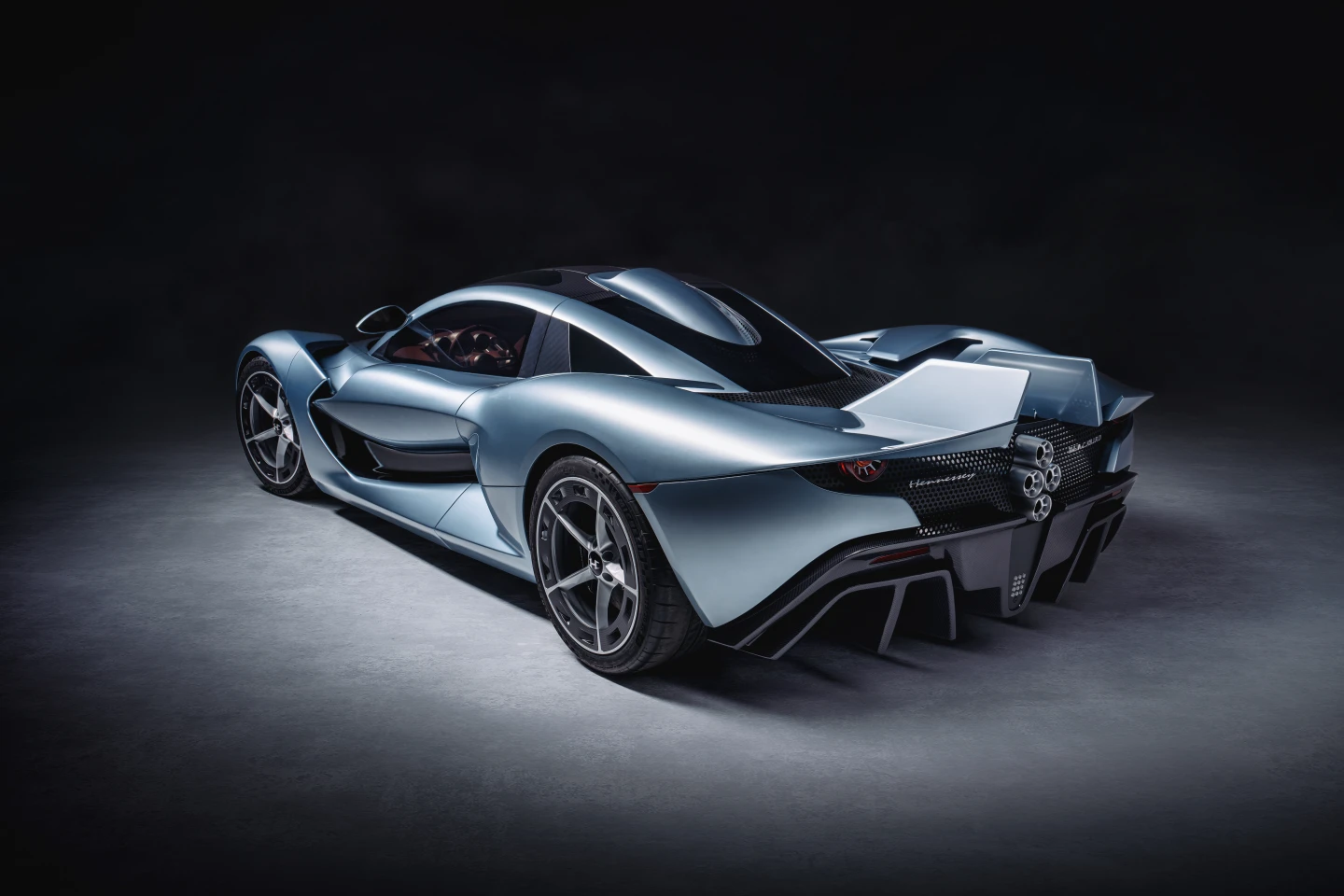
The 280-MPH Question: Inside Hennessey's Analogue Assault on the Hypercar Establishment
While the world’s legacy automakers chase hybrid complexity, Texas-based Hennessey is aiming for a 280-MPH ceiling with the 2,000-HP twin-turbo V8 ‘Blackbird.’ This is the deep story of how a boutique American shop is tackling the extreme aerodynamic and stability challenges that multi-billion dollar OEMs often avoid.
During the manicured pageantry of Monterey Car Week, amid a sea of pristine classics and electrified concepts, Hennessey Performance Engineering detonated a very different kind of statement. The newly unveiled Hennessey Blackbird is not a quiet nod to a hybrid future. Instead, it’s a chest-thumping declaration of internal combustion supremacy, an American-built missile [3] wrapped in carbon fiber [2] and powered by a gargantuan twin-turbo V8 producing a claimed 2,000 horsepower [4]. In an era where the hypercar conversation is dominated by the complex, electrified powertrains of the new ‘Holy Trinity’ from Porsche, Ferrari, and McLaren [3], Hennessey is making a colossal bet on brute force, targeting a top speed in excess of 280 MPH and a 0-60 mph time of around 1.8 seconds [4]. It’s a deliberately provocative move, a throwback philosophy executed with bleeding-edge numbers.During the manicured pageantry of Monterey Car Week, amid a sea of pristine classics and electrified concepts, Hennessey Performance Engineering detonated a very different kind of statement. The newly unveiled Hennessey Blackbird is not a quiet nod to a hybrid future. Instead, it’s a chest-thumping declaration of internal combustion supremacy, an American-built missile [3] wrapped in carbon fiber [2] and powered by a gargantuan twin-turbo V8 producing a claimed 2,000 horsepower [4]. In an era where the hypercar conversation is dominated by the complex, electrified powertrains of the new ‘Holy Trinity’ from Porsche, Ferrari, and McLaren [3], Hennessey is making a colossal bet on brute force, targeting a top speed in excess of 280 MPH and a 0-60 mph time of around 1.8 seconds [4]. It’s a deliberately provocative move, a throwback philosophy executed with bleeding-edge numbers.
The heart of the Blackbird is a staggering piece of engineering that both builds on and diverges from Hennessey’s previous triumphs. The firm’s preceding hypercar, the Venom F5, already rewrote expectations with its 6.6-liter twin-turbocharged ‘Fury’ V8, an engine that produces 1,817 horsepower in its most docile state and soars to 2,031 HP in the track-focused F5-M variant [2]. That car proved its mettle with a 0-186 mph sprint time of just 8.4 seconds for the coupe version [1]. Rather than simply inching those numbers forward, the Blackbird project appears to be a ground-up rethink of how to deploy even more extreme power. The headline figure of 2,000 HP from its own twin-turbo V8 [3] puts it at the absolute apex of production car power, posing an immense challenge: how to translate that volcanic force into stable, usable forward momentum, especially when chasing speeds north of 270 mph where the Venom F5 has already flown [2].The heart of the Blackbird is a staggering piece of engineering that both builds on and diverges from Hennessey’s previous triumphs. The firm’s preceding hypercar, the Venom F5, already rewrote expectations with its 6.6-liter twin-turbocharged ‘Fury’ V8, an engine that produces 1,817 horsepower in its most docile state and soars to 2,031 HP in the track-focused F5-M variant [2]. That car proved its mettle with a 0-186 mph sprint time of just 8.4 seconds for the coupe version [1]. Rather than simply inching those numbers forward, the Blackbird project appears to be a ground-up rethink of how to deploy even more extreme power. The headline figure of 2,000 HP from its own twin-turbo V8 [3] puts it at the absolute apex of production car power, posing an immense challenge: how to translate that volcanic force into stable, usable forward momentum, especially when chasing speeds north of 270 mph where the Venom F5 has already flown [2].
This machine is a calculated rejection of the digital comfort blanket enveloping modern performance. While its contemporaries, like the legendary McLaren P1, integrate sophisticated hybrid systems with their twin-turbo V8s [2], the Blackbird’s mission is fundamentally more visceral. Hennessey Director of Design, Nathan Malinick, admitted that the most expected route would have been a direct evolution of the F5 [2], but the company chose a different path. The Blackbird commits to an analogue-first ideology, channeling its colossal power through a rear-wheel-drive system and, most notably, a bespoke 6-speed gated manual transmission [8]. This is a car that demands a driver’s full attention, swapping the seamless, automated torque-fill of a hybrid for the mechanical satisfaction and high-stakes challenge of manually managing 2,000 horsepower. It’s a purpose-built experience for a select clientele who believe ultimate performance is measured not just in lap times, but in sweat and adrenaline.This machine is a calculated rejection of the digital comfort blanket enveloping modern performance. While its contemporaries, like the legendary McLaren P1, integrate sophisticated hybrid systems with their twin-turbo V8s [2], the Blackbird’s mission is fundamentally more visceral. Hennessey Director of Design, Nathan Malinick, admitted that the most expected route would have been a direct evolution of the F5 [2], but the company chose a different path. The Blackbird commits to an analogue-first ideology, channeling its colossal power through a rear-wheel-drive system and, most notably, a bespoke 6-speed gated manual transmission [8]. This is a car that demands a driver’s full attention, swapping the seamless, automated torque-fill of a hybrid for the mechanical satisfaction and high-stakes challenge of manually managing 2,000 horsepower. It’s a purpose-built experience for a select clientele who believe ultimate performance is measured not just in lap times, but in sweat and adrenaline.
For a boutique Texan manufacturer to credibly target a 280-MPH top speed, the primary challenge shifts from power generation to aerodynamic stability and structural integrity—the science of aero-elasticity. At such velocities, the air moving over the car exerts titanic forces that can deform body panels, upsetting airflow and potentially leading to catastrophic instability. The Blackbird’s extensive use of carbon fiber for its chassis and bodywork, a strategy carried over from the Venom F5 [2], is non-negotiable. This provides the immense structural rigidity required to maintain the car's carefully sculpted shape under extreme aerodynamic load. While global OEMs spend billions in proprietary wind tunnels perfecting these characteristics, Hennessey must achieve a similar level of stability with a fraction of the resources, relying on computational fluid dynamics (CFD) and a deep, focused understanding of high-speed airflow management.For a boutique Texan manufacturer to credibly target a 280-MPH top speed, the primary challenge shifts from power generation to aerodynamic stability and structural integrity—the science of aero-elasticity. At such velocities, the air moving over the car exerts titanic forces that can deform body panels, upsetting airflow and potentially leading to catastrophic instability. The Blackbird’s extensive use of carbon fiber for its chassis and bodywork, a strategy carried over from the Venom F5 [2], is non-negotiable. This provides the immense structural rigidity required to maintain the car's carefully sculpted shape under extreme aerodynamic load. While global OEMs spend billions in proprietary wind tunnels perfecting these characteristics, Hennessey must achieve a similar level of stability with a fraction of the resources, relying on computational fluid dynamics (CFD) and a deep, focused understanding of high-speed airflow management.
One of the most telling details of Hennessey’s aerodynamic strategy is found at the rear of the car. A key source notes that the specific placement of the Blackbird's rear central exhaust is engineered to directly influence the performance of the rear wing and diffuser by channeling high-energy gas flow over these critical surfaces [7]. This is an advanced technique, effectively creating a form of active, thrust-driven aerodynamics. The superheated, high-velocity exhaust gases can energize the boundary layer of air, helping it stay attached to the wing and diffuser for longer, which can dramatically increase downforce. However, it's a high-risk, high-reward approach. If the flow isn't managed with absolute precision, it could induce turbulence and create instability precisely where it’s least wanted. Mastering this interaction is a clear indicator of the sophisticated engineering happening in Sealy, Texas.One of the most telling details of Hennessey’s aerodynamic strategy is found at the rear of the car. A key source notes that the specific placement of the Blackbird's rear central exhaust is engineered to directly influence the performance of the rear wing and diffuser by channeling high-energy gas flow over these critical surfaces [7]. This is an advanced technique, effectively creating a form of active, thrust-driven aerodynamics. The superheated, high-velocity exhaust gases can energize the boundary layer of air, helping it stay attached to the wing and diffuser for longer, which can dramatically increase downforce. However, it's a high-risk, high-reward approach. If the flow isn't managed with absolute precision, it could induce turbulence and create instability precisely where it’s least wanted. Mastering this interaction is a clear indicator of the sophisticated engineering happening in Sealy, Texas.
Ultimately, the fantasies of 2,000 horsepower and advanced aerodynamics are rendered moot by the four small patches of rubber connecting the car to the pavement. For a rear-wheel-drive car of this caliber, the choice of tire is as critical as the engine itself. The Blackbird will rely on ultra-high-performance semi-slick tires like the Michelin Pilot Sport Cup 2 R, a piece of rubber described as the pinnacle of road-legal track tire technology [5]. Developed with insights from Michelin’s top-tier motorsports programs, this tire is designed for one thing: maximum dry grip [5]. The sheer violence of launching a 2,000 HP car, let alone keeping it stable at over 250 mph, places demands on a tire that few compounds can withstand. The investment is significant, with individual tires in this category costing anywhere from $411 to over $935 [6], but it is an essential component for taming the Blackbird’s power and achieving its audacious performance goals.Ultimately, the fantasies of 2,000 horsepower and advanced aerodynamics are rendered moot by the four small patches of rubber connecting the car to the pavement. For a rear-wheel-drive car of this caliber, the choice of tire is as critical as the engine itself. The Blackbird will rely on ultra-high-performance semi-slick tires like the Michelin Pilot Sport Cup 2 R, a piece of rubber described as the pinnacle of road-legal track tire technology [5]. Developed with insights from Michelin’s top-tier motorsports programs, this tire is designed for one thing: maximum dry grip [5]. The sheer violence of launching a 2,000 HP car, let alone keeping it stable at over 250 mph, places demands on a tire that few compounds can withstand. The investment is significant, with individual tires in this category costing anywhere from $411 to over $935 [6], but it is an essential component for taming the Blackbird’s power and achieving its audacious performance goals.
The Blackbird, named in a clear homage to the legendary SR-71 spy plane [8], is more than just a new model; it's the continuation of a narrative. With the Venom F5, Hennessey proved that 'smaller manufacturers without decades of proven success can still arrive and disrupt the industry' [2]. The Blackbird doubles down on this identity as an American disruptor. In a world where legacy European brands like McLaren, Porsche, and Ferrari are often seen as the arbiters of hypercar status [3], this 'Built in America' [3] machine is a direct challenge to the established order. It eschews the 'Holy Trinity' formula for a philosophy born from American muscle car culture but executed with hyper-advanced technology, aiming to beat the establishment at its own game of ultimate speed.The Blackbird, named in a clear homage to the legendary SR-71 spy plane [8], is more than just a new model; it's the continuation of a narrative. With the Venom F5, Hennessey proved that 'smaller manufacturers without decades of proven success can still arrive and disrupt the industry' [2]. The Blackbird doubles down on this identity as an American disruptor. In a world where legacy European brands like McLaren, Porsche, and Ferrari are often seen as the arbiters of hypercar status [3], this 'Built in America' [3] machine is a direct challenge to the established order. It eschews the 'Holy Trinity' formula for a philosophy born from American muscle car culture but executed with hyper-advanced technology, aiming to beat the establishment at its own game of ultimate speed.
The stakes for the Hennessey Blackbird are, therefore, stratospherically high. It represents a bet that in an increasingly electrified and automated automotive landscape, there remains a powerful demand for raw, unadulterated, and mechanically engaging performance. It’s a test of whether a small, focused team can master the brutal physics of 280+ MPH better than the giants of the industry. Success will mean cementing Hennessey’s place not just as a tuner, but as a world-class creator of automotive legends. Failure would be a spectacular, high-horsepower footnote. The world will be watching to see if this audacious, twin-turbocharged American dream can defy the hybrid consensus and fly.The stakes for the Hennessey Blackbird are, therefore, stratospherically high. It represents a bet that in an increasingly electrified and automated automotive landscape, there remains a powerful demand for raw, unadulterated, and mechanically engaging performance. It’s a test of whether a small, focused team can master the brutal physics of 280+ MPH better than the giants of the industry. Success will mean cementing Hennessey’s place not just as a tuner, but as a world-class creator of automotive legends. Failure would be a spectacular, high-horsepower footnote. The world will be watching to see if this audacious, twin-turbocharged American dream can defy the hybrid consensus and fly.
Gallery
"Smaller manufacturers without decades of proven success can still arrive and disrupt the industry."
Why it matters
The Hennessey Blackbird represents a major philosophical counterpoint in the hypercar market. Instead of following the trend of hybrid-electric complexity set by Europe's 'Holy Trinity,' it champions extreme, analogue performance with a 2,000-HP twin-turbo V8 and a manual gearbox. Its success or failure will signal whether this brute-force, driver-focused approach has a future at the pinnacle of automotive engineering.
Sources
- 1.
- 2.
- 3.New Holy Trinity Carstiktok.com
- 4.
- 5.
- 6.
- 7.
- 8.Michelin Pilot Sport Cup 2 R Review: Track-Ready Tires That ...thetirereviews.us
- 9.Michelin Pilot Sport Cup 2 R Tires Online & In-store Near Youadvantagetireor.com
- 10.Why is Hennessey building an analogue hypercar?facebook.com
Reported by the Downforce & Divots desk from the sources above.
The clubhouse.
- No replies yet. Be the first.