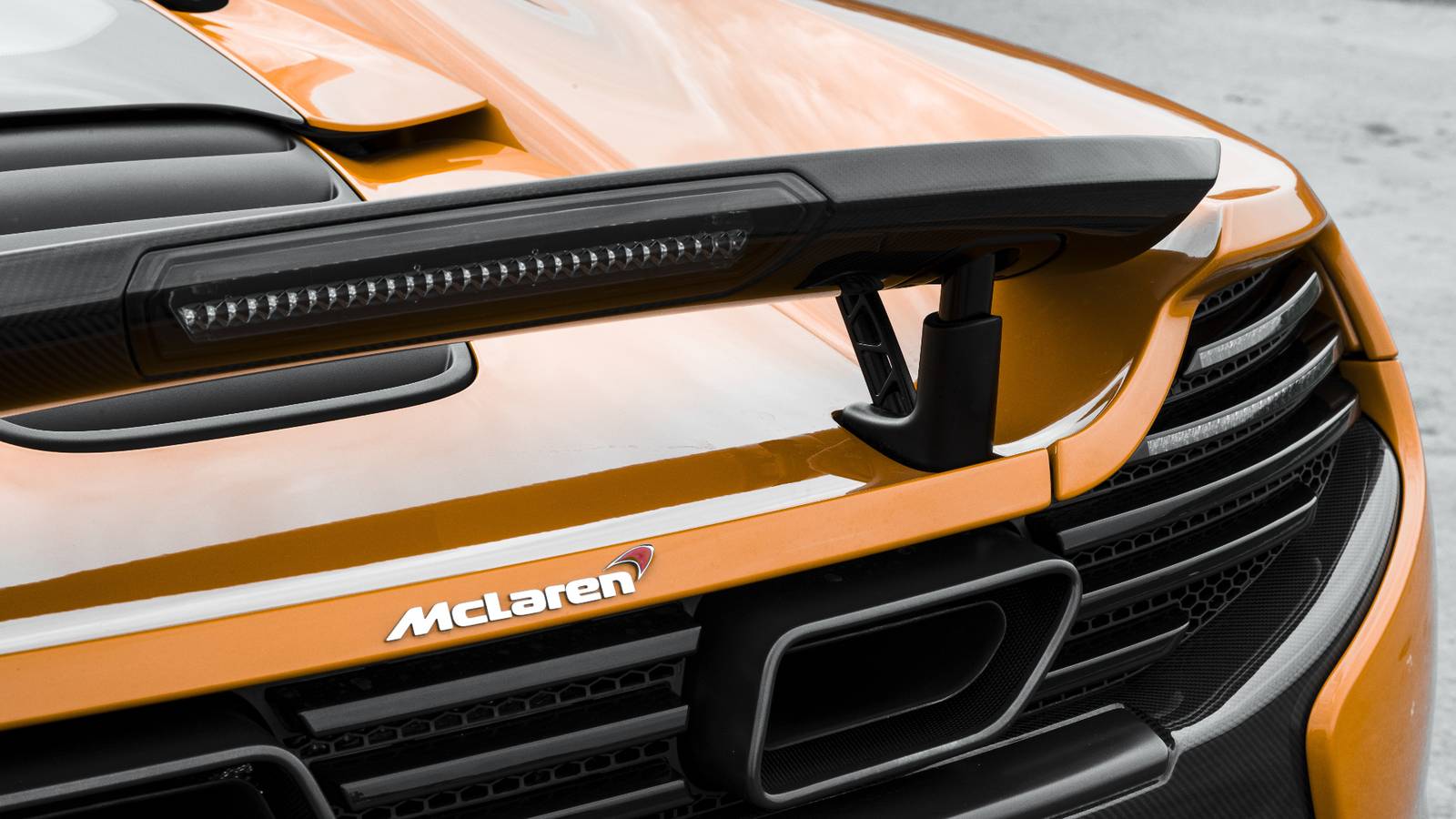
The $130,000 Question: Why McLaren’s 207-MPH 650S Depreciated Into Porsche 911 Territory
It features a carbon-fiber tub, dihedral doors, and 641 horsepower. So why does a British supercar with hypercar DNA now cost the exact same as a base-model German sports car? The answer lies in the terrifying economics of mechanical anxiety.
The air in Carmel during Monterey Car Week is historically thick with the scent of unburnt hydrocarbons and unbothered capital. As noted by CarSpex, the sight of a McLaren P1 idling on Highway 1 serves as the ultimate automotive flex, showcasing what remains one of the defining hypercars of its generation. Yet, while the automotive aristocracy chases those rare, multi-million-dollar unicorns along the Pacific coast, a far more compelling financial anomaly is quietly unfolding further down the secondary market food chain. The McLaren 650S—a 641-horsepower, carbon-tub marvel capable of a blistering 207 mph—has depreciated directly into the crosshairs of Stuttgart’s most ubiquitous product. Today, you can acquire this mid-engine British ballistic missile for roughly $137,000, which, as CarBuzz points out, is exactly what it takes to drive home in a brand-new, base-model Porsche 911 Carrera. It is a valuation that fundamentally breaks the established math of supercar ownership.The air in Carmel during Monterey Car Week is historically thick with the scent of unburnt hydrocarbons and unbothered capital. As noted by CarSpex, the sight of a McLaren P1 idling on Highway 1 serves as the ultimate automotive flex, showcasing what remains one of the defining hypercars of its generation. Yet, while the automotive aristocracy chases those rare, multi-million-dollar unicorns along the Pacific coast, a far more compelling financial anomaly is quietly unfolding further down the secondary market food chain. The McLaren 650S—a 641-horsepower, carbon-tub marvel capable of a blistering 207 mph—has depreciated directly into the crosshairs of Stuttgart’s most ubiquitous product. Today, you can acquire this mid-engine British ballistic missile for roughly $137,000, which, as CarBuzz points out, is exactly what it takes to drive home in a brand-new, base-model Porsche 911 Carrera. It is a valuation that fundamentally breaks the established math of supercar ownership.
To understand how a bona fide exotic slips into entry-level sports car territory, one must first examine the hardware at the heart of its steep depreciation curve. The 650S is propelled by the M838T, McLaren’s long-serving 3.8-litre twin-turbo V8. When analyzing the modern classic market, Hagerty’s recent data poses a provocative question to prospective buyers: “Why no turbo Ferrari V8?” The answer, they cheekily suggest, is because “McLaren might have done it better.” The engineers in Woking crafted a masterpiece of forced induction, a powertrain that delivers its fury with a clinical, almost aerospace-grade precision. Yet, despite this widely acknowledged engineering triumph, the sheer mechanical complexity of maintaining a bespoke, low-volume British twin-turbo V8 has cast a long, chilling shadow over its secondary market appeal.To understand how a bona fide exotic slips into entry-level sports car territory, one must first examine the hardware at the heart of its steep depreciation curve. The 650S is propelled by the M838T, McLaren’s long-serving 3.8-litre twin-turbo V8. When analyzing the modern classic market, Hagerty’s recent data poses a provocative question to prospective buyers: “Why no turbo Ferrari V8?” The answer, they cheekily suggest, is because “McLaren might have done it better.” The engineers in Woking crafted a masterpiece of forced induction, a powertrain that delivers its fury with a clinical, almost aerospace-grade precision. Yet, despite this widely acknowledged engineering triumph, the sheer mechanical complexity of maintaining a bespoke, low-volume British twin-turbo V8 has cast a long, chilling shadow over its secondary market appeal.
This pricing reality stands in stark contrast to the mythological status of McLaren’s legacy models, which have completely detached from the mortal economy to become asset-class investments. Consider the original McLaren F1. Equipped with a naturally aspirated 6.1-liter V12 and capable of annihilating the 0-60 mph sprint in 3.2 seconds, it was considered an exorbitant $815,000 gamble when new. Today, as market watchers at CarBuzz highlight, those same chassis are worth over $20 million and rarely trade hands in public without the involvement of elite auction houses. The 650S shares a spiritual bloodline with the F1 and a literal carbon-fiber tub architecture with the generation-defining P1, yet it finds itself punished by a modern market that views aging contemporary exotics not as blue-chip investments, but as rapidly depreciating liabilities.
The core of this liability lies in the terrifying, unquantifiable specter of maintenance—an issue Hagerty explicitly flags when discussing the "reliability" of these high-powered modern classics. Unlike the analog supercars of the 1990s, the 650S is essentially a rolling server farm governed by complex hydraulics and intricate software. The interconnected hydraulic suspension system that gives the car its legendary ride quality on the street and stiffness on the track is simultaneously a source of existential dread for second and third owners fearing accumulator failures. When CarBuzz declares that the 650S is "hypercar fast" but "costs the same as a base 911," the underlying truth is that the $130,000 entry price is merely the ante in a high-stakes game of mechanical roulette. Buyers aren't just pricing in the physical car; they are preemptively pricing in the potential for catastrophic five-figure service invoices.The core of this liability lies in the terrifying, unquantifiable specter of maintenance—an issue Hagerty explicitly flags when discussing the "reliability" of these high-powered modern classics. Unlike the analog supercars of the 1990s, the 650S is essentially a rolling server farm governed by complex hydraulics and intricate software. The interconnected hydraulic suspension system that gives the car its legendary ride quality on the street and stiffness on the track is simultaneously a source of existential dread for second and third owners fearing accumulator failures. When CarBuzz declares that the 650S is "hypercar fast" but "costs the same as a base 911," the underlying truth is that the $130,000 entry price is merely the ante in a high-stakes game of mechanical roulette. Buyers aren't just pricing in the physical car; they are preemptively pricing in the potential for catastrophic five-figure service invoices.
Beyond the very real fears of maintenance, there is also the broader cultural inflation of horsepower that has diluted the shock value of a 600-plus-horsepower exotic. To grasp how drastically the power landscape has shifted, one only needs to look at what General Motors is preparing for its commercial consumer base. According to AutoGuide, GM is unleashing a clean-sheet 8.3-liter Duramax turbo-diesel V8 for its 2027 Chevrolet Silverado HD and GMC Sierra HD lineup. This commercial-grade behemoth is engineered from the ground up to produce 555 horsepower and a tectonic 1,230 lb-ft of torque. When suburban tow rigs and heavy-duty work trucks are rolling off the assembly line with mid-500 horsepower figures that would have terrified a Group B rally driver, the raw numerical advantage of a decade-old British supercar loses some of its mystical aura in the broader marketplace, fundamentally altering what buyers will pay a premium for.Beyond the very real fears of maintenance, there is also the broader cultural inflation of horsepower that has diluted the shock value of a 600-plus-horsepower exotic. To grasp how drastically the power landscape has shifted, one only needs to look at what General Motors is preparing for its commercial consumer base. According to AutoGuide, GM is unleashing a clean-sheet 8.3-liter Duramax turbo-diesel V8 for its 2027 Chevrolet Silverado HD and GMC Sierra HD lineup. This commercial-grade behemoth is engineered from the ground up to produce 555 horsepower and a tectonic 1,230 lb-ft of torque. When suburban tow rigs and heavy-duty work trucks are rolling off the assembly line with mid-500 horsepower figures that would have terrified a Group B rally driver, the raw numerical advantage of a decade-old British supercar loses some of its mystical aura in the broader marketplace, fundamentally altering what buyers will pay a premium for.
This brings us back to the psychological battleground of the $137,000 price point and the inevitable comparison to the base Porsche 911 Carrera. Purchasing a new 911 is an exercise in clinical risk mitigation. You receive a factory warranty, a historically predictable depreciation schedule, and the ironclad guarantee that the car will start every single time you turn the key. Opting for the 650S at the same price point is an exercise in unadulterated automotive hedonism. As CarBuzz succinctly frames the dilemma, the 650S is "the ultimate $130,000 supercar," offering true hypercar acceleration for the price of a daily drivable German commuter. The market's current valuation reflects a deep-seated anxiety among enthusiasts: the collective belief that the visceral thrill of dihedral doors and a carbon monocoque cannot offset the sleepless nights brought on by an illuminated check-engine light.This brings us back to the psychological battleground of the $137,000 price point and the inevitable comparison to the base Porsche 911 Carrera. Purchasing a new 911 is an exercise in clinical risk mitigation. You receive a factory warranty, a historically predictable depreciation schedule, and the ironclad guarantee that the car will start every single time you turn the key. Opting for the 650S at the same price point is an exercise in unadulterated automotive hedonism. As CarBuzz succinctly frames the dilemma, the 650S is "the ultimate $130,000 supercar," offering true hypercar acceleration for the price of a daily drivable German commuter. The market's current valuation reflects a deep-seated anxiety among enthusiasts: the collective belief that the visceral thrill of dihedral doors and a carbon monocoque cannot offset the sleepless nights brought on by an illuminated check-engine light.
Yet, for the brave few willing to underwrite the running costs, the current market dynamics present an unprecedented and highly compelling opportunity. Hagerty’s analysis of modern classics with 400-plus horsepower indicates that we are in a transitional phase for vehicles powered by the M838T engine and its successors. The 650S is currently stranded in the valuation purgatory between "depreciating used car" and "appreciated modern classic." It is a specific window in time where the initial hype has faded, the early adopters have moved on to the latest hybrid exotics, and the long-term collectors haven't yet begun hoarding them in climate-controlled Carmel garages next to their multi-million-dollar P1s. It is an inflection point where intrinsic performance value vastly outweighs the current asking price.Yet, for the brave few willing to underwrite the running costs, the current market dynamics present an unprecedented and highly compelling opportunity. Hagerty’s analysis of modern classics with 400-plus horsepower indicates that we are in a transitional phase for vehicles powered by the M838T engine and its successors. The 650S is currently stranded in the valuation purgatory between "depreciating used car" and "appreciated modern classic." It is a specific window in time where the initial hype has faded, the early adopters have moved on to the latest hybrid exotics, and the long-term collectors haven't yet begun hoarding them in climate-controlled Carmel garages next to their multi-million-dollar P1s. It is an inflection point where intrinsic performance value vastly outweighs the current asking price.
Ultimately, the rapid depreciation of the McLaren 650S into the exact financial territory of a base Porsche 911 is a profound testament to how the modern supercar market prices peace of mind. Staggering performance metrics—like 207-mph top speeds and 641 horsepower—are no longer enough to insulate a vehicle from the brutal realities of maintenance anxiety in the secondary market. But for the driving purist who values steering feel, carbon-fiber rigidity, and the violent rush of a turbocharged V8 over the sanitized safety of a dealership warranty, this market anomaly is a rare gift. The $137,000 question isn't whether the McLaren 650S is objectively worth the money; it's whether the driver has the financial and emotional nerve to embrace the chaos.Ultimately, the rapid depreciation of the McLaren 650S into the exact financial territory of a base Porsche 911 is a profound testament to how the modern supercar market prices peace of mind. Staggering performance metrics—like 207-mph top speeds and 641 horsepower—are no longer enough to insulate a vehicle from the brutal realities of maintenance anxiety in the secondary market. But for the driving purist who values steering feel, carbon-fiber rigidity, and the violent rush of a turbocharged V8 over the sanitized safety of a dealership warranty, this market anomaly is a rare gift. The $137,000 question isn't whether the McLaren 650S is objectively worth the money; it's whether the driver has the financial and emotional nerve to embrace the chaos.
Gallery
"When a car is 'hypercar fast' but trades for $130,000, the entry price is merely the ante in a high-stakes game of mechanical roulette."
Why it matters
The secondary market valuation of the McLaren 650S highlights a crucial shift in supercar economics. Buyers are increasingly weighing raw horsepower and exotic lineage against the existential dread of out-of-warranty maintenance, fundamentally altering what defines value in the modern enthusiast landscape.
Sources
- 1.CarSpex - Facebookfacebook.com
- 2.
- 3.
- 4.5 Things You Need to Know About GM's All-New 8.3L V8autoguide.com
- 5.
Reported by the Downforce & Divots desk from the sources above.
The clubhouse.
- No replies yet. Be the first.