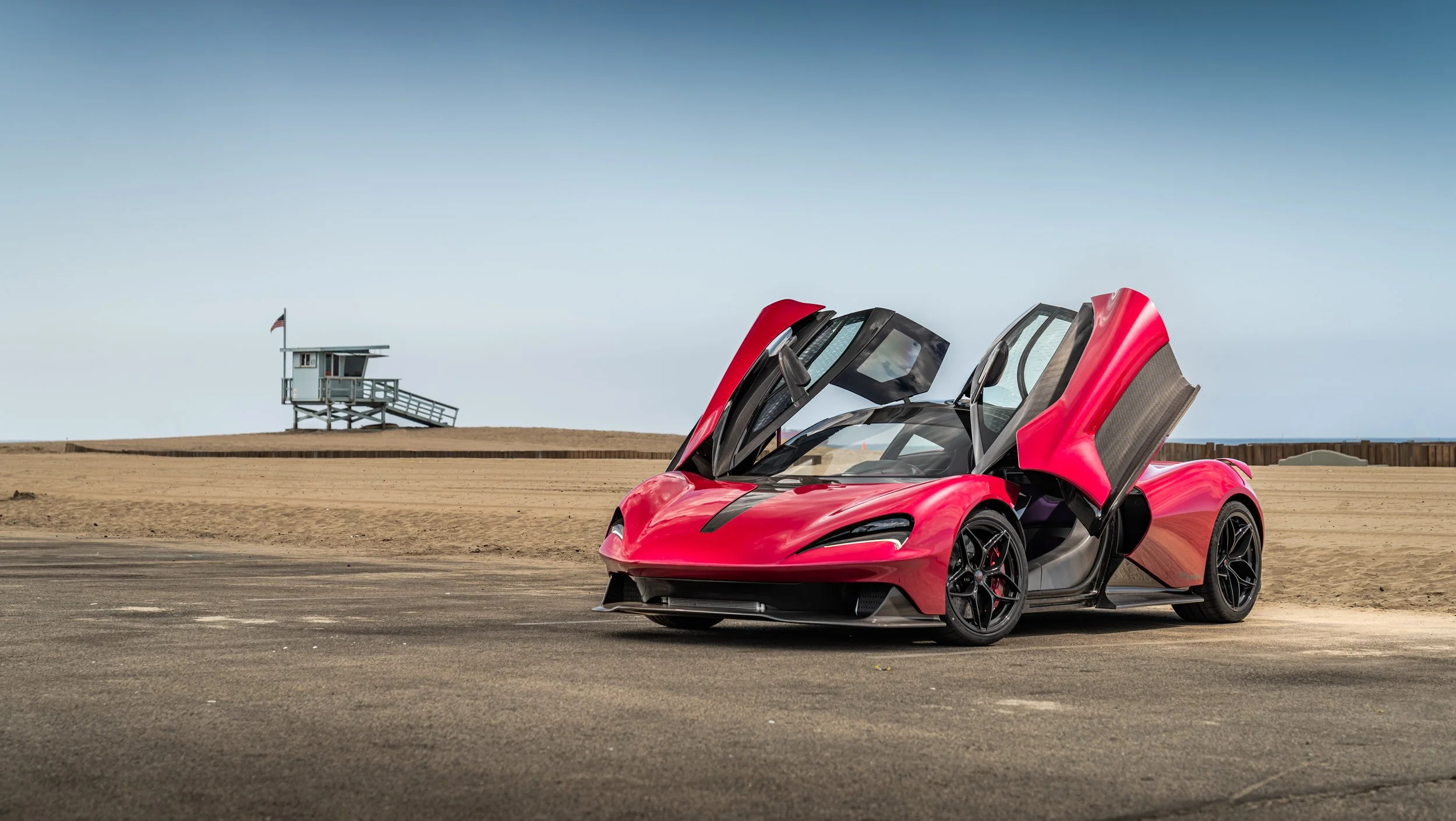
Out of the Shadows: How Lanzante’s 95-59 Reinvents the British Hypercar
After decades of transforming McLaren's most extreme track weapons for the street, the legendary British outfit is stepping into the spotlight with its first standalone machine. But as Lanzante looks to its 1995 Le Mans glory, McLaren itself is plotting a massive 2027 factory return to the legendary circuit.
For decades, the name Lanzante has been spoken in hushed, reverent tones within the ultra-exclusive enclaves of automotive collecting. The British bespoke supercar specialist built its legend not by manufacturing its own chassis from the ground up, but by applying dark, mechanical arts to the rarest machines on earth. They are the maestros famously responsible for converting track-only icons like the McLaren F1 GTR and the P1 LM for street duty, a process that requires an intimate understanding of both raw prototype performance and road-going homologation. But this week, the tuning outfit shattered its own long-established mold. As confirmed by recent social media drops that have quite literally taken the internet by storm, Lanzante has finally stepped out of the modification business and into the blinding, unforgiving light of bespoke manufacturing. Their weapon of choice is the newly unveiled 95-59, the brand's very first standalone, ground-up hypercar. It is a machine whose very nomenclature serves as a mission statement, drawing directly from the team's historic 1995 Le Mans overall victory with the legendary car #59.
The significance of that specific combination of numbers cannot be overstated in the annals of endurance racing history. When Lanzante Motorsport campaigned the #59 McLaren F1 GTR at the rain-soaked Circuit de la Sarthe in 1995, they achieved the unthinkable, securing an overall victory against faster, purpose-built prototype competition. For nearly thirty years, that monumental win has defined the company's internal DNA, shaping their reputation as the ultimate custodians of Woking's most extreme engineering exports. Now, the 95-59 project turns that foundational triumph into a physical blueprint for an entirely new marque. The first glimpses of the machine highlight a proud, bespoke emblem that signifies this transition—a badge that has already captivated the automotive corners of the internet. It marks the precise moment a legendary race outfit decided that perfecting other manufacturers' masterpieces was no longer a sufficient outlet for their engineering ambitions.The significance of that specific combination of numbers cannot be overstated in the annals of endurance racing history. When Lanzante Motorsport campaigned the #59 McLaren F1 GTR at the rain-soaked Circuit de la Sarthe in 1995, they achieved the unthinkable, securing an overall victory against faster, purpose-built prototype competition. For nearly thirty years, that monumental win has defined the company's internal DNA, shaping their reputation as the ultimate custodians of Woking's most extreme engineering exports. Now, the 95-59 project turns that foundational triumph into a physical blueprint for an entirely new marque. The first glimpses of the machine highlight a proud, bespoke emblem that signifies this transition—a badge that has already captivated the automotive corners of the internet. It marks the precise moment a legendary race outfit decided that perfecting other manufacturers' masterpieces was no longer a sufficient outlet for their engineering ambitions.
The timing of Lanzante’s emergence as a standalone constructor is steeped in profound, almost poetic industry synchronicity. Just days prior to the 95-59 breaking the internet, the very company whose history Lanzante has been so intimately tied to made a shockwaves-inducing announcement of its own. As revealed amidst the automotive pageantry of the Goodwood Festival of Speed, McLaren is officially mounting a return to the highest echelon of endurance racing. The British marque utilized Formula 1 star Lando Norris to debut the MCL-HY FIA Hypercar concept in front of a stunned crowd, signaling a massive corporate pivot toward modern prototype racing. According to the official FIA World Endurance Championship dispatches, this is not merely a token entry designed for marketing optics; McLaren has explicitly announced it as a renewed "Triple Crown attempt," formally linking their upcoming endurance campaign to their historic ambitions in Monaco and Indianapolis.
Digging into the architecture of McLaren's new factory effort provides crucial context for the broader hypercar renaissance we are currently witnessing across the British Isles. The MCL-HY concept is designed strictly according to the incoming LMDh regulations, a cost-capped prototype formula that has successfully lured the world's most prestigious manufacturers back to the grid by standardizing hybrid systems while allowing bespoke aerodynamic styling. While Lanzante’s 95-59 is being built to satisfy the whims of the world’s most elite private collectors, McLaren’s MCL-HY is built for the unforgiving crucible of the FIA World Endurance Championship. The timeline for this factory effort is set in stone: McLaren's LMDh challenger is slated to formally compete in the 24 Hours of Le Mans in 2027. It is a fascinating divergence of paths—Lanzante, the privateer hero of '95, is moving headlong into the bespoke consumer hypercar market just as McLaren readies a highly regulated, factory-backed prototype for a 2027 motorsport campaign.
This simultaneous explosion of British hypercar development highlights a massive cultural shift in how high-performance marques view their legacy and their future operating parameters. On one side, we have the stringent LMDh rulebook dictating McLaren’s 2027 WEC entry—a hybrid formula focused on aerodynamic efficiency, strict weight limits, and spec systems that force manufacturers to find an edge in suspension geometry, tire management, and pit-wall strategy. On the other side, Lanzante’s 95-59 operates entirely outside the constraints of the FIA’s balance of performance. By trading the highly regulated F1 paddock for the unrestricted canvas of a standalone street-legal hypercar, Lanzante is entirely free to build a machine that doesn't have to comply with any prototype homologation standards. The 95-59 exists purely to capture the raw, analog terror and triumph of that 1995 victory, completely unburdened by modern race regulations or class restrictions.This simultaneous explosion of British hypercar development highlights a massive cultural shift in how high-performance marques view their legacy and their future operating parameters. On one side, we have the stringent LMDh rulebook dictating McLaren’s 2027 WEC entry—a hybrid formula focused on aerodynamic efficiency, strict weight limits, and spec systems that force manufacturers to find an edge in suspension geometry, tire management, and pit-wall strategy. On the other side, Lanzante’s 95-59 operates entirely outside the constraints of the FIA’s balance of performance. By trading the highly regulated F1 paddock for the unrestricted canvas of a standalone street-legal hypercar, Lanzante is entirely free to build a machine that doesn't have to comply with any prototype homologation standards. The 95-59 exists purely to capture the raw, analog terror and triumph of that 1995 victory, completely unburdened by modern race regulations or class restrictions.
The aesthetic and engineering gulf between these two ambitious projects is rapidly becoming the defining narrative of this year's hypercar debut cycle. When Lando Norris muscled the MCL-HY concept up the famous Goodwood hillclimb, industry observers immediately noted the aggressive, wind-tunnel-sculpted aerodynamic profile characteristic of the LMDh class—a vehicle fundamentally shaped by mathematics, downforce targets, and rigid regulatory compliance. Conversely, the Lanzante 95-59 is driven purely by emotional resonance and bespoke craftsmanship. The emblem that took Instagram by storm isn't just a shiny corporate logo stamped onto a carbon tub; it is a seal of absolute authenticity from a firm that knows exactly what it takes to keep an untethered machine reliable and drivable on real-world tarmac. Lanzante is translating decades of hard-earned telemetry from maintaining P1 LMs into the architecture of their own chassis.The aesthetic and engineering gulf between these two ambitious projects is rapidly becoming the defining narrative of this year's hypercar debut cycle. When Lando Norris muscled the MCL-HY concept up the famous Goodwood hillclimb, industry observers immediately noted the aggressive, wind-tunnel-sculpted aerodynamic profile characteristic of the LMDh class—a vehicle fundamentally shaped by mathematics, downforce targets, and rigid regulatory compliance. Conversely, the Lanzante 95-59 is driven purely by emotional resonance and bespoke craftsmanship. The emblem that took Instagram by storm isn't just a shiny corporate logo stamped onto a carbon tub; it is a seal of absolute authenticity from a firm that knows exactly what it takes to keep an untethered machine reliable and drivable on real-world tarmac. Lanzante is translating decades of hard-earned telemetry from maintaining P1 LMs into the architecture of their own chassis.
What makes Lanzante's transition from an elite tuning shop to a full-fledged automotive marque so uniquely perilous is the notoriously unforgiving nature of the boutique hypercar market. It is an arena littered with the bankruptcies of ambitious engineers who vastly underestimated the sheer logistical nightmare of ground-up manufacturing and global supply chains. Yet, if any independent outfit possesses the institutional knowledge required to execute a standalone machine at this level, it is the one that has spent the last two decades tearing apart and painstakingly rebuilding the McLaren F1 GTR. They have spent a generation identifying the weakest links of the world's greatest cars. The 95-59 is, theoretically, the ultimate sum of those hard-learned lessons—a vehicle that translates the endurance and mechanical sympathy required to win at Le Mans in 1995 into a tangible physical product available to the modern connoisseur.What makes Lanzante's transition from an elite tuning shop to a full-fledged automotive marque so uniquely perilous is the notoriously unforgiving nature of the boutique hypercar market. It is an arena littered with the bankruptcies of ambitious engineers who vastly underestimated the sheer logistical nightmare of ground-up manufacturing and global supply chains. Yet, if any independent outfit possesses the institutional knowledge required to execute a standalone machine at this level, it is the one that has spent the last two decades tearing apart and painstakingly rebuilding the McLaren F1 GTR. They have spent a generation identifying the weakest links of the world's greatest cars. The 95-59 is, theoretically, the ultimate sum of those hard-learned lessons—a vehicle that translates the endurance and mechanical sympathy required to win at Le Mans in 1995 into a tangible physical product available to the modern connoisseur.
Ultimately, the synchronized arrival of the Lanzante 95-59 and the McLaren MCL-HY signals the dawn of a golden era for British motorsport engineering, one that bridges the gap between historical reverence and future-forward prototype competition. By 2027, motorsport fans will witness McLaren fighting tooth and nail for an outright victory in the LMDh class at Le Mans, chasing down a legendary Triple Crown legacy. Meanwhile, out on the world's most exclusive canyon roads and private test facilities, the 95-59 will serve as a breathtaking rolling monument to the privateer effort that achieved the impossible over thirty years prior. Lanzante is no longer content just preserving the history of other manufacturers; with the 95-59, they are finally picking up the pen and writing their own chapter entirely from scratch.Ultimately, the synchronized arrival of the Lanzante 95-59 and the McLaren MCL-HY signals the dawn of a golden era for British motorsport engineering, one that bridges the gap between historical reverence and future-forward prototype competition. By 2027, motorsport fans will witness McLaren fighting tooth and nail for an outright victory in the LMDh class at Le Mans, chasing down a legendary Triple Crown legacy. Meanwhile, out on the world's most exclusive canyon roads and private test facilities, the 95-59 will serve as a breathtaking rolling monument to the privateer effort that achieved the impossible over thirty years prior. Lanzante is no longer content just preserving the history of other manufacturers; with the 95-59, they are finally picking up the pen and writing their own chapter entirely from scratch.
Gallery
"Lanzante is no longer content just preserving the history of other manufacturers; with the 95-59, they are finally picking up the pen and writing their own chapter entirely from scratch."
Why it matters
The launch of the 95-59 signifies a monumental shift for Lanzante, transitioning them from a world-class tuner to a bespoke hypercar manufacturer. Concurrent with McLaren's LMDh announcement for a 2027 Le Mans entry, it highlights a dual renaissance in high-end British automotive engineering, splitting the focus between unregulated street art and highly restricted motorsport prototype development.
Sources
- 1.
- 2.McLaren Hypercar Concept Revealed - Facebookfacebook.com
- 3.
Reported by the Downforce & Divots desk from the sources above.
The clubhouse.
- No replies yet. Be the first.