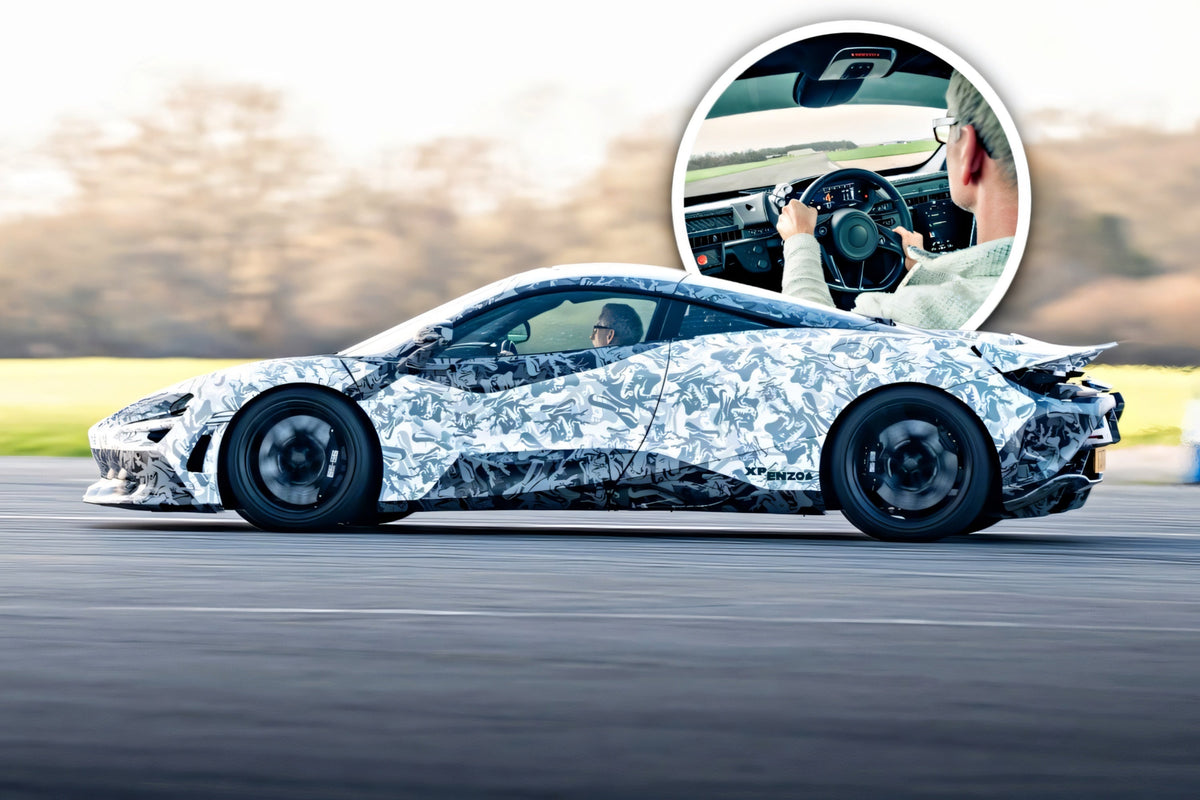
Center of Gravity: Inside Lanzante’s 850-HP, 1+2 Seating Masterpiece
At the Wynn Concours, the British specialist revived the ghost of the McLaren F1 with a bespoke central-cockpit supercar that solves decades of insurmountable packaging and homologation hurdles.
The Las Vegas Strip is a theater of excess, a place where automotive spectacle is usually measured in sheer volume and neon reflection. Just down the boulevard, an orange and black McLaren W1 hypercar was recently spotted prowling the asphalt, a brutalist wedge of hybrid-electric aerospace engineering stopping traffic and dominating social media feeds. But inside the manicured grounds of the Wynn Concours, a different, far more cerebral kind of automotive shockwave was taking place. British specialist Lanzante pulled the covers off a bespoke, 850-horsepower twin-turbo V8 supercar that dares to resurrect the holiest, and most notoriously difficult, of all automotive architectures: the 1+2 central driving position. In an era where bespoke hypercars are often just reskinned donor chassis, Lanzante has engineered a machine that forces the driver to sit dead center, flanked by two slightly recessed passenger seats. It is an ergonomic configuration that has remained functionally extinct in the mainstream supercar market since Gordon Murray penned the McLaren F1 over three decades ago.
The reason the true central-cockpit layout has become an endangered species is not a lack of driver desire, but the brutal reality of modern engineering constraints. Building a 1+2 cabin is a packaging nightmare that touches every single millimeter of a car’s architecture. When you move the driver to the center, the steering column, pedal box, and instrument binnacle must follow, carving directly into the space traditionally reserved for the fuel cell, front differential, or crash structures. HVAC routing becomes a labyrinthine puzzle. But the steepest mountain to climb is modern homologation. Side-impact crash structures have thickened exponentially since the 1990s. Securing the driver in the middle while maintaining safe ingress, egress, and lateral impact dissipation for the two outboard passengers requires a radical rethinking of the carbon-fiber tub. Lanzante, a firm whose DNA is inextricably linked to the McLaren F1 GTR—having famously run the car that won the 1995 24 Hours of Le Mans—is perhaps the only boutique outfit with the institutional memory and sheer stubbornness to solve these hurdles for a modern road car.
Squeezing an 850-hp, twin-turbo V8 behind a centralized driver amplifies the complexity of the heat management and firewall geometry. In a traditional two-seater, the engine sits neatly behind a flat bulkhead. With a 1+2 layout, the cabin intrudes deeper into the rear of the chassis, forcing the powertrain to sit further back or the firewall to be sculpted around the staggered seating arrangement. Lanzante’s engineers had to meticulously route the twin-turbocharger plumbing, intercoolers, and exhaust manifolds to ensure the immense thermal load of an 850-horsepower V8 doesn’t cook the outboard passengers. It’s an exercise in thermodynamic gymnastics, demanding aerospace-grade heat shielding and bespoke carbon ducting to feed the engine while maintaining the structural rigidity required of a modern hypercar.Squeezing an 850-hp, twin-turbo V8 behind a centralized driver amplifies the complexity of the heat management and firewall geometry. In a traditional two-seater, the engine sits neatly behind a flat bulkhead. With a 1+2 layout, the cabin intrudes deeper into the rear of the chassis, forcing the powertrain to sit further back or the firewall to be sculpted around the staggered seating arrangement. Lanzante’s engineers had to meticulously route the twin-turbocharger plumbing, intercoolers, and exhaust manifolds to ensure the immense thermal load of an 850-horsepower V8 doesn’t cook the outboard passengers. It’s an exercise in thermodynamic gymnastics, demanding aerospace-grade heat shielding and bespoke carbon ducting to feed the engine while maintaining the structural rigidity required of a modern hypercar.
To understand the magnitude of Lanzante’s achievement, one must look at the current titans of the supercar establishment. The orthodox two-seat layout remains the unquestioned standard, as showcased in a recent Carwow drag race hosted by Mat Watson. Pitting the Ferrari 296 GTB against the McLaren 765LT and the Porsche 911 GT2 RS highlights the apex of contemporary performance. The Ferrari uses a hybrid V6, the McLaren a twin-turbo V8, and the Porsche a rear-slung flat-six. Yet, for all their varied propulsion methods, active aerodynamics, and staggering straight-line supremacy, every single one of them fundamentally compromises the driver's connection to the road by offsetting their mass to the left or the right. Driving these cars at the limit requires a subconscious mental calculation to account for the asymmetry of your seating position relative to the car’s roll center.To understand the magnitude of Lanzante’s achievement, one must look at the current titans of the supercar establishment. The orthodox two-seat layout remains the unquestioned standard, as showcased in a recent Carwow drag race hosted by Mat Watson. Pitting the Ferrari 296 GTB against the McLaren 765LT and the Porsche 911 GT2 RS highlights the apex of contemporary performance. The Ferrari uses a hybrid V6, the McLaren a twin-turbo V8, and the Porsche a rear-slung flat-six. Yet, for all their varied propulsion methods, active aerodynamics, and staggering straight-line supremacy, every single one of them fundamentally compromises the driver's connection to the road by offsetting their mass to the left or the right. Driving these cars at the limit requires a subconscious mental calculation to account for the asymmetry of your seating position relative to the car’s roll center.
Even the most steadfast traditionalists are shifting their permanent lineups to fight the escalating supercar wars, though they still cling to two seats. Porsche has just signaled a massive shift in its philosophy with the reveal of the Mission S, a dedicated mid-engine supercar positioned permanently above the 911 to take on the likes of Ferrari and Lamborghini. For decades, Porsche resisted building a permanent mid-engine flagship that wasn't a limited-run special project like the Carrera GT or 918 Spyder. The arrival of the Mission S proves that the major manufacturers are locked in an arms race of mid-engine dominance. In a market this saturated with conventional excellence, boutique builders like Lanzante cannot simply compete on horsepower alone; they must offer an alien, transcendent driving experience. The 1+2 layout is exactly that—a layout traditionally reserved for the narrow confines of a prototype racing paddock, finally unleashed on the street.Even the most steadfast traditionalists are shifting their permanent lineups to fight the escalating supercar wars, though they still cling to two seats. Porsche has just signaled a massive shift in its philosophy with the reveal of the Mission S, a dedicated mid-engine supercar positioned permanently above the 911 to take on the likes of Ferrari and Lamborghini. For decades, Porsche resisted building a permanent mid-engine flagship that wasn't a limited-run special project like the Carrera GT or 918 Spyder. The arrival of the Mission S proves that the major manufacturers are locked in an arms race of mid-engine dominance. In a market this saturated with conventional excellence, boutique builders like Lanzante cannot simply compete on horsepower alone; they must offer an alien, transcendent driving experience. The 1+2 layout is exactly that—a layout traditionally reserved for the narrow confines of a prototype racing paddock, finally unleashed on the street.
The dynamic advantages of Lanzante’s central seating position are profound. By placing the meat of the driver’s mass perfectly on the car’s longitudinal axis, the polar moment of inertia is optimized. The driver becomes the pivot point around which the 850-hp twin-turbo V8 rotates. Sightlines over the front fenders are perfectly symmetrical, allowing for millimeter-perfect apex clipping on both left and right-hand corners. In a conventional supercar, a left-hand drive configuration makes right-hand hairpins a guessing game of blind spots and A-pillar obstruction. Sitting in the center eradicates this guesswork. It creates a telepathic connection to the front axle, transforming the act of driving from piloting a machine to wearing one.The dynamic advantages of Lanzante’s central seating position are profound. By placing the meat of the driver’s mass perfectly on the car’s longitudinal axis, the polar moment of inertia is optimized. The driver becomes the pivot point around which the 850-hp twin-turbo V8 rotates. Sightlines over the front fenders are perfectly symmetrical, allowing for millimeter-perfect apex clipping on both left and right-hand corners. In a conventional supercar, a left-hand drive configuration makes right-hand hairpins a guessing game of blind spots and A-pillar obstruction. Sitting in the center eradicates this guesswork. It creates a telepathic connection to the front axle, transforming the act of driving from piloting a machine to wearing one.
Getting this bespoke creation crash-tested and road-legal is a Herculean task that speaks volumes about Lanzante’s engineering capabilities. Boutique manufacturers usually rely on low-volume exemption rules, but even those have tightened drastically in the last decade concerning pedestrian safety and occupant protection. Solving the egress issue—ensuring a central driver can escape the vehicle quickly in the event of an inversion or fire—requires incredibly clever door kinematics and a roof structure that can bear immense loads without obstructing the exit path. Lanzante’s ability to navigate these homologation minefields without diluting the purity of the 1+2 vision is a triumph of small-scale British engineering over draconian global legislation.Getting this bespoke creation crash-tested and road-legal is a Herculean task that speaks volumes about Lanzante’s engineering capabilities. Boutique manufacturers usually rely on low-volume exemption rules, but even those have tightened drastically in the last decade concerning pedestrian safety and occupant protection. Solving the egress issue—ensuring a central driver can escape the vehicle quickly in the event of an inversion or fire—requires incredibly clever door kinematics and a roof structure that can bear immense loads without obstructing the exit path. Lanzante’s ability to navigate these homologation minefields without diluting the purity of the 1+2 vision is a triumph of small-scale British engineering over draconian global legislation.
As the Wynn Concours wound down, the contrast between the cars on display and the cars on the street couldn't have been starker. The McLaren W1 prowling the Vegas Strip represents the bleeding edge of the hybrid-electric future, a hypercar defined by complex algorithms and electrified torque fill. Lanzante’s 850-hp, central-cockpit marvel represents something entirely different: the ultimate refinement of analog, internal-combustion purism. By solving the packaging and crash-structure hurdles that have kept the center-seat layout dormant for decades, Lanzante hasn’t just built a new supercar. They have resurrected a philosophy, proving that uncompromising ergonomic visions still have a place in the modern automotive landscape.As the Wynn Concours wound down, the contrast between the cars on display and the cars on the street couldn't have been starker. The McLaren W1 prowling the Vegas Strip represents the bleeding edge of the hybrid-electric future, a hypercar defined by complex algorithms and electrified torque fill. Lanzante’s 850-hp, central-cockpit marvel represents something entirely different: the ultimate refinement of analog, internal-combustion purism. By solving the packaging and crash-structure hurdles that have kept the center-seat layout dormant for decades, Lanzante hasn’t just built a new supercar. They have resurrected a philosophy, proving that uncompromising ergonomic visions still have a place in the modern automotive landscape.
Gallery
"By placing the meat of the driver’s mass perfectly on the car’s longitudinal axis, the driver becomes the pivot point around which the 850-hp twin-turbo V8 rotates."
Why it matters
Lanzante’s successful execution of a 1+2 central-cockpit supercar proves that boutique builders can still conquer modern, draconian homologation and safety standards. It represents a victory for pure driving dynamics over the rigid, asymmetrical packaging constraints that define the mass-produced supercar establishment.
Sources
- 1.
- 2.
- 3.
Reported by the Downforce & Divots desk from the sources above.
The clubhouse.
- No replies yet. Be the first.