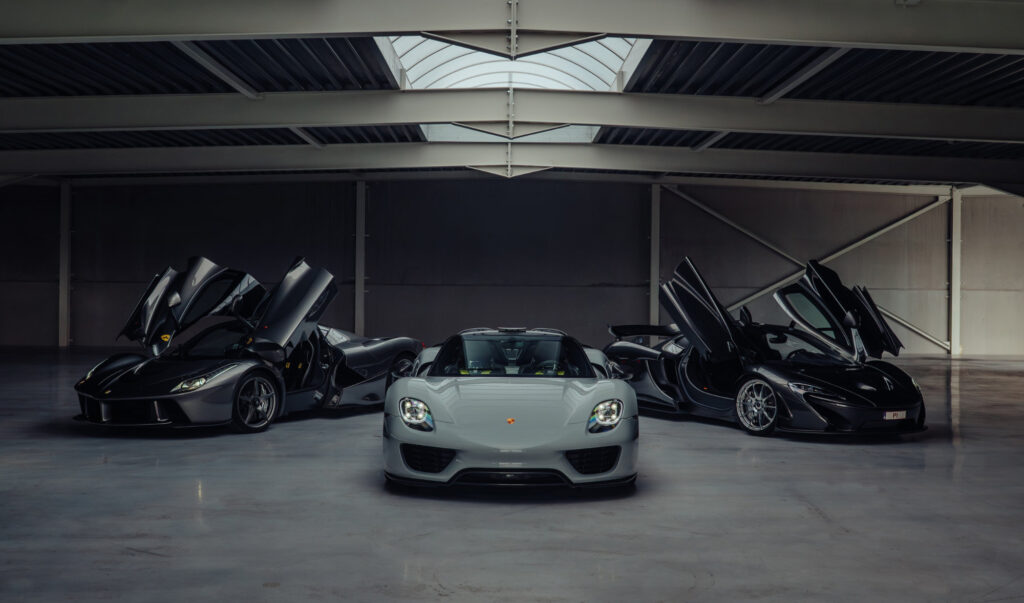
Three Paths Through the Voltage: Why the Holy Trinity Still Defines the Hypercar Era
A decade after the LaFerrari, Porsche 918 Spyder, and McLaren P1 rewrote the performance rulebook, their diverging hybrid blueprints remain the ultimate technical debate.
More than ten years after Ferrari, Porsche, and McLaren unleashed their respective halo machines upon the world, the automotive landscape has yet to produce a triumvirate with equal cultural gravity. Dubbed the "Holy Trinity," the Ferrari LaFerrari, Porsche 918 Spyder, and McLaren P1 did not merely escalate the horsepower arms race; they established three fundamentally distinct interpretations of how electrification should serve ultra-high-performance internal combustion.More than ten years after Ferrari, Porsche, and McLaren unleashed their respective halo machines upon the world, the automotive landscape has yet to produce a triumvirate with equal cultural gravity. Dubbed the "Holy Trinity," the Ferrari LaFerrari, Porsche 918 Spyder, and McLaren P1 did not merely escalate the horsepower arms race; they established three fundamentally distinct interpretations of how electrification should serve ultra-high-performance internal combustion.
The ideological divergence among the three remains striking. Porsche treated the 918 Spyder as a showcase of complex, all-wheel-drive torque vectoring, pairing a naturally aspirated V8 with dual electric motors to create an unflappable technical weapon. McLaren took the opposite philosophical tack with the P1, deploying rear-wheel-drive turbocharging and instant electric torque-fill to emulate the raw, uncompromising lineage of the legendary McLaren F1. Ferrari, meanwhile, used HY-KERS in the LaFerrari purely as an invisible multiplier for its howling atmospheric V12, refusing even an electric-only driving mode.
That ideological split echoes across contemporary supercar culture today. From concours lawns in Miami to modern high-downforce machinery like the McLaren 765LT, the lineage of lightweight composites and extreme aerodynamic efficiency can be traced directly back to the carbon tubs perfected during that mid-2010s clash. Even as grids expand to include boutique track specials from Koenigsegg and modern customer GT3 machinery, the Trinity remains the definitive high-water mark for analog feel married to early hybrid tech.That ideological split echoes across contemporary supercar culture today. From concours lawns in Miami to modern high-downforce machinery like the McLaren 765LT, the lineage of lightweight composites and extreme aerodynamic efficiency can be traced directly back to the carbon tubs perfected during that mid-2010s clash. Even as grids expand to include boutique track specials from Koenigsegg and modern customer GT3 machinery, the Trinity remains the definitive high-water mark for analog feel married to early hybrid tech.
What separates that era from modern multi-motor EV hypercars is the sheer variety of character each powertrain delivered. In contemporary track paddocks and private competitions, modern exotics like the Ferrari F8 and track-honed Porsche 911 GT models lean heavily on electronic chassis wizardry pioneered during the development of those three halo projects. The Trinity proved that hybrid systems could enhance driver engagement rather than mute it under layers of battery ballast.What separates that era from modern multi-motor EV hypercars is the sheer variety of character each powertrain delivered. In contemporary track paddocks and private competitions, modern exotics like the Ferrari F8 and track-honed Porsche 911 GT models lean heavily on electronic chassis wizardry pioneered during the development of those three halo projects. The Trinity proved that hybrid systems could enhance driver engagement rather than mute it under layers of battery ballast.
As modern homologation requirements push manufacturers toward uniform electric architectures, the Holy Trinity looks less like a transitional experiment and more like a golden age of engineering freedom. Three manufacturers were given the exact same brief—build the fastest road-legal machine possible using hybrid technology—and arrived at three entirely different, fiercely individual answers.As modern homologation requirements push manufacturers toward uniform electric architectures, the Holy Trinity looks less like a transitional experiment and more like a golden age of engineering freedom. Three manufacturers were given the exact same brief—build the fastest road-legal machine possible using hybrid technology—and arrived at three entirely different, fiercely individual answers.
"The Ferrari LaFerrari, Porsche 918 Spyder and McLaren P1 became known as the Holy Trinity, each representing a different interpretation of hybrid power."
Why it matters
The Holy Trinity established the benchmark for high-performance electrification that automakers still chase today. Understanding their competing hybrid architectures explains how modern exotics balance weight, torque-fill, and driver engagement.
Sources
- 1.
- 2.The #1 Holy Trinity Car? 😍 #porscheinstagram.com
- 3.
- 4.
Reported by the Downforce & Divots desk from the sources above.
The clubhouse.
- No replies yet. Be the first.