The Unbreakable Myth: Why Bugatti Is Putting Fine Porcelain in a 250-MPH Hypercar
Bugatti’s W16 Mistral ‘Blanc Éternel’ features handcrafted porcelain from Germany’s legendary Königliche Porzellan-Manufaktur. It’s not a fragile gimmick—it’s a calculated play on material science that redefines the meaning of automotive performance.
At the heart of the latest Bugatti, a one-of-a-kind roadster named the W16 Mistral ‘Blanc Éternel’, sits an object of profound and perplexing contradiction. The gear selector, cool and smooth to the touch, is hewn from authentic porcelain. In a cockpit engineered to withstand the forces generated by a 1,578-horsepower engine, surrounded by exposed carbon fiber and materials chosen for their immense strength-to-weight ratios, this delicate-seeming ceramic detail feels less like a component and more like a provocation. Unveiled in June 2026, the unique Mistral, a collaboration with the revered Königliche Porzellan-Manufaktur (KPM) Berlin, features these porcelain accents throughout its cabin and even on its exterior. It immediately begs the question: why would Molsheim’s engineers, obsessive architects of speed, willingly integrate a material synonymous with fragility into the very epicenter of automotive extremity?At the heart of the latest Bugatti, a one-of-a-kind roadster named the W16 Mistral ‘Blanc Éternel’, sits an object of profound and perplexing contradiction. The gear selector, cool and smooth to the touch, is hewn from authentic porcelain. In a cockpit engineered to withstand the forces generated by a 1,578-horsepower engine, surrounded by exposed carbon fiber and materials chosen for their immense strength-to-weight ratios, this delicate-seeming ceramic detail feels less like a component and more like a provocation. Unveiled in June 2026, the unique Mistral, a collaboration with the revered Königliche Porzellan-Manufaktur (KPM) Berlin, features these porcelain accents throughout its cabin and even on its exterior. It immediately begs the question: why would Molsheim’s engineers, obsessive architects of speed, willingly integrate a material synonymous with fragility into the very epicenter of automotive extremity?
The answer begins with a trip back in time. This seemingly radical act of material integration is not a sudden impulse, but the revival of a specific and celebrated chapter in Bugatti's history. According to company archives, fifteen years prior to the Mistral's debut, on June 30, 2011, Bugatti and KPM Berlin first joined forces. That original creation, the Veyron “L’Or Blanc,” was a watershed moment, a unique piece unveiled at KPM's own workshops in Berlin, proving that porcelain could not only survive but also elevate the world's fastest production car. The ‘Blanc Éternel’ is therefore a conscious anniversary piece, a renewed partnership that deliberately echoes that first experiment. This historical context is critical; it reframes the project from a curious one-off into a deliberate statement on brand legacy and the enduring power of authentic master craftsmanship.The answer begins with a trip back in time. This seemingly radical act of material integration is not a sudden impulse, but the revival of a specific and celebrated chapter in Bugatti's history. According to company archives, fifteen years prior to the Mistral's debut, on June 30, 2011, Bugatti and KPM Berlin first joined forces. That original creation, the Veyron “L’Or Blanc,” was a watershed moment, a unique piece unveiled at KPM's own workshops in Berlin, proving that porcelain could not only survive but also elevate the world's fastest production car. The ‘Blanc Éternel’ is therefore a conscious anniversary piece, a renewed partnership that deliberately echoes that first experiment. This historical context is critical; it reframes the project from a curious one-off into a deliberate statement on brand legacy and the enduring power of authentic master craftsmanship.
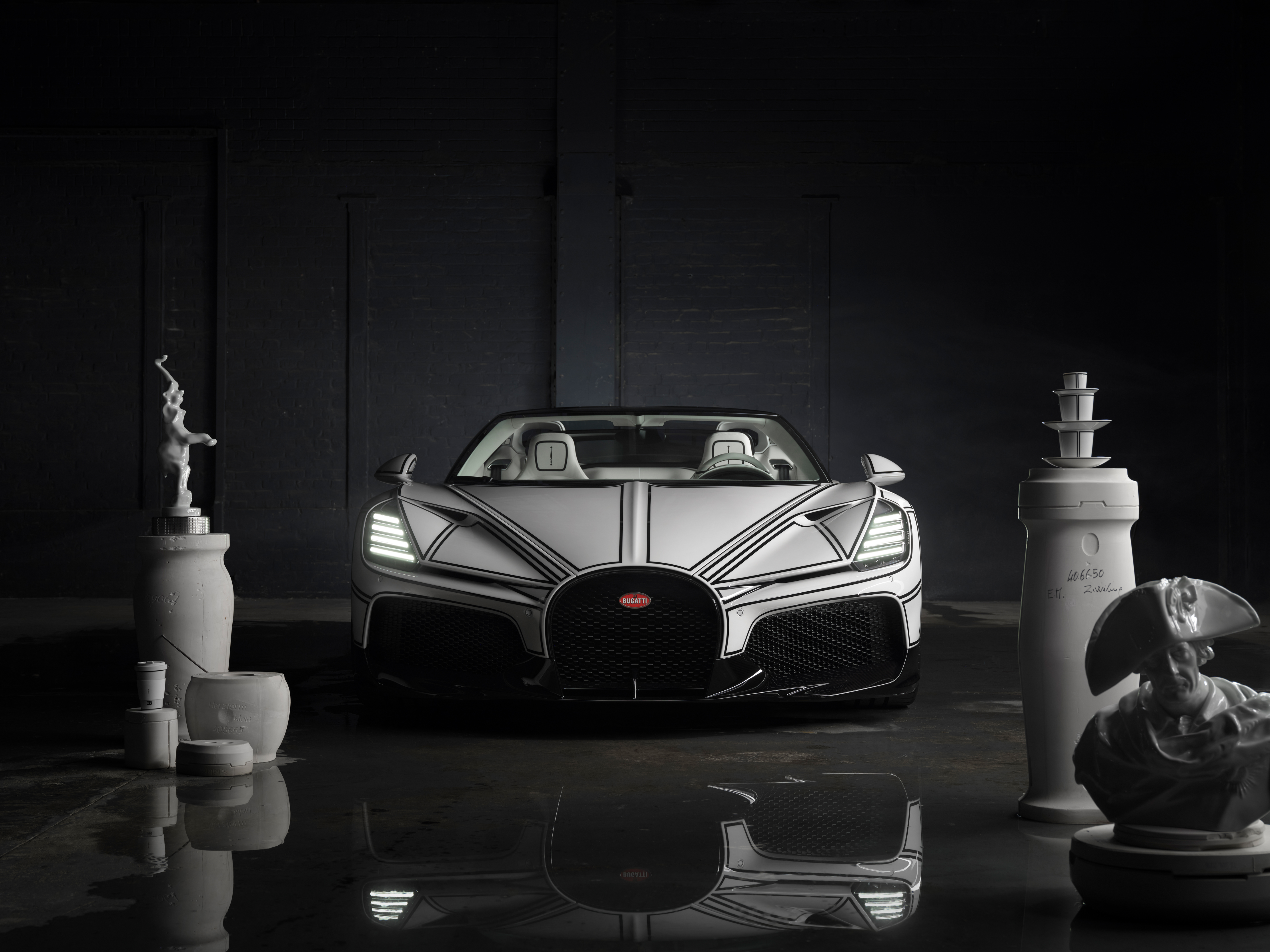
The car itself is a testament to this duality of heritage and hyper-modernity. The ‘Blanc Éternel’ name is a carefully chosen descriptor, evoking what Bugatti calls the “perpetual beauty” of pure-white porcelain and the equally enduring place of its quad-turbo W16 engine in automotive lore. As per Bugatti’s press release, the design is a sophisticated dance between digital precision and human artistry. The pure white finish is traced with delicate, hand-painted black lines which make the car’s “digital patch layout”—the normally invisible polygonal mesh that forms the basis of every computer-modeled automotive surface—strikingly visible. This decision transforms a technical blueprint into a primary aesthetic feature, a clear visual language of digital modeling rendered by hand. It’s a level of detail that elevates the car beyond a mere collection of high-performance parts into a cohesive, rolling sculpture.The car itself is a testament to this duality of heritage and hyper-modernity. The ‘Blanc Éternel’ name is a carefully chosen descriptor, evoking what Bugatti calls the “perpetual beauty” of pure-white porcelain and the equally enduring place of its quad-turbo W16 engine in automotive lore. As per Bugatti’s press release, the design is a sophisticated dance between digital precision and human artistry. The pure white finish is traced with delicate, hand-painted black lines which make the car’s “digital patch layout”—the normally invisible polygonal mesh that forms the basis of every computer-modeled automotive surface—strikingly visible. This decision transforms a technical blueprint into a primary aesthetic feature, a clear visual language of digital modeling rendered by hand. It’s a level of detail that elevates the car beyond a mere collection of high-performance parts into a cohesive, rolling sculpture.
To truly understand the choice of porcelain, however, one must discard the domestic imagery of teacups and dinner plates and look instead toward heavy industry. The very properties that make porcelain seem delicate are, in different contexts, signs of immense strength. As documented in industrial applications, high-strength porcelain is the material of choice for high-voltage power line insulators, specifically for its “superior durability and mechanical performance.” Found on 11-33kV distribution lines, these insulators are engineered to withstand decades of environmental abuse, extreme temperatures, and immense mechanical stress while providing flawless electrical insulation. Their anti-fouling glazed surfaces are designed to repel contaminants and reduce the risk of catastrophic electrical failure. This is porcelain in its raw, industrial form: a tough, stable, and highly resistant engineering material.To truly understand the choice of porcelain, however, one must discard the domestic imagery of teacups and dinner plates and look instead toward heavy industry. The very properties that make porcelain seem delicate are, in different contexts, signs of immense strength. As documented in industrial applications, high-strength porcelain is the material of choice for high-voltage power line insulators, specifically for its “superior durability and mechanical performance.” Found on 11-33kV distribution lines, these insulators are engineered to withstand decades of environmental abuse, extreme temperatures, and immense mechanical stress while providing flawless electrical insulation. Their anti-fouling glazed surfaces are designed to repel contaminants and reduce the risk of catastrophic electrical failure. This is porcelain in its raw, industrial form: a tough, stable, and highly resistant engineering material.
This industrial-grade resilience is rooted in the material’s fundamental composition and the immense craft required to perfect it. According to material science sources, the production of high-quality porcelain begins with the careful selection of raw materials like kaolin clay and limestone, specifically chosen for being extremely low in mineral impurities such as iron and manganese, which ensures both aesthetic purity and structural integrity. This foundation is then transformed through firing into a ceramic body with remarkable properties, including being an exceptional electrical insulator. This is why, as electrical component manufacturer Grainger notes, ceramics are often used for fuses designed to protect critical systems from surges—the material is a guardian, not a liability. The painstaking process echoes the world of high-end car detailing, where, as experts point out, the majority of time spent on a ceramic coating is in the meticulous preparation of the surface. For both a half-micron-thick coating and a solid KPM inlay, the results are born from an uncompromising process.This industrial-grade resilience is rooted in the material’s fundamental composition and the immense craft required to perfect it. According to material science sources, the production of high-quality porcelain begins with the careful selection of raw materials like kaolin clay and limestone, specifically chosen for being extremely low in mineral impurities such as iron and manganese, which ensures both aesthetic purity and structural integrity. This foundation is then transformed through firing into a ceramic body with remarkable properties, including being an exceptional electrical insulator. This is why, as electrical component manufacturer Grainger notes, ceramics are often used for fuses designed to protect critical systems from surges—the material is a guardian, not a liability. The painstaking process echoes the world of high-end car detailing, where, as experts point out, the majority of time spent on a ceramic coating is in the meticulous preparation of the surface. For both a half-micron-thick coating and a solid KPM inlay, the results are born from an uncompromising process.
Integrating such a material into the Mistral's cockpit is an engineering feat that goes far beyond simple decoration. Bugatti states unequivocally that “real handcrafted porcelain is integrated into the interior,” a phrase that implies far more than adhesive. It suggests a bespoke mounting and dampening system, a piece of sub-assembly engineering designed to completely isolate the KPM components from the ferocious harmonics and g-forces inherent to a 1,578 hp hypercar. The challenge is twofold: first, KPM must create a piece of art that meets Bugatti’s dimensional and quality specifications; second, Bugatti must engineer a way for that art to survive in an environment more hostile than any museum display case. This deep integration is part of the brand’s philosophy, where every surface a driver interacts with—from the leather wrap on the wheel to the cool touch of a porcelain shifter—is part of a cohesive and uncompromising sensory experience.Integrating such a material into the Mistral's cockpit is an engineering feat that goes far beyond simple decoration. Bugatti states unequivocally that “real handcrafted porcelain is integrated into the interior,” a phrase that implies far more than adhesive. It suggests a bespoke mounting and dampening system, a piece of sub-assembly engineering designed to completely isolate the KPM components from the ferocious harmonics and g-forces inherent to a 1,578 hp hypercar. The challenge is twofold: first, KPM must create a piece of art that meets Bugatti’s dimensional and quality specifications; second, Bugatti must engineer a way for that art to survive in an environment more hostile than any museum display case. This deep integration is part of the brand’s philosophy, where every surface a driver interacts with—from the leather wrap on the wheel to the cool touch of a porcelain shifter—is part of a cohesive and uncompromising sensory experience.
Ultimately, the ‘Blanc Éternel’ is Bugatti’s powerful answer to a looming existential question in the hypercar space. As raw performance metrics become increasingly stratospheric across the board—with competitors like Koenigsegg fielding machines like the 1,700-horsepower Gemera—the definition of ultimate luxury must evolve beyond simple speed. What truly differentiates a multi-million-dollar vehicle when several rivals offer similar, earth-shattering acceleration? Bugatti is betting the answer lies in tactile sensation, material authenticity, and historical narrative. The partnership with a 260-year-old institution like KPM is a profound statement. It declares that true performance is no longer just about the stopwatch; it’s about the quality of the materials you touch, the depth of the story they tell, and the audacity of the artists and engineers who dared to combine them.Ultimately, the ‘Blanc Éternel’ is Bugatti’s powerful answer to a looming existential question in the hypercar space. As raw performance metrics become increasingly stratospheric across the board—with competitors like Koenigsegg fielding machines like the 1,700-horsepower Gemera—the definition of ultimate luxury must evolve beyond simple speed. What truly differentiates a multi-million-dollar vehicle when several rivals offer similar, earth-shattering acceleration? Bugatti is betting the answer lies in tactile sensation, material authenticity, and historical narrative. The partnership with a 260-year-old institution like KPM is a profound statement. It declares that true performance is no longer just about the stopwatch; it’s about the quality of the materials you touch, the depth of the story they tell, and the audacity of the artists and engineers who dared to combine them.
As the automotive world pivots toward a quieter, electric future, the W16 engine's final, triumphant roar in the Mistral is a poignant moment. But cars like the ‘Blanc Éternel’ suggest a path forward for Bugatti's mythos. When the visceral symphony of internal combustion is gone, what will form the soul of the hyper-luxury machine? Bugatti proposes that it will be found in these new-old alliances, in radical material pairings, and in an obsession with craftsmanship that borders on the fanatical. The legacy will be carried not just by performance data, but by the cool, immutable surface of a porcelain inlay, a tangible link to a tradition of European artistry that long predates the automobile itself. It’s a way of embedding value so deeply into the object that it transcends the technology of its era.As the automotive world pivots toward a quieter, electric future, the W16 engine's final, triumphant roar in the Mistral is a poignant moment. But cars like the ‘Blanc Éternel’ suggest a path forward for Bugatti's mythos. When the visceral symphony of internal combustion is gone, what will form the soul of the hyper-luxury machine? Bugatti proposes that it will be found in these new-old alliances, in radical material pairings, and in an obsession with craftsmanship that borders on the fanatical. The legacy will be carried not just by performance data, but by the cool, immutable surface of a porcelain inlay, a tangible link to a tradition of European artistry that long predates the automobile itself. It’s a way of embedding value so deeply into the object that it transcends the technology of its era.
Gallery
"Real handcrafted porcelain is integrated into the interior, transforming the cabin."
Why it matters
In an increasingly crowded hypercar market defined by staggering performance figures, Bugatti is using its 'Blanc Éternel' and KPM porcelain collaboration to redefine ultimate luxury. The project champions material science and artisanal history as the new benchmarks for value, suggesting that the future of elite carmaking lies not just in speed, but in tactile artistry and authentic storytelling.
Sources
- 1.
- 2.
- 3.
- 4.
- 5.
- 6.Bugatti - Facebookfacebook.com
- 7.The W16 Mistral 'Blanc Éternel': Celebrating PERPETUAL BEAUTYnewsroom.bugatti.com
- 8.
- 9.Austin Pruett | Ceramic Coating: Never Wax Againinstagram.com
- 10.Find the right fuse for the job.facebook.com
Reported by the Downforce & Divots desk from the sources above.
The clubhouse.
- No replies yet. Be the first.