The Hennessey Blackbird and the Death of the Digital Hypercar
By stripping the cabin of screens and hiding mandatory safety readouts in the rearview mirror, Hennessey’s 850-hp, gated-manual Blackbird is waging a 9,000-RPM war on the modern hybrid establishment.
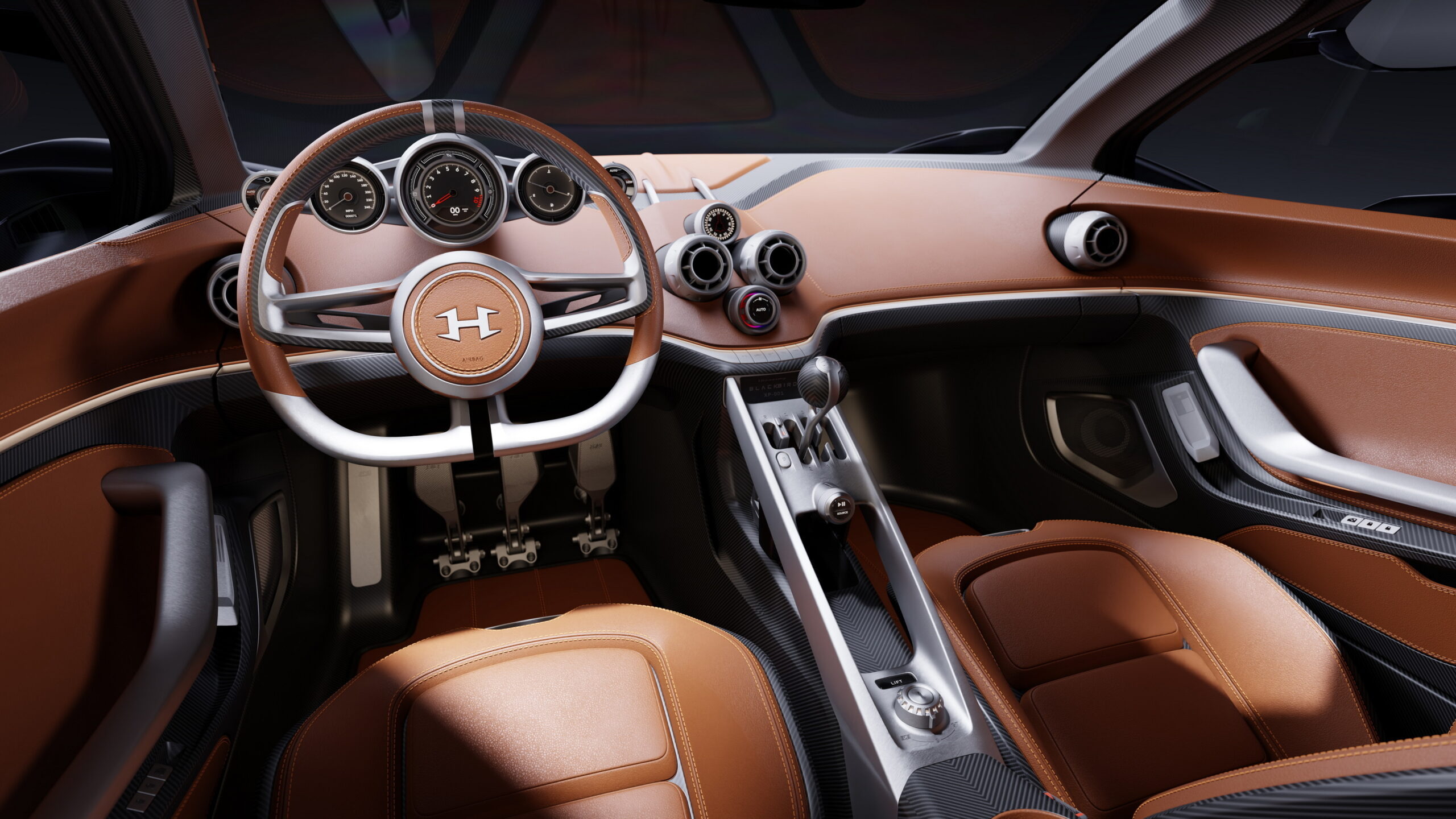
Drop into the carbon-fiber tub of the new Hennessey Blackbird, and the silence is deafening—not because of the engine, but because of what is missing. The modern hypercar cabin has become an exercise in digital real estate, a sprawling matrix of OLED touchscreens, haptic feedback panels, and biometric telemetry. Hennessey has violently rejected this premise. The Blackbird features a naturally aspirated V8 that wails to a 9,000-RPM redline, sending 850 horsepower to the rear wheels through a gated six-speed manual transmission. But the most radical engineering choice is what you cannot see: there is not a single infotainment screen in the dashboard. To satisfy homologation rules, Hennessey tucked the mandatory safety displays—backup cameras and critical warning lights—straight into the glass of the rearview mirror. When the car is off, the cabin is a barren, purposeful landscape of leather, titanium, and carbon. It is a deliberate middle finger to the iPad-ification of ultimate performance.Drop into the carbon-fiber tub of the new Hennessey Blackbird, and the silence is deafening—not because of the engine, but because of what is missing. The modern hypercar cabin has become an exercise in digital real estate, a sprawling matrix of OLED touchscreens, haptic feedback panels, and biometric telemetry. Hennessey has violently rejected this premise. The Blackbird features a naturally aspirated V8 that wails to a 9,000-RPM redline, sending 850 horsepower to the rear wheels through a gated six-speed manual transmission. But the most radical engineering choice is what you cannot see: there is not a single infotainment screen in the dashboard. To satisfy homologation rules, Hennessey tucked the mandatory safety displays—backup cameras and critical warning lights—straight into the glass of the rearview mirror. When the car is off, the cabin is a barren, purposeful landscape of leather, titanium, and carbon. It is a deliberate middle finger to the iPad-ification of ultimate performance.
To understand the audacity of the Blackbird, you have to look at the vanguard of the current market. The hypercar establishment is currently racing headlong into a silent, software-driven future. Consider the upcoming Porsche Mission S. Slated for a 2030 release, the Mission S is already generating feverish industry chatter, with insiders suggesting it proves exactly why Stuttgart remains the undisputed supercar king. The prevailing sentiment among the digital-performance faithful is that any traditionalist at Ferrari, McLaren, or Lamborghini clinging to purely mechanical thrills is simply in denial about the physics of electrification. The future, we are told, is all-wheel-drive torque vectoring and silent, instantaneous acceleration. Hennessey, conversely, has stepped entirely off that developmental curve, choosing instead to build a monument to the analog age.To understand the audacity of the Blackbird, you have to look at the vanguard of the current market. The hypercar establishment is currently racing headlong into a silent, software-driven future. Consider the upcoming Porsche Mission S. Slated for a 2030 release, the Mission S is already generating feverish industry chatter, with insiders suggesting it proves exactly why Stuttgart remains the undisputed supercar king. The prevailing sentiment among the digital-performance faithful is that any traditionalist at Ferrari, McLaren, or Lamborghini clinging to purely mechanical thrills is simply in denial about the physics of electrification. The future, we are told, is all-wheel-drive torque vectoring and silent, instantaneous acceleration. Hennessey, conversely, has stepped entirely off that developmental curve, choosing instead to build a monument to the analog age.
This current obsession with digital augmentation traces its lineage back a decade to the so-called 'Holy Trinity,' which fundamentally altered the trajectory of automotive engineering. The McLaren P1, of which only 375 examples were ever built, remains one of the most sought-after modern hypercars on the planet precisely because it introduced the concept of hybrid torque-fill to the street. Alongside the Ferrari LaFerrari, these machines proved that electrification could make a car violently, incomprehensibly fast. But they also crossed a philosophical Rubicon. They began a trend where the driver was no longer a mechanical conductor, but an orchestrator of microprocessors. The P1 laid the groundwork for the hybrid spaceships of today; the Blackbird is attempting to burn that blueprint to the ground.This current obsession with digital augmentation traces its lineage back a decade to the so-called 'Holy Trinity,' which fundamentally altered the trajectory of automotive engineering. The McLaren P1, of which only 375 examples were ever built, remains one of the most sought-after modern hypercars on the planet precisely because it introduced the concept of hybrid torque-fill to the street. Alongside the Ferrari LaFerrari, these machines proved that electrification could make a car violently, incomprehensibly fast. But they also crossed a philosophical Rubicon. They began a trend where the driver was no longer a mechanical conductor, but an orchestrator of microprocessors. The P1 laid the groundwork for the hybrid spaceships of today; the Blackbird is attempting to burn that blueprint to the ground.
Yet, the appetite for visceral, untamed machines has never fully evaporated—it simply retreated into the ultra-exclusive, low-volume stratosphere of special projects. You can see echoes of this analog yearning in cars like the Ferrari Daytona SP3, a crown jewel of Maranello’s exclusive Icona series. The Daytona SP3 was a signal that the world's most cynical, deep-pocketed collectors still crave the theatre of a pure combustion engine wrapped in a chassis that demands respect, prioritizing tactile emotion over pure numerical superiority. Like the Blackbird, the SP3 relies on sensory overload rather than a top-speed spec sheet. It serves as proof that there is a highly lucrative market segment willing to pay a premium for a car that makes them work for the speed.Yet, the appetite for visceral, untamed machines has never fully evaporated—it simply retreated into the ultra-exclusive, low-volume stratosphere of special projects. You can see echoes of this analog yearning in cars like the Ferrari Daytona SP3, a crown jewel of Maranello’s exclusive Icona series. The Daytona SP3 was a signal that the world's most cynical, deep-pocketed collectors still crave the theatre of a pure combustion engine wrapped in a chassis that demands respect, prioritizing tactile emotion over pure numerical superiority. Like the Blackbird, the SP3 relies on sensory overload rather than a top-speed spec sheet. It serves as proof that there is a highly lucrative market segment willing to pay a premium for a car that makes them work for the speed.
The true spiritual ancestor to the Blackbird’s unhinged ethos, however, isn't a modern Ferrari, but the fearsome Porsche Carrera GT. Often mentioned in the same breath as track-only monsters like the McLaren P1 GTR when discussing the pantheon of elite, terrifyingly raw supercars, the Carrera GT demanded absolute concentration. It lacked electronic stability nets and relied on a screaming naturally aspirated engine mated to a notoriously tricky manual clutch. Hennessey has channeled that exact frequency with the Blackbird. They are explicitly targeting a demographic that wants to sweat when they drive, owners who want to brave a cold start on a volatile hypercar without relying on a suite of digital safety nets to keep them out of the armco.The true spiritual ancestor to the Blackbird’s unhinged ethos, however, isn't a modern Ferrari, but the fearsome Porsche Carrera GT. Often mentioned in the same breath as track-only monsters like the McLaren P1 GTR when discussing the pantheon of elite, terrifyingly raw supercars, the Carrera GT demanded absolute concentration. It lacked electronic stability nets and relied on a screaming naturally aspirated engine mated to a notoriously tricky manual clutch. Hennessey has channeled that exact frequency with the Blackbird. They are explicitly targeting a demographic that wants to sweat when they drive, owners who want to brave a cold start on a volatile hypercar without relying on a suite of digital safety nets to keep them out of the armco.
Engineering an analog experience in 2026 is paradoxically more complex than building a digital one. Hennessey's decision to banish the center screen isn't just an aesthetic choice; it fundamentally alters the vehicle's electrical architecture and packaging. By routing necessary homologation hardware into the rearview mirror, Hennessey frees the driver from the visual pollution of lap-timer graphics and smartphone mirroring. You are forced to rely on the auditory cues of the 9,000-RPM V8 and the mechanical clack of the gear lever slotting through the metal gate. The car doesn't offer an endlessly customizable drive mode selector because the drive mode is entirely dictated by the organic weight of your right foot and the speed of your left leg.Engineering an analog experience in 2026 is paradoxically more complex than building a digital one. Hennessey's decision to banish the center screen isn't just an aesthetic choice; it fundamentally alters the vehicle's electrical architecture and packaging. By routing necessary homologation hardware into the rearview mirror, Hennessey frees the driver from the visual pollution of lap-timer graphics and smartphone mirroring. You are forced to rely on the auditory cues of the 9,000-RPM V8 and the mechanical clack of the gear lever slotting through the metal gate. The car doesn't offer an endlessly customizable drive mode selector because the drive mode is entirely dictated by the organic weight of your right foot and the speed of your left leg.
This shift speaks volumes about the changing definition of automotive exclusivity. When the McLaren P1 debuted, exclusivity was defined by having access to bleeding-edge, hybrid technology before anyone else. Today, that technology is ubiquitous; a family luxury sedan has more computing power than early hypercars, and electric commuter cars can easily dispatch quarter-mile times that would have shamed a decade-old supercar. Therefore, true exclusivity has inverted. It is now defined by what a manufacturer has the audacity to leave out. Hennessey is betting that a small subset of buyers will pay a massive premium precisely because the Blackbird refuses to hold their hand, sync with their calendar, or smooth out their mistakes with an electric motor.This shift speaks volumes about the changing definition of automotive exclusivity. When the McLaren P1 debuted, exclusivity was defined by having access to bleeding-edge, hybrid technology before anyone else. Today, that technology is ubiquitous; a family luxury sedan has more computing power than early hypercars, and electric commuter cars can easily dispatch quarter-mile times that would have shamed a decade-old supercar. Therefore, true exclusivity has inverted. It is now defined by what a manufacturer has the audacity to leave out. Hennessey is betting that a small subset of buyers will pay a massive premium precisely because the Blackbird refuses to hold their hand, sync with their calendar, or smooth out their mistakes with an electric motor.
Ultimately, the Blackbird is a line drawn in the tarmac. As the industry accelerates toward the Porsche Mission S's 2030 arrival and an increasingly sanitized, algorithmically managed future, the Blackbird stands as a defiant monument to internal combustion. It reminds us that the essence of a hypercar shouldn't be how efficiently it can manage traction protocols, but how thoroughly it can hijack your central nervous system. By putting the digital world exactly where it belongs—hidden out of sight in the rearview mirror—Hennessey has ensured that the driver's focus remains squarely on the horizon.Ultimately, the Blackbird is a line drawn in the tarmac. As the industry accelerates toward the Porsche Mission S's 2030 arrival and an increasingly sanitized, algorithmically managed future, the Blackbird stands as a defiant monument to internal combustion. It reminds us that the essence of a hypercar shouldn't be how efficiently it can manage traction protocols, but how thoroughly it can hijack your central nervous system. By putting the digital world exactly where it belongs—hidden out of sight in the rearview mirror—Hennessey has ensured that the driver's focus remains squarely on the horizon.
Gallery
"True exclusivity has inverted. It is now defined by what a manufacturer has the audacity to leave out."
Why it matters
As the hypercar market hurtles toward an electrified, software-heavy future, the Blackbird proves there is a highly lucrative segment of collectors who actively reject digital intervention. It highlights a growing shift where true automotive luxury is defined by analog engagement and mechanical purity rather than screen size and hybrid torque.
Sources
- 1.
- 2.
- 3.
Reported by the Downforce & Divots desk from the sources above.
The clubhouse.
- No replies yet. Be the first.