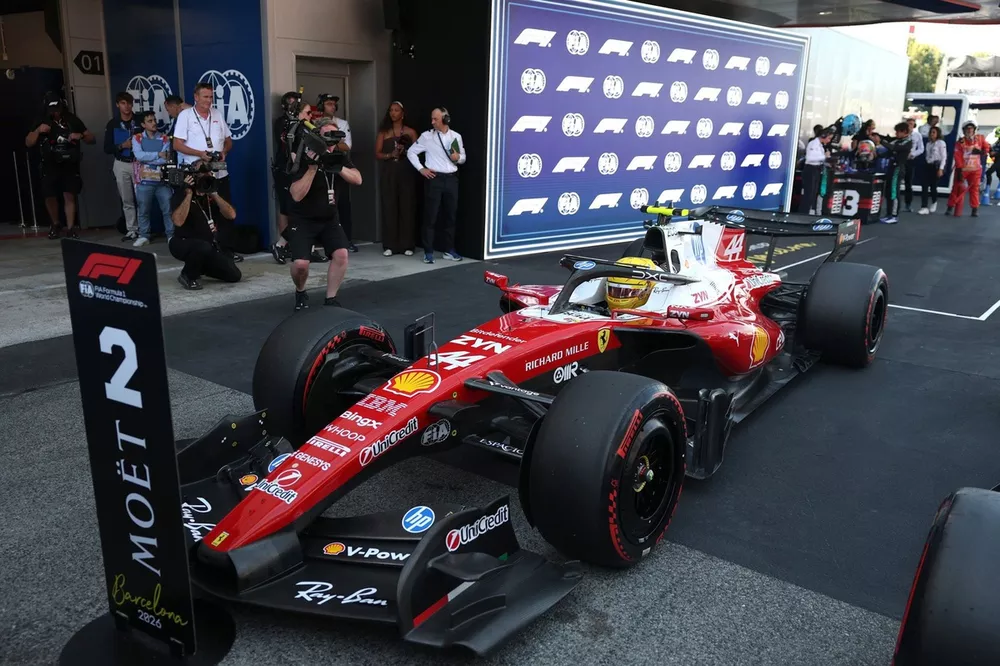
The Ghost in the Machine: Active Aero's Unseen Threat to F1's 2026 Generation
Lewis Hamilton's recent front wing failure in Barcelona reveals a terrifying new variable in Formula 1's 2026 regulations. As drivers push the limits, the invisible hand of software can now destabilize a car—and a psyche—at over 200 mph.
It wasn't a crash or a plume of smoke, but a quiet, digital failure that sent a chill through the Barcelona paddock. During Friday practice for the Catalunya Grand Prix, Lewis Hamilton’s new Ferrari upgrade hit a snag. As detailed by trackside observers, the ‘straight line mode’ on his front wing refused to engage. The result was a car behaving differently on every straight, a compromised setup that left the seven-time champion struggling for balance, running wide onto the grass, and finishing the session in ninth place. Meanwhile his teammate, Charles Leclerc, with the same parts functioning correctly, finished a comfortable fourth, demonstrating just how much performance now hangs on a single electronic command.
The 2026 regulations, with their emphasis on active aerodynamics, have introduced a new dynamic between driver and machine. Onboard systems now physically re-angle wings, toggling between a high-downforce ‘Z-mode’ for corners and a slippery, low-drag ‘X-mode’ for straights. What Hamilton experienced is the first public demonstration of this system’s insidious failure mode. According to analysis from F1 broadcast perspectives, a non-responsive front wing completely alters a car's aerodynamic balance, which could single-handedly explain Hamilton’s complaints about the rear of the car feeling wrong. While the Ferrari update was designed to expand the SF-25's operating window and improve balance, this new variable proves that a single malfunctioning actuator can erase any gains and leave a driver wrestling with an entirely unpredictable car.
This raises a terrifying question: what if this happens not in practice, but on the knife-edge of qualifying at a track like Spa-Francorchamps? Imagine a wing failing to retract on the blast up from Eau Rouge, a section of track where incidents can create near-zero visibility from smoke or spray. The psychological parallel isn't another driver error, but something more akin to Miguel Molina’s #50 Ferrari suddenly grinding to a halt just before the Mulsanne Straight at Le Mans. But where Molina’s failure was binary—the car simply stopped—an active aero malfunction is a persistent state of betrayal. The car keeps going, but it’s no longer the one you trained with in the simulator; its very physics have become a moving target.
While Mercedes prodigy Kimi Antonelli is making waves at the top of the championship standings, even his prodigious talent is subject to this new technological reality. His P5 in that same practice session underscores the performance available in the new Mercedes. However, the Hamilton incident is a stark reminder that the fight for the 2026 title isn't just between drivers on the grid. It’s also a battle against the ghosts in their own machines, where the biggest performance differentiator might just be the one you can’t see: digital reliability.While Mercedes prodigy Kimi Antonelli is making waves at the top of the championship standings, even his prodigious talent is subject to this new technological reality. His P5 in that same practice session underscores the performance available in the new Mercedes. However, the Hamilton incident is a stark reminder that the fight for the 2026 title isn't just between drivers on the grid. It’s also a battle against the ghosts in their own machines, where the biggest performance differentiator might just be the one you can’t see: digital reliability.
Gallery
"A malfunctioning front wing changes the balance of the entire car, which alone could explain everything."
Why it matters
The 2026 regulations introduced active aerodynamics to improve racing, but they also created a new form of high-speed reliability risk. Unlike a mechanical failure that stops a car, an active aero malfunction can subtly and continuously destabilize it, forcing drivers to distrust their own machinery. This shifts the sport's core challenge, adding a layer of psychological warfare between the driver and their own unpredictable technology.
Sources
- 1.
- 2.
- 3.
- 4.
- 5.
- 6.
- 7.
- 8.
- 9.
Reported by the Downforce & Divots desk from the sources above.
The clubhouse.
- No replies yet. Be the first.