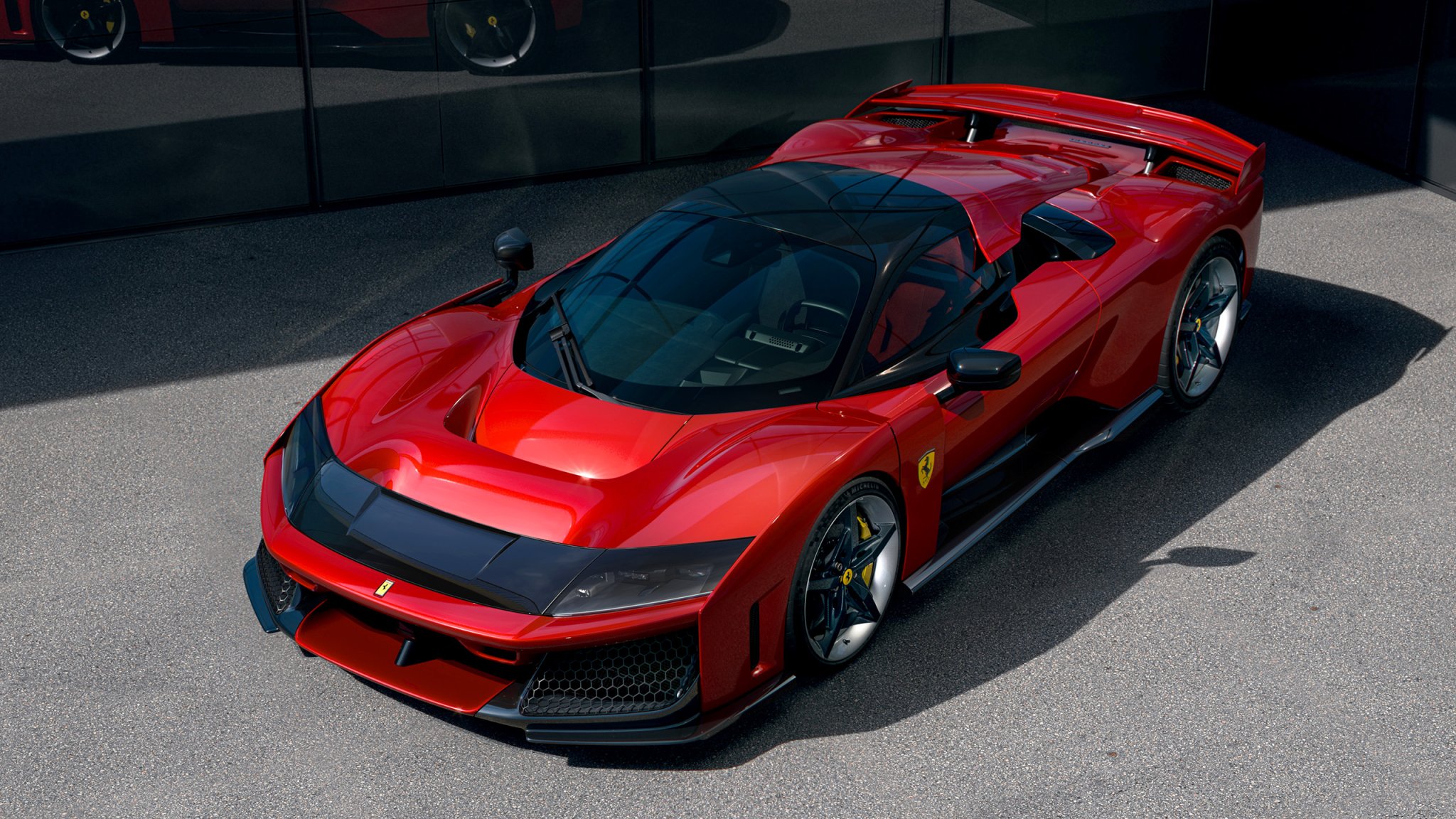
The Cylinder Count is Dead: Inside the Ferrari F80’s 1,184-HP Le Mans-Bred Heart
By abandoning the screaming V12 for a 3.0-liter hybrid V6, Maranello’s latest halo car doesn't just shatter its own lineage—it forces the collector market to worship at the altar of extreme thermal efficiency.
When a brand-new Koenigsegg CCGT1 barks to life at a Monterey Car Week gathering, or when a multimillion-dollar roster of supercars peels out of a Zuma Beach Cars and Coffee, the concussive noise of a massive displacement engine is supposed to be the entire point. For decades, the ultimate flex in the hypercar universe was the shrieking wail of twelve naturally aspirated cylinders. But with the launch of the F80, Ferrari has executed a massive, deeply polarizing philosophical pivot. Instead of a towering V12, Maranello has equipped its newest flagship with a highly stressed 3.0-liter twin-turbo V6 hybrid powertrain, entirely rewriting the rules of engagement for the modern halo car.When a brand-new Koenigsegg CCGT1 barks to life at a Monterey Car Week gathering, or when a multimillion-dollar roster of supercars peels out of a Zuma Beach Cars and Coffee, the concussive noise of a massive displacement engine is supposed to be the entire point. For decades, the ultimate flex in the hypercar universe was the shrieking wail of twelve naturally aspirated cylinders. But with the launch of the F80, Ferrari has executed a massive, deeply polarizing philosophical pivot. Instead of a towering V12, Maranello has equipped its newest flagship with a highly stressed 3.0-liter twin-turbo V6 hybrid powertrain, entirely rewriting the rules of engagement for the modern halo car.
Following on from the Enzo and LaFerrari is no small feat for Ferrari, and replacing the visceral shock of a V12 with half the cylinder count requires an irrefutable engineering defense. The raw metrics of the F80’s internal combustion element are staggering on their own. The engine is a dry-sump V6 set at a wide 120-degree bank angle, displacing exactly 2992 cc with an 88 mm bore and an 82 mm stroke. Stripped of any electrical assistance, this compact mechanical heart produces a towering 900 cv at a screaming 8750 rpm, while delivering 850 Nm of torque at 5550 rpm. It is a masterpiece of friction reduction and turbocharging, but it is only part of the equation.Following on from the Enzo and LaFerrari is no small feat for Ferrari, and replacing the visceral shock of a V12 with half the cylinder count requires an irrefutable engineering defense. The raw metrics of the F80’s internal combustion element are staggering on their own. The engine is a dry-sump V6 set at a wide 120-degree bank angle, displacing exactly 2992 cc with an 88 mm bore and an 82 mm stroke. Stripped of any electrical assistance, this compact mechanical heart produces a towering 900 cv at a screaming 8750 rpm, while delivering 850 Nm of torque at 5550 rpm. It is a masterpiece of friction reduction and turbocharging, but it is only part of the equation.
To truly understand the F80, you have to realize that Ferrari basically built a Formula 1 car for the street. The 3.0-liter twin-turbo V6 doesn't work in isolation; it is intricately paired with three electric motors that fill in torque gaps and dramatically escalate the car's dynamic ceiling. The result is a ridiculous 1,184 horsepower combined output. When deployed through the car's all-wheel-drive architecture, that immense electrical and combustion thrust hurls the carbon-tubbed chassis from 0 to 62 mph in around 2.15 seconds. Top speed figures remain securely in the stratosphere, but the sheer violence of that launch metric proves this is an entirely new breed of prancing horse.
The genesis of this extreme downsizing traces directly to the highest echelon of modern motorsport. Ferrari built an exceptional racing car in the Hypercar 499P, a machine that marked the brand's triumphant return to the top tier of endurance racing after a 50-year absence. The 499P utilized a hybridized twin-turbo V6 to conquer the 24 Hours of Le Mans, proving that outright efficiency and thermal management win long-distance races better than raw displacement. The F80 is the direct road-going beneficiary of that grueling crucible. Its powertrain architecture isn't a regulatory compromise; it is a Le Mans-winning blueprint bolted behind the driver's seat.
Yet, the cultural translation of this motorsport technology remains an open question on the concourse. At high-society gatherings and Beverly Hills car shows—where a red Ferrari hypercar wearing 'F1' license plates is expected to hold court—the currency has long been theater. The collector market is fiercely traditional. Will a clientele currently awaiting their 1:8 scale Porsche models or dissecting the incoming successor to the McLaren P1 accept a V6? When the public still readily points to the McLaren 720S as a benchmark of modern speed, Ferrari is betting that the F80's overwhelming dynamic force will silence the purists who expected twelve cylinders.
From a pure engineering standpoint, the advantages of the F80’s configuration are impossible to ignore. The 120-degree bank angle of the V6 isn't just about internal packaging; it lowers the center of gravity drastically compared to a towering V12, allowing the car to corner flatter and harder. Furthermore, the dry-sump lubrication ensures that oil starvation is a mathematical impossibility, no matter the sustained lateral G-loads generated by the active aerodynamics. It is a calculated, cold-blooded trade-off by Ferrari's engineering team: sacrificing a fraction of nostalgic emotion for absolute, measurable dominance on the tarmac.From a pure engineering standpoint, the advantages of the F80’s configuration are impossible to ignore. The 120-degree bank angle of the V6 isn't just about internal packaging; it lowers the center of gravity drastically compared to a towering V12, allowing the car to corner flatter and harder. Furthermore, the dry-sump lubrication ensures that oil starvation is a mathematical impossibility, no matter the sustained lateral G-loads generated by the active aerodynamics. It is a calculated, cold-blooded trade-off by Ferrari's engineering team: sacrificing a fraction of nostalgic emotion for absolute, measurable dominance on the tarmac.
You can see this ruthless pragmatism playing out in the WEC paddock. Factory drivers like Phil Hanson, recently confirmed to continue as an Official Ferrari Driver, rely on the 499P's electrified V6 architecture to set the pace in opening practice sessions worldwide. The data harvested from Hanson pushing the prototype to its absolute limit directly informs the torque-vectoring and battery-management software found in the F80. This car isn't cosplaying as a race car; it is a literal, mechanical translation of the hardware required to secure endurance racing podiums.You can see this ruthless pragmatism playing out in the WEC paddock. Factory drivers like Phil Hanson, recently confirmed to continue as an Official Ferrari Driver, rely on the 499P's electrified V6 architecture to set the pace in opening practice sessions worldwide. The data harvested from Hanson pushing the prototype to its absolute limit directly informs the torque-vectoring and battery-management software found in the F80. This car isn't cosplaying as a race car; it is a literal, mechanical translation of the hardware required to secure endurance racing podiums.
The F80 ultimately forces a complete re-evaluation of what a flagship Ferrari must be. By delivering 1,184 combined horsepower and a devastating 2.15-second sprint to 62 mph from just 2992 cc of displacement, Maranello has drawn a definitive line in the sand. The screaming V12 will always be the cornerstone of Ferrari's romantic past, but the brutal, race-validated efficiency of a 3.0-liter hybrid V6 is its uncompromising future.The F80 ultimately forces a complete re-evaluation of what a flagship Ferrari must be. By delivering 1,184 combined horsepower and a devastating 2.15-second sprint to 62 mph from just 2992 cc of displacement, Maranello has drawn a definitive line in the sand. The screaming V12 will always be the cornerstone of Ferrari's romantic past, but the brutal, race-validated efficiency of a 3.0-liter hybrid V6 is its uncompromising future.
Gallery
"Following on from the Enzo and LaFerrari is no small feat for Ferrari... but the F80 basically builds a Formula 1 car for the street."
Why it matters
Ferrari's halo cars have historically dictated the architectural trends of the supercar market for the following decade. By pivoting from naturally aspirated V12s to a highly stressed, Le Mans-derived hybrid V6, Maranello is betting its ultimate legacy on motorsport trickle-down rather than nostalgic cylinder counts.
Sources
- 1.
- 2.LEGENDARY FERRARI. UNMATCHED PERFORMANCE ...facebook.com
- 3.
- 4.
- 5.
- 6.
- 7.
Reported by the Downforce & Divots desk from the sources above.
The clubhouse.
- No replies yet. Be the first.