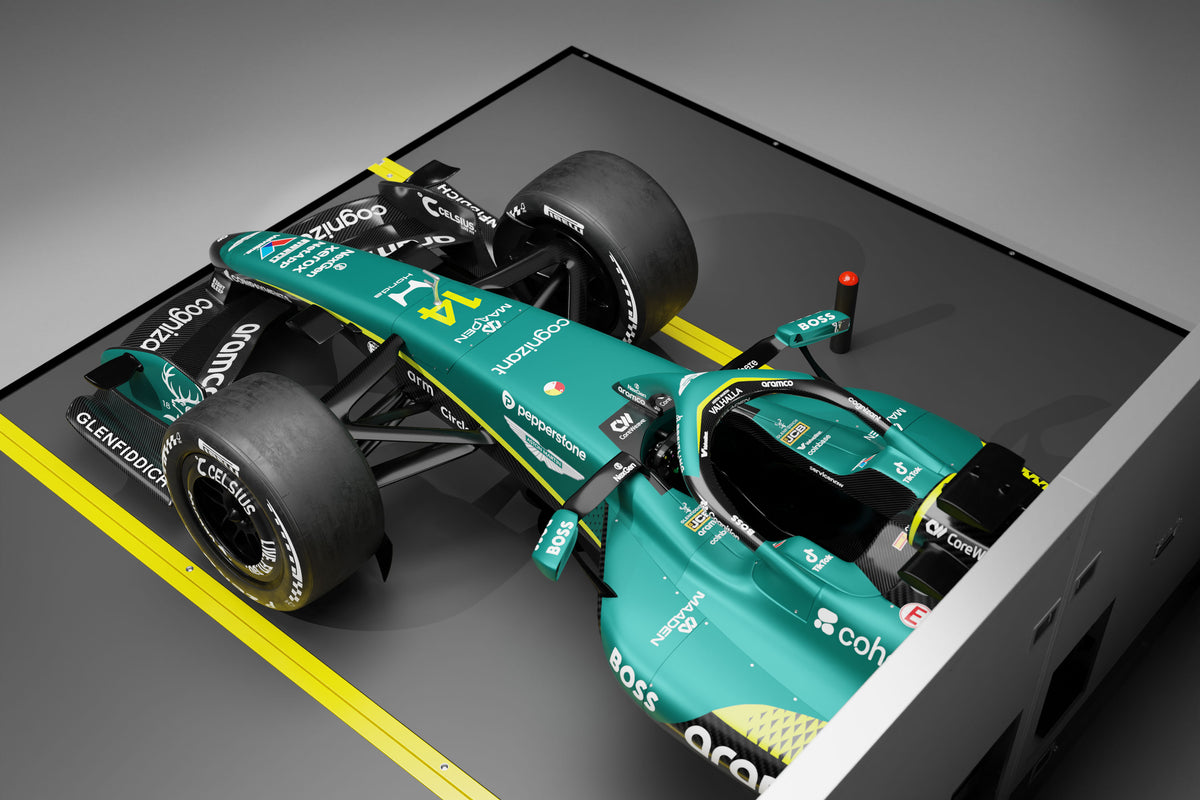
The Carbon Crucible: Inside Aston Martin’s High-Stakes Gearbox Gamble at the Madring
Desperate to offset a suffocating engine deficit, Aston Martin is rushing a radical, lightweight transmission casing to Formula 1’s newest and most punishing street circuit. Is it a stroke of composite genius, or a recipe for structural collapse?
Deep in the structural anatomy of a modern Formula 1 challenger, the gearbox casing occupies sacred, inviolable ground. It does not merely house the intricate planetary gears of the transmission; it serves as the foundational bridge between the carbon-fibre survival cell and the entire rear suspension assembly. To compromise its rigidity is to invite a cascade of aerodynamic and mechanical failures. Yet, as the grid descends on the inaugural Madrid street circuit—the much-hyped "Madring"—Aston Martin is aggressively altering that very equation. The Silverstone-based outfit is rolling out a radical, revised lightweight gearbox casing for the AMR26. Slashing mass from the rear structural core at a brand-new venue that Williams team principal James Vowles has already preemptively dubbed a "car killer" is an engineering gamble of the highest order. It represents a fascinating, desperate swing at salvaging a season that is threatening to slip away.
The desperation driving this bespoke composite surgery is written in cold, unforgiving telemetry. Aston Martin’s 2026 power unit development has been broadly characterized by insiders as a highly frustrating "mixed bag," leaving the team on the back foot as the championship fight intensifies. The haunting reality for double world champion Fernando Alonso is a glaring engine deficit. While rival machinery from Mercedes and Ferrari confidently screams toward the blistering 12,100 RPM threshold, the AMR26 is frequently forced to hold back, heavily mapping its engine to avoid a catastrophic mechanical meltdown. A glance at the recent timing screens from Monza’s third practice session paints a stark picture of the current hierarchy. Mercedes’ George Russell topped the charts with a blistering 1:22.219, closely shadowed by Ferrari’s Lewis Hamilton and Red Bull’s Max Verstappen. Even junior prodigies like Kimi Antonelli and Arvid Lindblad are finding the sharp end of the grid, while Aston Martin remains conspicuously absent from the leading pace. When the power unit becomes a liability, engineers are forced to pull the only other lever available: shedding structural weight.The desperation driving this bespoke composite surgery is written in cold, unforgiving telemetry. Aston Martin’s 2026 power unit development has been broadly characterized by insiders as a highly frustrating "mixed bag," leaving the team on the back foot as the championship fight intensifies. The haunting reality for double world champion Fernando Alonso is a glaring engine deficit. While rival machinery from Mercedes and Ferrari confidently screams toward the blistering 12,100 RPM threshold, the AMR26 is frequently forced to hold back, heavily mapping its engine to avoid a catastrophic mechanical meltdown. A glance at the recent timing screens from Monza’s third practice session paints a stark picture of the current hierarchy. Mercedes’ George Russell topped the charts with a blistering 1:22.219, closely shadowed by Ferrari’s Lewis Hamilton and Red Bull’s Max Verstappen. Even junior prodigies like Kimi Antonelli and Arvid Lindblad are finding the sharp end of the grid, while Aston Martin remains conspicuously absent from the leading pace. When the power unit becomes a liability, engineers are forced to pull the only other lever available: shedding structural weight.
Trimming weight from a modern Grand Prix car is traditionally an exercise in microscopic gains—shaving grams off titanium fasteners or stripping paint from the livery. Modifying the physical transmission casing, however, is a monumental architectural shift. Formula 1 is currently in the throes of what composites engineers are dubbing the "atomic weaving" era. The FIA’s recent authorization of advanced carbon composite structural cores, manufactured utilizing supersonic laser technology, has opened a wild new frontier in material science. By weaving carbon at a near-molecular level, teams are theoretically able to retain immense torsional stiffness while radically reducing material density. The automotive aftermarket has long known the value of shedding mass in this specific area; even in extreme commercial trucking applications, swapping standard metals for carbon floor panels and transmission belly pans routinely nets immediate savings of over four pounds per component. In the hyper-sensitive world of Formula 1, finding that kind of weight savings at the rear of the car is the equivalent of discovering a holy grail.Trimming weight from a modern Grand Prix car is traditionally an exercise in microscopic gains—shaving grams off titanium fasteners or stripping paint from the livery. Modifying the physical transmission casing, however, is a monumental architectural shift. Formula 1 is currently in the throes of what composites engineers are dubbing the "atomic weaving" era. The FIA’s recent authorization of advanced carbon composite structural cores, manufactured utilizing supersonic laser technology, has opened a wild new frontier in material science. By weaving carbon at a near-molecular level, teams are theoretically able to retain immense torsional stiffness while radically reducing material density. The automotive aftermarket has long known the value of shedding mass in this specific area; even in extreme commercial trucking applications, swapping standard metals for carbon floor panels and transmission belly pans routinely nets immediate savings of over four pounds per component. In the hyper-sensitive world of Formula 1, finding that kind of weight savings at the rear of the car is the equivalent of discovering a holy grail.
But taking mass out of the gearbox casing inherently threatens its torsional stiffness, a terrifying prospect when factoring in the sheer violence of a modern hybrid power unit. The monocoque—the single-piece carbon-fibre structure that forms the chassis and survival cell—is an impregnable fortress. The gearbox casing attached to its rear bulkhead must match that rigidity. If the transmission housing flexes even a fraction of a millimeter under load, the rear suspension geometry alters instantaneously. When the suspension angles move unpredictably, the aerodynamic platform collapses, downforce bleeds away, and tire degradation spikes exponentially. Aston Martin’s lightweight casing is attempting to toe an invisible line between shedding the drag of excess weight and maintaining the absolute stiffness required to keep the AMR26 planted through heavy traction zones.But taking mass out of the gearbox casing inherently threatens its torsional stiffness, a terrifying prospect when factoring in the sheer violence of a modern hybrid power unit. The monocoque—the single-piece carbon-fibre structure that forms the chassis and survival cell—is an impregnable fortress. The gearbox casing attached to its rear bulkhead must match that rigidity. If the transmission housing flexes even a fraction of a millimeter under load, the rear suspension geometry alters instantaneously. When the suspension angles move unpredictably, the aerodynamic platform collapses, downforce bleeds away, and tire degradation spikes exponentially. Aston Martin’s lightweight casing is attempting to toe an invisible line between shedding the drag of excess weight and maintaining the absolute stiffness required to keep the AMR26 planted through heavy traction zones.
The environment waiting to stress-test this new composite architecture is uniquely punishing. The Madring is a sprawling 5.47-kilometer hybrid layout woven meticulously through and around Madrid's IFEMA exhibition center. It demands an impossible mechanical compromise, aggressively linking suffocatingly tight street sections with sweeping, permanent-style high-speed corners. Featuring 22 distinct turns, the circuit's topography will subject the rear of the cars to violent, traction-heavy acceleration zones and immense lateral loading. A circuit with this many rapid transitions requires a car that can rotate instantly and put power down cleanly over abrasive, untested street asphalt. Vowles’ assessment of the venue as a car killer is not mere hyperbole; it is a recognition of the sheer physical violence the Spanish circuit will inflict on the foundational components of the 2026 grid.The environment waiting to stress-test this new composite architecture is uniquely punishing. The Madring is a sprawling 5.47-kilometer hybrid layout woven meticulously through and around Madrid's IFEMA exhibition center. It demands an impossible mechanical compromise, aggressively linking suffocatingly tight street sections with sweeping, permanent-style high-speed corners. Featuring 22 distinct turns, the circuit's topography will subject the rear of the cars to violent, traction-heavy acceleration zones and immense lateral loading. A circuit with this many rapid transitions requires a car that can rotate instantly and put power down cleanly over abrasive, untested street asphalt. Vowles’ assessment of the venue as a car killer is not mere hyperbole; it is a recognition of the sheer physical violence the Spanish circuit will inflict on the foundational components of the 2026 grid.
To introduce an unproven, heavily revised structural element to a virgin street track suggests that Aston Martin’s internal simulator modeling has identified a weight-to-lap-time ratio that heavily justifies the immense structural risk. For Alonso, the stakes could not be higher or more personal. The veteran Spaniard, ever the eternal optimist regarding his home race, has publicly stated his belief that the 5.47-kilometer Madring layout has the genuine potential to host the finest Grand Prix on the entire calendar. He is acutely aware that the sweeping high-speed sections will heavily penalize the AMR26's ongoing RPM limitations. The lightweight gearbox is viewed internally not just as an upgrade, but as a necessary, bespoke weapon to ensure Alonso is actually fighting at the sharp end of the grid in front of a rabid hometown crowd, rather than merely making up the numbers.To introduce an unproven, heavily revised structural element to a virgin street track suggests that Aston Martin’s internal simulator modeling has identified a weight-to-lap-time ratio that heavily justifies the immense structural risk. For Alonso, the stakes could not be higher or more personal. The veteran Spaniard, ever the eternal optimist regarding his home race, has publicly stated his belief that the 5.47-kilometer Madring layout has the genuine potential to host the finest Grand Prix on the entire calendar. He is acutely aware that the sweeping high-speed sections will heavily penalize the AMR26's ongoing RPM limitations. The lightweight gearbox is viewed internally not just as an upgrade, but as a necessary, bespoke weapon to ensure Alonso is actually fighting at the sharp end of the grid in front of a rabid hometown crowd, rather than merely making up the numbers.
When the AMR26 rolls out of the garage for opening practice under the Spanish sun, every telemetry engineer on the pit wall will have their eyes glued to the rear suspension data. They will be looking for micro-oscillations, tiny vibrations in the data that would suggest the atomic weaving of the new transmission belly pan is failing to hold the immense torque of the hybrid drivetrain. If the casing survives the aggressive curbing and the relentless 22-turn punishment of the IFEMA complex, Aston Martin may have unlocked a composite blueprint that the rest of the grid will be forced to urgently copy. If it flexes, the AMR26 will eat its rear tires alive, leaving Alonso to wrestle an unpredictable, oversteering nightmare through the tight confines of Madrid's streets.When the AMR26 rolls out of the garage for opening practice under the Spanish sun, every telemetry engineer on the pit wall will have their eyes glued to the rear suspension data. They will be looking for micro-oscillations, tiny vibrations in the data that would suggest the atomic weaving of the new transmission belly pan is failing to hold the immense torque of the hybrid drivetrain. If the casing survives the aggressive curbing and the relentless 22-turn punishment of the IFEMA complex, Aston Martin may have unlocked a composite blueprint that the rest of the grid will be forced to urgently copy. If it flexes, the AMR26 will eat its rear tires alive, leaving Alonso to wrestle an unpredictable, oversteering nightmare through the tight confines of Madrid's streets.
In the relentless, unsentimental arms race of the 2026 technical regulations, the demarcation line between engineering innovation and structural hubris is razor-thin. Aston Martin's decision to deploy this bespoke lightweight gearbox at the Madring is a definitive statement of intent. They are refusing to accept their engine deficits as a terminal condition, opting instead to push the outer boundaries of supersonic laser carbon weaving to level the playing field. It is the ultimate test of modern composite alchemy: attempting to shed the weight of a ghost without inadvertently removing the spine of a killer. The 5.47 kilometers of Madrid asphalt will deliver the final verdict on whether the gamble was a masterstroke or a catastrophic miscalculation.In the relentless, unsentimental arms race of the 2026 technical regulations, the demarcation line between engineering innovation and structural hubris is razor-thin. Aston Martin's decision to deploy this bespoke lightweight gearbox at the Madring is a definitive statement of intent. They are refusing to accept their engine deficits as a terminal condition, opting instead to push the outer boundaries of supersonic laser carbon weaving to level the playing field. It is the ultimate test of modern composite alchemy: attempting to shed the weight of a ghost without inadvertently removing the spine of a killer. The 5.47 kilometers of Madrid asphalt will deliver the final verdict on whether the gamble was a masterstroke or a catastrophic miscalculation.
Gallery
"When you cannot turn up the engine without risking a total mechanical meltdown, you must ruthlessly cull the weight from the skeleton itself."
Why it matters
Aston Martin's aggressive weight-saving measure highlights the severe compromises teams must make when suffering from a power deficit. Testing a radical new structural component on a brutal 22-turn street circuit underscores the lengths to which Formula 1 engineering will stretch to claw back lap time.
Sources
- 1.
- 2.
- 3.Formula 1 2026 Italian GP Results - Motorsport.commotorsport.com
- 4.F1Grids - Facebookfacebook.com
- 5.
- 6.
- 7.
- 8.
- 9.
- 10.
Reported by the Downforce & Divots desk from the sources above.
The clubhouse.
- No replies yet. Be the first.