The 24-Month Metabolism: How China Rewired the Automotive Development Cycle
Legacy automakers still require up to five years to take a clean-sheet architecture from sketch to showroom. Chinese EV manufacturers are doing it in under two. The secret isn't cutting corners—it's a complete eradication of the traditional assembly line mindset.
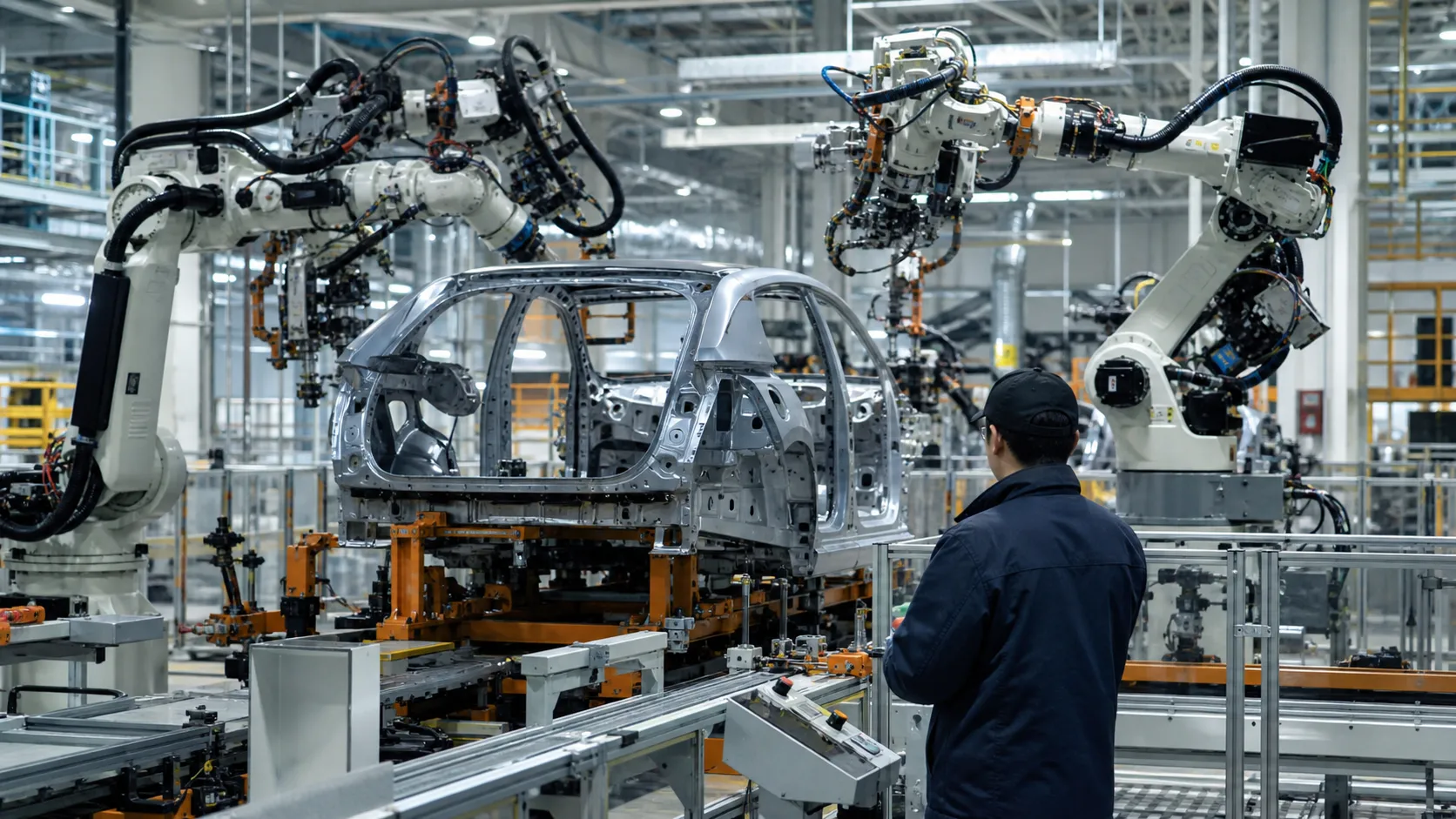
Step inside the automated Zeekr factory and the first thing you notice is the sound—or rather, the lack of it. There is no chaotic clanging of traditional manufacturing, only the precise, synchronized hum of robotics assembling luxury electric cars. It is an industrial ballet orchestrated by Geely, China’s biggest carmaker and the corporate parent to legacy European performance and safety marques like Volvo and Lotus. But what is happening on this factory floor is fundamentally different from anything occurring in Gothenburg or Norfolk. While legacy Western automakers still require anywhere from 48 to 60 grueling months to take a clean-sheet vehicle architecture from a preliminary designer’s sketch to a physical showroom floor, a new breed of Chinese EV manufacturers has violently compressed that development cycle to under two years. This temporal wizardry is not the result of skipping crucial steps. The secret isn't cutting corners on physical crash tests or ignoring fundamental safety mandates. Instead, it is rooted in an entirely different operational philosophy: a simultaneous, aggressive approach to software integration, tier-one supplier co-design, and digital twin validation that makes the traditional sequential engineering process look like a relic of the steam age.
To understand this 24-month metabolism, you have to look at the anatomy of the modern vehicle. For decades, the automotive industry operated on a waterfall methodology. Design the chassis, package the drivetrain, source the interior components, and finally, figure out how to wire it all together. But as vehicles transitioned from mechanical machines to rolling computers, this sequential approach became a liability. Brands like BYD, Xiaomi, XPeng, and Nio realized that if they treated software as an afterthought, they would inevitably bottleneck their own production timelines. Instead, these companies now develop their own proprietary software, AI-powered features, and comprehensive smart cockpits entirely in-house, running parallel to the physical engineering. By vertically integrating the digital architecture, they eliminate the friction of waiting on third-party vendors to write code for a mechanical prototype that might change shape next week. The software and the hardware evolve in a continuous, intertwined feedback loop, allowing these brands to launch entirely new models much more rapidly than their global rivals.
This digital-first strategy relies heavily on the concept of the digital twin—a perfect, hyper-accurate virtual replica of the vehicle that exists long before the first sheet of aluminum is stamped. In the 60-month legacy cycle, engineers had to build physical test mules to figure out if a cooling system functioned correctly under load or if a suspension setup could handle a specific frequency of vibration. Today, Chinese EV makers are running millions of simulated miles in the digital realm. They can validate thermal dynamics, aerodynamic drag coefficients, and even the latency of AI-powered smart cockpit features using raw computational power. By the time a physical prototype rolls onto a test track, the engineering team isn't discovering new problems; they are merely confirming the digital twin's predictions. This shifts the bulk of the engineering timeline from physical space—where things take months to fabricate—into virtual space, where iterations happen at the speed of a processor.This digital-first strategy relies heavily on the concept of the digital twin—a perfect, hyper-accurate virtual replica of the vehicle that exists long before the first sheet of aluminum is stamped. In the 60-month legacy cycle, engineers had to build physical test mules to figure out if a cooling system functioned correctly under load or if a suspension setup could handle a specific frequency of vibration. Today, Chinese EV makers are running millions of simulated miles in the digital realm. They can validate thermal dynamics, aerodynamic drag coefficients, and even the latency of AI-powered smart cockpit features using raw computational power. By the time a physical prototype rolls onto a test track, the engineering team isn't discovering new problems; they are merely confirming the digital twin's predictions. This shifts the bulk of the engineering timeline from physical space—where things take months to fabricate—into virtual space, where iterations happen at the speed of a processor.
The other half of the equation involves tearing down the traditional walls between the automaker and its tier-one suppliers. Historically, the relationship between an Original Equipment Manufacturer and a supplier was purely transactional. The automaker would hand down a rigid specification sheet for a steering rack or a brake caliper, and the supplier would return months later with a finished component. In the hyper-compressed Chinese development ecosystem, tier-one suppliers are brought into the design room before the initial sketches are even finalized. This co-design strategy means that the suppliers are adapting their components in real-time as the vehicle's architecture shifts. If the digital twin reveals that the battery pack needs to be shifted by three millimeters for better weight distribution, the supplier modifying the subframe is instantly aware and adjusts their tooling specs the same afternoon. It is a level of collaborative synchronicity that effectively erases months of bureaucratic friction from the traditional supply chain.The other half of the equation involves tearing down the traditional walls between the automaker and its tier-one suppliers. Historically, the relationship between an Original Equipment Manufacturer and a supplier was purely transactional. The automaker would hand down a rigid specification sheet for a steering rack or a brake caliper, and the supplier would return months later with a finished component. In the hyper-compressed Chinese development ecosystem, tier-one suppliers are brought into the design room before the initial sketches are even finalized. This co-design strategy means that the suppliers are adapting their components in real-time as the vehicle's architecture shifts. If the digital twin reveals that the battery pack needs to be shifted by three millimeters for better weight distribution, the supplier modifying the subframe is instantly aware and adjusts their tooling specs the same afternoon. It is a level of collaborative synchronicity that effectively erases months of bureaucratic friction from the traditional supply chain.
Of course, moving at this unprecedented velocity introduces an entirely new spectrum of real-world friction. No matter how perfect the digital twin is, the analog world remains stubbornly chaotic and unpredictable. A prime example surfaced recently with a bizarre incident involving a Lynk & Co 900. When the vehicle unexpectedly caught fire, the ensuing investigation yielded an explanation that no AI simulation could have possibly predicted: a local dealer claimed that a pedestrian had somehow kicked a portable power bank directly underneath the chassis, triggering a catastrophic thermal event. It is a slightly surreal, almost comical reminder that vehicles must ultimately survive the unforgiving, wildly erratic reality of the street. You can program a smart cockpit to recognize a driver's mood via AI, and you can automate a Zeekr factory to flawless precision, but you cannot simulate a rogue pedestrian with a stray lithium-ion battery. The 24-month cycle gets the car to the street faster, but the street remains the ultimate, untamed frontier.Of course, moving at this unprecedented velocity introduces an entirely new spectrum of real-world friction. No matter how perfect the digital twin is, the analog world remains stubbornly chaotic and unpredictable. A prime example surfaced recently with a bizarre incident involving a Lynk & Co 900. When the vehicle unexpectedly caught fire, the ensuing investigation yielded an explanation that no AI simulation could have possibly predicted: a local dealer claimed that a pedestrian had somehow kicked a portable power bank directly underneath the chassis, triggering a catastrophic thermal event. It is a slightly surreal, almost comical reminder that vehicles must ultimately survive the unforgiving, wildly erratic reality of the street. You can program a smart cockpit to recognize a driver's mood via AI, and you can automate a Zeekr factory to flawless precision, but you cannot simulate a rogue pedestrian with a stray lithium-ion battery. The 24-month cycle gets the car to the street faster, but the street remains the ultimate, untamed frontier.
Despite these analog anomalies, the sheer scale and speed of product hitting the market is transforming the economic realities of the global auto industry. We are not talking about limited-run compliance cars; we are witnessing a massive, national flood of inventory. Consider BYD, which is currently orchestrating shipments of its newly developed Sealion 08 across China at a staggering pace. Because their development pipeline is so short, BYD can identify a market trend—whether it's an aesthetic shift in crossover design or a sudden consumer demand for specific active safety features—and have a fully validated vehicle addressing that demand rolling off the automated line in just two years. This is an immense tactical advantage. If a legacy brand requires five years to bring a vehicle to market, they are aiming their product planning at a target that will have fundamentally moved twice before their car ever sees a showroom. The Chinese EV makers aren't just reacting to the market; their development speed allows them to actively dictate the market's direction.Despite these analog anomalies, the sheer scale and speed of product hitting the market is transforming the economic realities of the global auto industry. We are not talking about limited-run compliance cars; we are witnessing a massive, national flood of inventory. Consider BYD, which is currently orchestrating shipments of its newly developed Sealion 08 across China at a staggering pace. Because their development pipeline is so short, BYD can identify a market trend—whether it's an aesthetic shift in crossover design or a sudden consumer demand for specific active safety features—and have a fully validated vehicle addressing that demand rolling off the automated line in just two years. This is an immense tactical advantage. If a legacy brand requires five years to bring a vehicle to market, they are aiming their product planning at a target that will have fundamentally moved twice before their car ever sees a showroom. The Chinese EV makers aren't just reacting to the market; their development speed allows them to actively dictate the market's direction.
For the executives sitting in boardrooms in Detroit, Stuttgart, and Tokyo, the realization of what is happening in factories like Geely's is a chilling wake-up call. The competitive moat they once relied on—their century of institutional knowledge regarding how to bend metal and tune dampers—is rapidly evaporating in the face of software-defined agility. The 24-month vehicle development cycle is not a temporary anomaly or a reckless experiment. It is a permanent rewiring of the automotive industry's baseline metabolism. When a company can take a clean-sheet design, integrate a proprietary AI software suite, validate the physical structure via a digital twin, co-design the complex hardware with tier-one suppliers, and unleash a fleet of Sealion 08s onto the streets in the time it takes a legacy automaker to approve a mid-cycle facelift, the old rules of the game no longer apply. The future of mobility is being forged at a pace that leaves traditional manufacturing gasping for air on the factory floor, proving that in the new electric era, speed is not just an advantage—it is the only metric that guarantees survival.For the executives sitting in boardrooms in Detroit, Stuttgart, and Tokyo, the realization of what is happening in factories like Geely's is a chilling wake-up call. The competitive moat they once relied on—their century of institutional knowledge regarding how to bend metal and tune dampers—is rapidly evaporating in the face of software-defined agility. The 24-month vehicle development cycle is not a temporary anomaly or a reckless experiment. It is a permanent rewiring of the automotive industry's baseline metabolism. When a company can take a clean-sheet design, integrate a proprietary AI software suite, validate the physical structure via a digital twin, co-design the complex hardware with tier-one suppliers, and unleash a fleet of Sealion 08s onto the streets in the time it takes a legacy automaker to approve a mid-cycle facelift, the old rules of the game no longer apply. The future of mobility is being forged at a pace that leaves traditional manufacturing gasping for air on the factory floor, proving that in the new electric era, speed is not just an advantage—it is the only metric that guarantees survival.
Gallery
"If a legacy brand requires five years to bring a vehicle to market, they are aiming their product planning at a target that will have fundamentally moved twice before their car ever sees a showroom."
Why it matters
The compression of vehicle development from 60 to 24 months represents an existential threat to legacy automakers. It proves that software-defined architecture and digital validation can fundamentally outpace traditional mechanical engineering processes without sacrificing luxury or core safety.
Sources
- 1.
- 2.
- 3.EV - CarNewsChina.comcarnewschina.com
Reported by the Downforce & Divots desk from the sources above.
The clubhouse.
- No replies yet. Be the first.