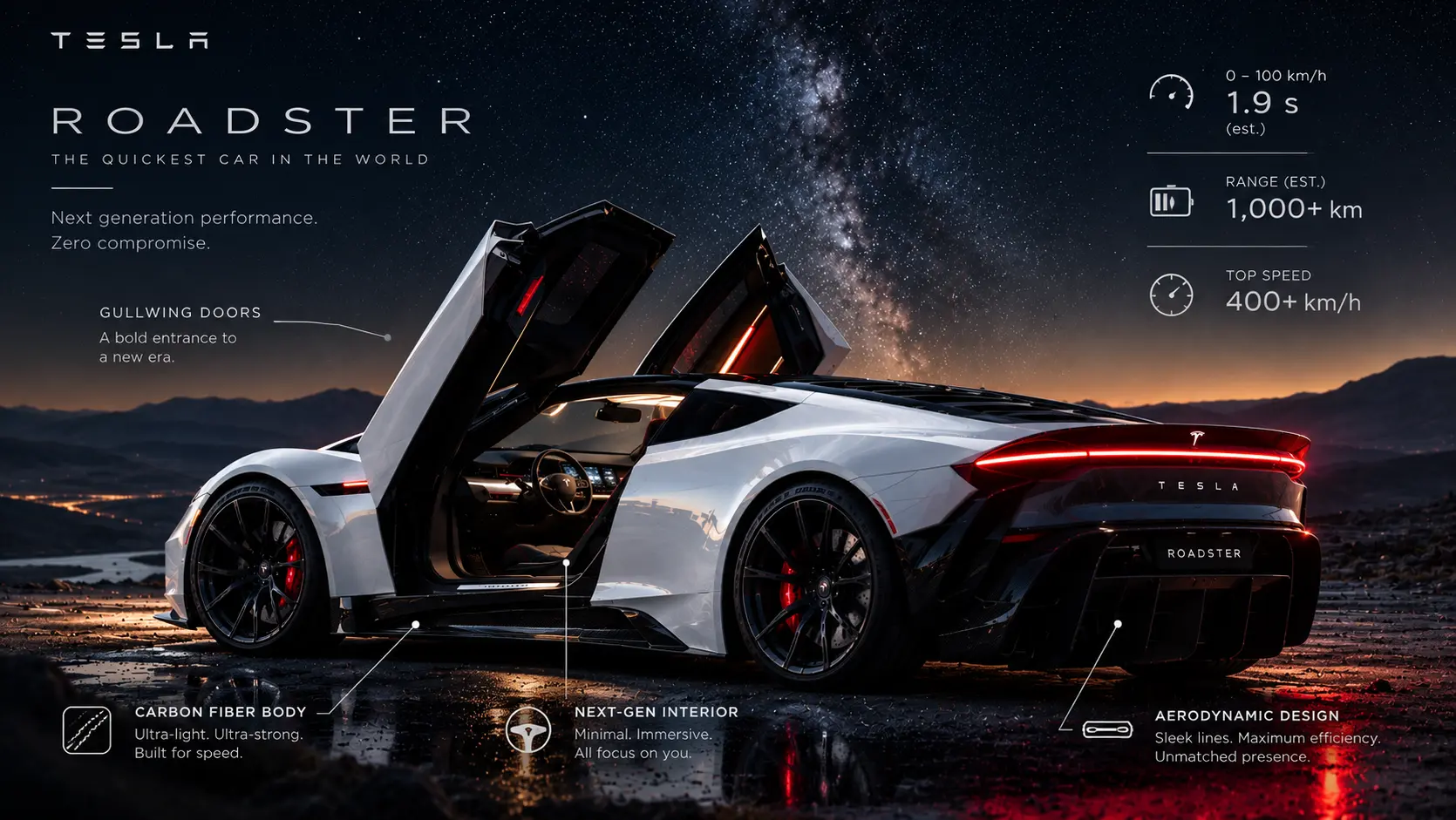
Suction, Thrust, and Sub-Second Theatre: Unpacking the Second-Gen Roadster Reveal
Tesla’s claims of sub-1-second sprints and wall-clinging aerodynamics push hypercar rhetoric into uncharted territory.
The modern hypercar debut has long traded in eye-watering statistics, but the arrival of the second-generation Tesla Roadster has escalated the numbers game into pure physics-defying bravado. Reported by Henry Payne in The Detroit News following its mid-October unveiling, the machine arrives carrying a spec sheet headlined by sub-one-second zero-to-60 mph sprints, alongside claims that it can 'fly' and literally suck itself to a vertical wall.The modern hypercar debut has long traded in eye-watering statistics, but the arrival of the second-generation Tesla Roadster has escalated the numbers game into pure physics-defying bravado. Reported by Henry Payne in The Detroit News following its mid-October unveiling, the machine arrives carrying a spec sheet headlined by sub-one-second zero-to-60 mph sprints, alongside claims that it can 'fly' and literally suck itself to a vertical wall.
Such claims immediately reposition the hypercar performance benchmark from traditional mechanical grip to extreme aerodynamic and propulsion theatrics. While traditional performance houses measure progress in tenths of a second at apex speeds, the second-generation Roadster is leaning into aerospace-grade hyperbole—promising active suction mechanisms capable of sticking the chassis against sheer surfaces and explosive launch performance that shatters conventional tyre adhesion limits.Such claims immediately reposition the hypercar performance benchmark from traditional mechanical grip to extreme aerodynamic and propulsion theatrics. While traditional performance houses measure progress in tenths of a second at apex speeds, the second-generation Roadster is leaning into aerospace-grade hyperbole—promising active suction mechanisms capable of sticking the chassis against sheer surfaces and explosive launch performance that shatters conventional tyre adhesion limits.
The timing of the revelation creates a striking contrast across the performance landscape. On the very same day in mid-October, Porsche took to New York to stage the world debut of its Mission S concept, previewing a dedicated mid-engine hypercar architecture rooted in traditional aerodynamic form and high-voltage circuit design, while European halls like the Paris Motor Show charted industry-wide shifts for 2027.The timing of the revelation creates a striking contrast across the performance landscape. On the very same day in mid-October, Porsche took to New York to stage the world debut of its Mission S concept, previewing a dedicated mid-engine hypercar architecture rooted in traditional aerodynamic form and high-voltage circuit design, while European halls like the Paris Motor Show charted industry-wide shifts for 2027.
Whether active ground-effect suction fans and thruster-assisted acceleration can translate from launch-stage spectacle to production reality remains the central question for engineers and enthusiasts alike. Generating sufficient downforce at zero miles per hour to cling to a wall demands massive pneumatic power, just as breaching the one-second barrier to 60 mph requires overcoming fundamental traction coefficients that have capped road-legal machinery for decades.Whether active ground-effect suction fans and thruster-assisted acceleration can translate from launch-stage spectacle to production reality remains the central question for engineers and enthusiasts alike. Generating sufficient downforce at zero miles per hour to cling to a wall demands massive pneumatic power, just as breaching the one-second barrier to 60 mph requires overcoming fundamental traction coefficients that have capped road-legal machinery for decades.
What the Roadster reveal undeniably confirms is that the halo battleground has fundamentally fractured. On one side stands Stuttgart’s meticulous mid-engine design discipline with concepts like the Mission S; on the other, Tesla’s high-octane engineering theatrics designed to shock the industry into rethinking what a halo electric vehicle is permitted to do.What the Roadster reveal undeniably confirms is that the halo battleground has fundamentally fractured. On one side stands Stuttgart’s meticulous mid-engine design discipline with concepts like the Mission S; on the other, Tesla’s high-octane engineering theatrics designed to shock the industry into rethinking what a halo electric vehicle is permitted to do.
Gallery
"Tesla Roadster supercar flies, sucks to wall, hits sub-1 second 0-60 mph."
Why it matters
Tesla's claims of sub-second acceleration and wall-suction capabilities challenge the traditional definitions of road-car performance. As legacy rivals like Porsche double down on track-honed mid-engine architecture, the battle for hypercar supremacy is splitting into two wildly different philosophies.
Sources
- 1.
- 2.
- 3.
- 4.
Reported by the Downforce & Divots desk from the sources above.
The clubhouse.
- No replies yet. Be the first.