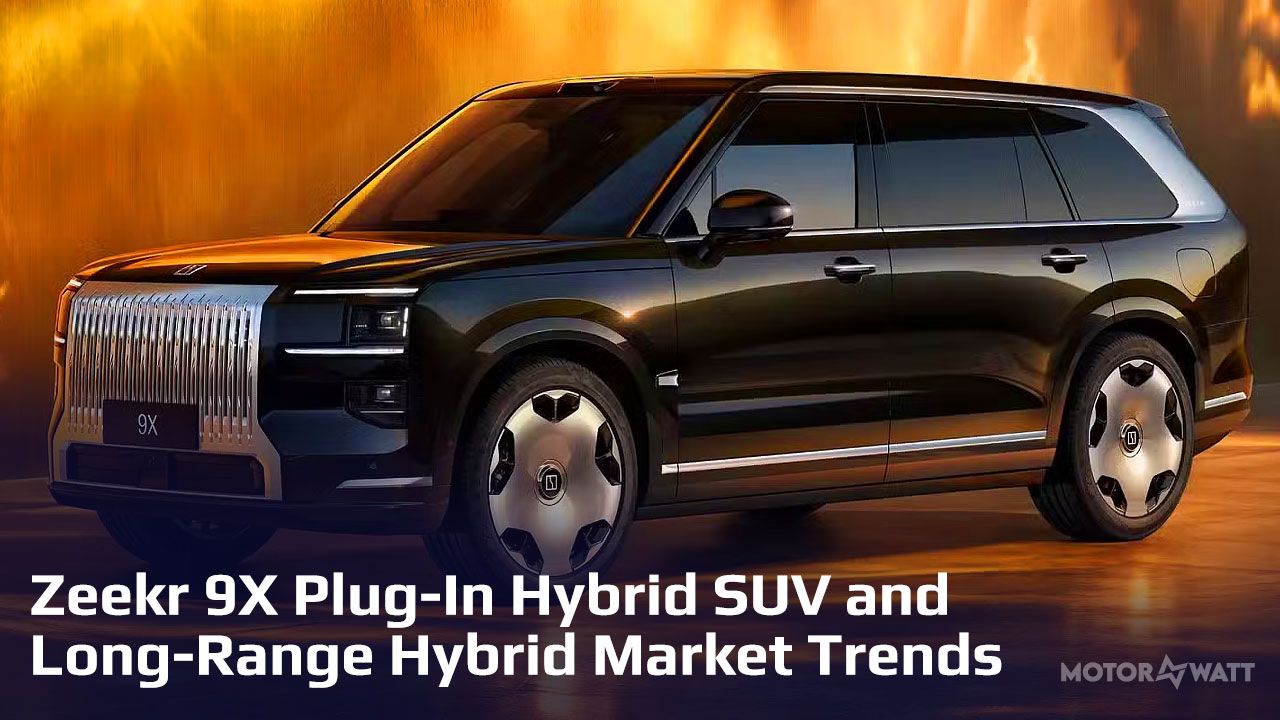
China's EV Champions Are Adding Gas Tanks. It's Not a Retreat.
While Western markets debate BEVs vs hybrids, the 'survivors' of China’s brutal EV wars are making a counterintuitive pivot. Brands from Xiaomi to Zeekr are adding combustion engines back into their flagships, deploying a new strategy to dominate both at home and abroad.
In the brutal, Darwinian arena of the Chinese auto market, where thousands of startups competed and most failed, a strange thing is happening. The anointed 'survivors'—the EV-first darlings like Xiaomi and Zeekr that clawed their way to the top—are quietly re-introducing the internal combustion engine. This isn't a nostalgic revival, but a calculated pivot to Extended-Range Electric Vehicles (EREVs), a move so decisive that some players, like Voyah, have even dropped pure BEV models in favor of the range-extended architecture. It’s a baffling play for brands forged in the fires of an all-electric revolution, suggesting the next phase of automotive dominance won't be as straightforward as simply unplugging the gas pump.
This pivot isn't happening from a position of weakness. Far from it. China's domestic New Energy Vehicle (NEV) market just hit a record-high penetration rate, accounting for more than half of all new car sales—a stark contrast to the roughly one-in-ten figure in the United States. The top-sellers chart is a wall of domestic NEV brands. Yet even here, luxury state-backed players like Hongqi are launching flagship models like the G919 off-road SUV as a four-motor EREV. The strategy is to use the EREV's blueprint—a large battery for significant all-electric daily driving, with a small gas generator for backup—as a precision tool to convert the last holdouts and eliminate range anxiety as a talking point entirely.This pivot isn't happening from a position of weakness. Far from it. China's domestic New Energy Vehicle (NEV) market just hit a record-high penetration rate, accounting for more than half of all new car sales—a stark contrast to the roughly one-in-ten figure in the United States. The top-sellers chart is a wall of domestic NEV brands. Yet even here, luxury state-backed players like Hongqi are launching flagship models like the G919 off-road SUV as a four-motor EREV. The strategy is to use the EREV's blueprint—a large battery for significant all-electric daily driving, with a small gas generator for backup—as a precision tool to convert the last holdouts and eliminate range anxiety as a talking point entirely.
Viewed from a wider lens, this is the automotive equivalent of a dominant software company leveraging open-source components to accelerate expansion into new ecosystems. Having effectively won the domestic BEV prize, China’s automakers are wielding the EREV as a bridge technology to conquer markets where charging infrastructure remains a legitimate concern. This tactical flexibility is crucial for their aggressive global expansion into Europe, the U.K., Asia, and Australia, where the country already exports millions of vehicles annually. The EREV allows them to sidestep the charging debate and compete on their proven strengths: in-car tech, build quality, and value.Viewed from a wider lens, this is the automotive equivalent of a dominant software company leveraging open-source components to accelerate expansion into new ecosystems. Having effectively won the domestic BEV prize, China’s automakers are wielding the EREV as a bridge technology to conquer markets where charging infrastructure remains a legitimate concern. This tactical flexibility is crucial for their aggressive global expansion into Europe, the U.K., Asia, and Australia, where the country already exports millions of vehicles annually. The EREV allows them to sidestep the charging debate and compete on their proven strengths: in-car tech, build quality, and value.
This isn’t just a theoretical export strategy; it’s happening now. Li Auto, a pioneer of the EREV-first model in China, is laying the groundwork for a full-scale European invasion, building out its commercial infrastructure in the Netherlands by hiring senior executives and planning for sales, dealer networks, and aftersales support. By leading with a pragmatic technology that solves a real-world problem for consumers, these brands can get their advanced vehicle platforms into Western garages, establishing brand loyalty before the charging networks even catch up. It’s a sophisticated, multi-pronged assault that makes the West's binary BEV-or-hybrid debate look dangerously one-dimensional.This isn’t just a theoretical export strategy; it’s happening now. Li Auto, a pioneer of the EREV-first model in China, is laying the groundwork for a full-scale European invasion, building out its commercial infrastructure in the Netherlands by hiring senior executives and planning for sales, dealer networks, and aftersales support. By leading with a pragmatic technology that solves a real-world problem for consumers, these brands can get their advanced vehicle platforms into Western garages, establishing brand loyalty before the charging networks even catch up. It’s a sophisticated, multi-pronged assault that makes the West's binary BEV-or-hybrid debate look dangerously one-dimensional.
"Multiple Chinese EV brands are looking at add an ICE as EREV into their lineup - Xiaomi, Zeekr, XPeng."
This pivot demonstrates that China's auto strategy is more pragmatic and adaptable than a simple, all-in BEV push. By embracing EREVs, Chinese automakers can immediately address range anxiety and infrastructure gaps, making their vehicles more competitive in diverse global markets. This 'bridge technology' could accelerate their market share gains against Western incumbents who are still largely locked in a binary debate between pure EVs and traditional hybrids.
- 1.
- 2.CariCarz.com - Facebookfacebook.com
- 3.
- 4.
- 5.Li Auto's European Expansion to Include the Netherlands, Job ... - EVeletric-vehicles.com
- 6.
- 7.
- 8.
- 9.
- 10.
Reported by the Downforce & Divots desk from the sources above.
The clubhouse.
- No replies yet. Be the first.